12. Sandan
The god standing on the lion is in the
Hellenistic period Zas/Sandan seen on many coins, always naked - standing
behind an incense-burner, with Baal from Tarsus as the highgod of vegetation on
the reverse (a), - standing on a horned and winged lion with the mystical
flower and the axe in his left
hand and on his head a polos showing
that he is the world-pillar keeping heaven and earth apart (b). He is also
pictured inside a pyramid structure called his pyra, his funeral fire, but obviously constructed in a very
artificial way so that it becomes a symbol of the world-mountain with the eagle
of ecstasy and apotheosis at the top[1]
and flanked by the two personified world-pillars which represent the split
world-mountain (c). He is the founder of Tarsus and often identified with
Perseus, also honoured as the city-founder. Perseus is shown with a big sickle
sword and an idol of Wolf-Apollo (handling not two lions, but two wolves, see
below), and the symbol of the lion killing the bull, the lord of vegetation
being killed by the lord of heat and fire (d).
a:

b: c: c: d:

a: Cook, Zeus I, fig.455. The others from Hans Böhlig, Die
Geisteskultur von Tarsus, 1913, fig. 2,3 & 6.
Very important
is Sandan's pyra, the pyramid made of wood, and most certainly made for the
burning of Sandan symbolized by some doll. In Roman time this cult around
Sandans pyra becomes the pattern for the emperor’s apotheosis. Like Heracles,
Sandan (and the Tyrian Melqart) is taken up to heaven in fire. Somehow this
symbolism has very strong connections to the Phoenician sun bird, the Phoenix
growing old, but eternally rejuvenated in fire, reborn out of its burning nest.
The Roman
emperor is, like Sandan, burnt in the humble shape of a doll (a wax-doll played
the part of the deceased Caesar in the consecratio-ceremony),
and the soul is carried to heaven by the sun-bird, an eagle let out from its cage
at the top of the burning wood-pyramid (the Phoenix symbolism). Also in Tyre at
the Melqart temple the burning world pillar, or world tree, has an eagle flying
in its top.
In Cilician myth, Sandan-Zeus is the
killer of the Typhon-snake. Now this snake is obviously, as we shall see,
identical with the monster Jamm killed by Baal. The opponent of Baal is called
Jaw. The names of the priests serving
at the cave in Cilicia which was thought to be the lair of the monster show
that many of them were called something similar to Ja (as Pythia in Delphi and
Pythagoras were named after the snake Python). The name Typhon is derived from
the Semitic Tsaphon, the paradise mountain, and the monster hopes that it will
be strengthened for the fight with Zeus-Sandan by eating a certain
"ephemeral fruit", which the monster thinks will give eternal life
but has the opposite effect. So obviously we have here a late development of
the demon god killing the god of primordial reality, the primordial paradise
mountain with the fruit of life and the snake.
But all this certainly needs a
little more proof.
a) As Typhon and the creature on the
Jao-gems also Jamm/Jaw in Ugarit has the double snake as the lower part of his
body: it is called “the snake with two tales”[2]
“whose tongues lick the heaven”.
b) Also the killing of the Python
snake by Apollo is the killing of the god of the primeval mountain. Apollo sets
fire to the hut of the snake called “the king´s palace”. The myth about Apollo
born on the distant island, where his mother is hiding from the king of chaos,
the snake, who has had a prophecy that his life will be threatened by a divine
child (acc. to Ps.Hyginus), is a variation of the old motif known to both Philo
and Hittite texts and Hesiod (the child Zeus born among shepherds and given
milk by a she-goat in safe hide of his father Kronos): “the fight for the
kingdom of heaven”. The fight is about who is going to rule the mountain in the
centre, where the holy well of life, the Castalia well, and the tree, the holy
laurel are situated. In many Mesopotamian seals a god is seen setting fire to
another god lying on a mountain. Even Mithras is (on a fragment) seen setting
the temple of the bull on fire.
The Python-snake is here demonized, and Apollo made the creator of order.
The young Zeus Cretagenes is called upon with the name “Jo, greatest
curos”, and
Apollo is called upon with the word “Je Paian”.
c) Python-Typhon is acc. to Movers,
Saphon, in our opinion the snake coiling around the primordial mountain. The
Castalia-well has a name with some connexion to Kassios, another name for Mt
Saphon outside Ugarit[3].
d) H.A.Cahn[4]
has proved the oriental origin of Apollo. Two Lions were figuring in one of the
most honourable places at Delphi, on the temple built by the Alkmenoid family
around 520 B.C. Here the god is seen coming to Delphi in a quadriga with his
sister and mother, and on both sides he is surrounded by people from Athens,
who, with axes in their hands, clear the road for him. To the far right a stag
is attacked by a lion, to the far left a bull is attacked by a lion.
e) It is interesting to see that
most cult places where Apollo was worshipped, there was also the tradition of a
hero closely linked to vegetation. Hyakinthos in Sparta, and Anios on Delos.
The first is killed by accident with Apollo´s discos. He has 4 daughters. The
next has tree daughters, Oino, Elais, Spermo, all with names suggesting some
links to vegetation.
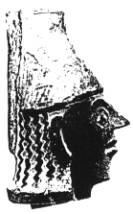
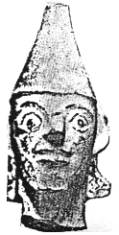
Acc. to modern research, Apollo has
some links to Resheph “with the arrow”, god for pestilence, cf. the description
of Apollo at the beginning of the Iliad. The oldest version of Apollo brought
to light at Delphi shows him together with a tamed lion whom he is patting on
the head. The oldest picture of Apollo from Amyclas seems very similar to the
pictures of Resheph.
Sparta
720 B.C. Metropolitan Mus. of Art.
In Apollodor´s account of the fight
between Zeus and Typhon, Typhon meets his final defeat on Mt Nysa, where he is
tricked by the Moirai into eating some of this paradise mountain´s “ephemeral
fruit”. This would give him strength, they said, but it made him weak. This
incident shows that the tradition about the paradise mountain with the fruit of
life is closely connected to the Typhon-figure. But the version of the
tradition given by Apollodor seems very hostile: the plant of life is reduced
to mere swindle, and Mt Tsaphon is transformed into a monster. With Zeus
pursuing, Typhon fled to Mt Haimos in Thrace. He tried to defend himself by
throwing whole mountains at Zeus, but the god pushed them back on top of him,
and Typhon´s blood (haima) flowed
forth over the mountain and gave it its name.
This important motif shows that
Typhon is the high god killed. By Philo of Byblos the blood flows from the
genitalia of the god and falls into wells and rivers: the water in cosmos is
transformed into divine life giving water (I,10,29). This could be compared
with the scene around the dying bull in the mysteries of Mithras. Its male
organ is pumped by the scorpion and its blood is licked by the dog or is
transformed into ears of corn. We find the same motif by Hesiod: the blood from
the cut off genitalia of Uranos falls into the ocean and creates foam, and out
of the foam comes the goddess Aphrodite. The fact that Aphrodite comes from the
oldest generation of gods, even older than Zeus, shows that this is the birth
of the Palestinian Aphrodite Urania given us by Hesiod, and a parallel to the
description by Ovid of the intense foaming and bubbling of the blood of Adonis
when sprinkled by Aphrodite with divine perfume.
The intensified activity of the
blood-water bubbling and foaming is the sure sign of the life force hiding in
it. These very different versions of the same motif show that Philo of Byblos
is not a copyist. He works with an independent authentic tradition and is not a
mere inventor of his material.
Judging from names, Sandon or
Shantash is honoured not only in Cilicia and Cappadocia, but also in Lycaonia,
Isauria, Pisidia, Caria and Lydia (Pauly-Wissowa under “Sandon”, Roscher under
“Sandas”). Acc. to H.T.Bossert[5],
he was also the main god of Crete, and he is the god whose epiphany is longed
for when the women dance with naked breasts and snakes in their hands. In
historical time he is surviving in Dionysos and in Bes, the dwarf with a lion's
skin over his shoulders, in Heracles with the lion's skin, dressing as a woman
at the court of Omfale, wrestling with the lion and taking hold of the bull by
Marathon, Apollo and Ares/Arte-mis Lafria = Labrys, i.e. “with the double axe”
(the androgynous hunter split into a male and female aspect).
In the Hieroglyph-Hittite texts
Santas is called “the great”, and in Syria his cult could be followed down to
the 3rd cent. A.C. In Eusebios´ Chronicle[6]
it is told that Heracles in Phoenicia and Cappadocia and still up to the time
of the author was honoured under the name Desandus (Tesh Shandash). Different rulers also seem to have called
themselves Tesh Shantash, where Tesh is the stem in a word that we also know
from Greece: Theos (= “god”). The great hunter is directly identical with the
ruler, an idea that later had great impact on the ideology surrounding the
Roman emperor, his funeral fire, the so-called consecratio, being a direct replica of Sandans pyra.
It is Santas and no one else who
hides behind the Baal of Ugarit, and this god´s relationship to the god of the
Bible could therefore only be one of opposition and enmity.
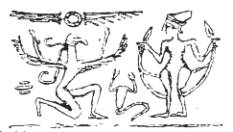
From Anatolian cylinder seals is
also known a man with a griffin´s mask, partner to a naked goddess sitting in
some kind of swing. The name of the griffon man is acc to H.Th. Bossert[7] Ara. He is seen in this picture
together with the scorpion:[8]
To our opinion Ara is another name
for the “hunter”. On coins from Tarsus the naked god is seen with an
inscription Ana. It would be tempting to read this as an error, as a coin with
the same motif spells Tadarmes instead of Tadanmes. The griffin man is seen in
the same function as Sandas: as the one who holds heaven and earth separated.
As a matter of fact Sandas' opponent in the myth, Typhon, has a mate. He is the
double snake = primordial massive totality before Sandan divided heaven and
earth.