15. Baal in Ugarit as a
hunter
An Ugarit text is named Els marzeah,
RS 24.258: El invites to a feast in his temple. The guests are behaving like
dogs, like dogs they tear the meat. The "guardian of the gate", El´s son,
is very annoyed at this and reproaches
his father because he does not want to sit beside his wife, but takes his seat next to another woman[1].
El gets so drunk that he has to be carried home by “Ridge and Range (of
hills)”probably the same as the guardian of the gate (and his brother?). We
have seen how the first splitting up of the primeval mountain results in the
two world-pillars often personified as the two sons of the highgod, the two
bull-men who support the sky (carry the heavenly bull) and are the guardians of
“the gate of the sun”, identical with the temple gate. This gate is the symbol
of fixed order: space for the sun to shine and the rain to fall. The guardian
of this gate is very much against the chaos developing inside the temple and tries
to warn his father, but the “hidden one, Baal with horn and tale” (changed to
animal or demon) hunts him down. Out of pure fear El lets go of his fæces and
drops down as dead “becoming like one of those who go down to the realm of
death”. After that “´Anat and ´Athtarte go hunting (sd)”.
What are we looking at
here? Certainly not an innocent prayer to the Highest. The tablet with this
text was found in a house that seems to belong to a priest, and it is the
secret myth about a murder of God the Kindly, the Highest, in Ugarit always
called El, the “Bull”, a murder described in a very humiliating way and
celebrated during an orgiastic feast, where men are changed into dogs and
beasts of pray and give themselves to free sexuality (prostitutes?). They
celebrate the death of god, the death of divine order and hail the great hunt.
Perhaps the words msd sd in the first
two lines of the text have to be translated by "hunts game (in his
temple)". The god who prepares and serves the meal is Yarich, the moon, in
Near Eastern myth the spender of ambrosia and nectar, but not to all: some are
"scolded" and receive minor punishments on their legs with a stick.
This strange scenario is the picture of a freemason-like lodge meeting and
eating in the presence of gods and disciplined by some "grand
wizard".
“The hunting of Baal”
is the name given by John Gray to a very demolished text found in Ugarit
(Virolleaud calls it “Les Chasses de Baal”). It talks about Baal hunting some
creatures called “the devourers”/”voracious ones” (Gray´s transl.), “rippers”
(de Moor).
They have horns and
humps like bulls. Baal catches them in a net, gives them wine to drink and
shoots them down with his bow[2].
But in the next moment, Baal, the great hunter, will become the victim. He
falls into a swamp and is devoured by a fire that also has a withering effect
on vegetation, turning it “brown”. Although Baal is clearly the hunter, he is
also the victim and pictured as the suffering and “fallen bull” “prostrate lay
the god Hadad as a steer in the midst of the mire”(Gray´s trans). Here Baal is
both hunter and bull. He dies in the swamp as a representative of the wet
element and as a victim of the fire raging in his limbs. The result is water
(end of the text).
But the rendering
asunder (the sparagmos in Greek)
which Jamm (“Sea”), the beloved son of El, suffers at the hands of Baal
(“scatter (him), o mightiest Baal”, 2, IV, 28) shows that Baal is the “Great
Hunter”, and so do the two throwing-clubs with which he brings poor Jamm down.
This is the archaic weapon of the great hunter.
Baal is accompanied by
his “seven pages, eight boars” (5, V, 9). Tammuz is killed by 7 demons from the
underworld. Resheph, “the burning one”, kills Adonis in the shape of a boar.
The hunter is often followed by 7 helpers seen as boars. A text from Ugarit
refers to the demons as “flies”[3],
so the title “Lord of the Flies”(Baal Zebub) is “Lord of the swarm of flying
demons”.
But in Ugarit it is
first and foremost ´Anat who is pictured as the divine hunter with cruel
features. She is the “destroying” ´Anat. Without the faintest feeling of mercy
she goes berserk and makes a massacre of the totally innocent people coming to
dine in her temple, “a grim and bloodthirsty goddess”[4].
The fact that Baal is the male hunter and she the female hunter and his sister
makes them a couple very similar to Apollo and Artemis. Originally the great
hunter was “androgynous”: Sandan-Heracles serves Omphale dressed in women´s
clothes. But this androgynity can be split into male and female hunter. In the scene
of ´Anat´s massacre she is put back into balance by her love for Baal: the
union of female and male god stands for harmony and is also seen as a union of
heaven with earth and underworld (´Anat's dwelling is somewhere under the
surface of the earth) SHE IS IN ALL ASPECTS IDENTICAL WITH THE INDIAN GODDESS
KALI riding the tiger with the scimitar in her hand, a weapon also given to
´Anat.
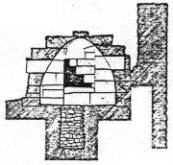 Of special importance are the graves
found in Ugarit. They are underground tholoi with a removable top-stone making
it possible to pour libations into the graves. Now Elioun and the two brothers
in Tyre, Usoos and Hypsuranios, were receivers of such libations acc. to Philo.
Even the highest gods were considered dead and called El-rp´u, Baal-rp´u
("rephait"). Now this special crypt for the dead is also known from
Tepe Gawra and from the Jezidi memorial to Sheik Adi. A.Tobler says about the
tholoi dug out in Tepe Gawra: “the sacred character of the tholoi and their
dedication to chthonic gods is firmly established by the heavy concentrations
of graves around and within”[5].
Of special importance are the graves
found in Ugarit. They are underground tholoi with a removable top-stone making
it possible to pour libations into the graves. Now Elioun and the two brothers
in Tyre, Usoos and Hypsuranios, were receivers of such libations acc. to Philo.
Even the highest gods were considered dead and called El-rp´u, Baal-rp´u
("rephait"). Now this special crypt for the dead is also known from
Tepe Gawra and from the Jezidi memorial to Sheik Adi. A.Tobler says about the
tholoi dug out in Tepe Gawra: “the sacred character of the tholoi and their
dedication to chthonic gods is firmly established by the heavy concentrations
of graves around and within”[5].
Also Tall Arpachiyah,
another Halafian culture in North Iraq, has the tholos as a dominating element[6].
The deceased are mostly not buried inside the tholos but all around it. The
tholos is the centre in a system of graves.
The tholoi are most
certainly the forerunners of the pyramids and symbols of kur/kurkura[7] so admirably described by
Fr.Delitzsh[8]. This
mountain where the gods were born, was also called Arallu, and more or less
reflected in the temple called E-kur (“Mountain house”). It was shining like
pure gold, and Delitzsh quote Job 37,22: “From the north comes gold”.
Tiglathpileser I proclaims that he is called to “a seat in the House of the
kurkura-mountain forever” and Delitzsh compares with Is 14,13.
In Cyprus there is an
interesting piece of ceramics showing the interior of a tholos[9]:
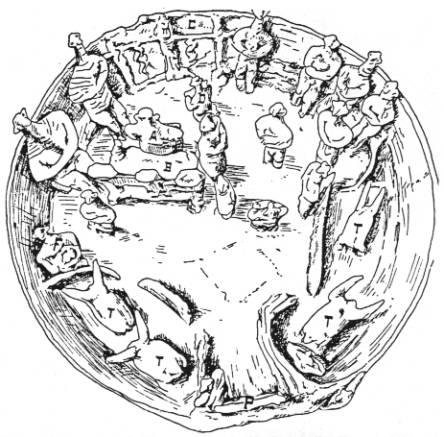
A tripple goddess (C)
is prayed to by a man falling on his knees (D). The goddess has snakes in her
hands and is the female counterpart of a man sitting on some kind of triple
throne just opposite her (A,B). But in the nether half of the picture a woman
with a child is hiding by the cows. (F,T). In Armenia some churches were built
as tholoi because Armenia was believed to be the centre of the world (Ringbom: Paradisus).
15.a. Baal coming to Rome: Dionysiac
anti-religion
The nature of the hunter
comes out very clearly in a late secret Dionysiac cult discovered in Rome where
the courtesan Hispalla revealed the following details to consul Postumius[10]:
“it was known that for two years now no one had been initiated who had passed
the age of twenty years. As each
was introduced, he became a sort of victim for the priests. They, she
continued, would lead him to a place which would ring with howls and the song
of a choir and the beating of cymbals and drums, that the voice of the sufferer
when his virtue was violently attacked, might not be heard ... the mingling
of males with females, youth with age had destroyed every sentiment of modesty,
all varieties of corruption first began to be practiced, since each one had at hand the pleasure answering
to that to which his nature was more inclined. There was not one form of vice
alone, the promiscuous matings of free men and women, but perjured witnesses,
forged seals and wills and evidence, all issued from this same workshop:
likewise poisonings and murders of kindred, so that at times not even the
bodies were found for burial. Much was
ventured by craft, more by violence. This violence was concealed because amid
the howlings and the crash of drums and cymbals no cry of the sufferers could
be heard as the debauchery and murders proceeded”[11].
A famous fresco from
Pompeii shows a naked woman dancing and a woman with big black wings and a long
whip, the symbol of Dike (“justice”). Nilsson has dealt with this motif (“The
Winged Woman Fleeing”):
The winged demoniac woman is one
of the apparitions and terrifying figures that were introduced in the Bacchic
mysteries, reminiscent of the evil fate awaiting the unjust in the afterlife.
But salvation is at hand. To the left of the winged woman the girl reveals the
liknon with its contents, promising life and luck. The Campana relief: a young
man is seen to the left, then the kneeling girl revealing the liknon, to the right a winged woman running away hurriedly.
The girl takes hold of a corner of her long robe to hold her back, but she
makes an averting gesture. The cameos are similar. Instead of the youth there
is a Silenus holding up a basket of
fruit, and the object revealed is a bearded bald head, probably that of a
Silenus.
Bad conscience and the fear of retaliation by Dike are driven away by the
holy symbol of Dionysos (often the lingam of the god) hidden in the liknon
(basket). Another fresco shows the burdened soul standing between two options:
the woman clad in black with the staff as the instrument of punishment, and the
dancing naked maenad.
The cult described by Livius is, acc to R.Reitzenstein[12],
the cult of an Oriental god identified
with Dionysos.
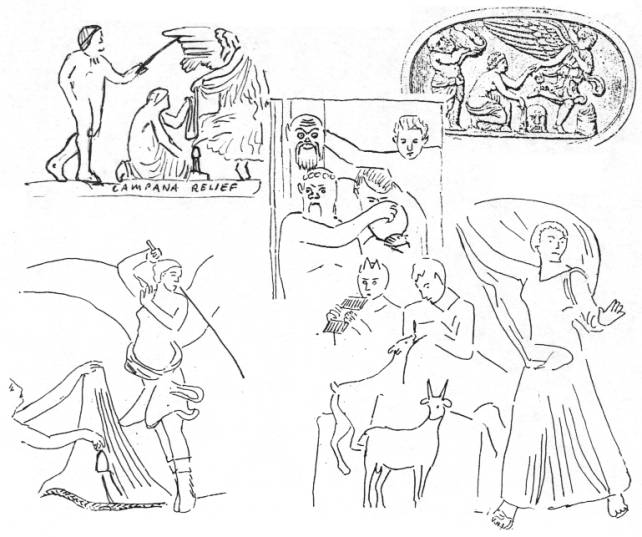
The next picture (from
the same villa in Pompeii) shows a woman (the soul) flying towards an idyllic
scenery: a Satyr playing the Pan-flute, and a female Satyr offering her breast
to a kid. In the Hellenistic novels the heroine is often taken away to a
bucolic sphere, a symbol of her being taken away to unity with the highgod. The
picture shows the cloak of the woman blown out by the wind to become a picture
of the heavenly vault: she is taken away to the stars. (Europa in the care of
Asterios, Jo in the care of the thousand eyed Argos.) Europa riding on the back
of the bull is often pictured with her cloak blown out to become a vault over
her head.
The last picture shows
a young man tricked into seeing himself as a demon. Perhaps a symbol of the initiate
discovering/accepting a demonic side of himself.