16. North Syrian Temple
M. von Oppenheim's expedition to
Tell Halaf has not only given us the beautiful painted bowls from the
prehistoric Halafian culture, but also brought to light the ruins of a temple from
the 9th century B.C. Passing along an endless gallery of sculptured stone
slabs, the visitor will finally reach the “Scorpion Gate”. Inside the temple
area the processional road will turn 180 degrees, and suddenly you are standing
face to face with the temple-facade with a giant portico as entrance to the
temple rooms inside. The top-stone is supported by three gods. A male standing
in the centre on the back of a bull, a female and another male standing on
lions. If we compare with the material from Catal Hüyük, we can quickly
conclude that they must be the high god, the goddess and the hunter. And as a
matter of fact the lion carrying the hunter has a stag with its stomach ripped
open lying between its legs. If we pass the lion carrying the god, we can move
on through a kind of hall to the inner chamber. The entrance to this room is
guarded by a lion, in some ways identical with the lion at the entrance to the
hall, but looking much more demonic. It has the head of an eagle and big folded
wing and a tail covered with scales. The two lions are parallels, the last
being a demonised variation of the first. It has taken both the nature of the
eagle and the scorpion into its lion nature, thereby becoming an ecstatic
(eagle), but also using sex as a way to vision (the scorpion). Its visionary
power is stressed by the inlaid eyes being placed in something similar to
telescopic tubes. The same scary eyes are seen on two eagles put on the top of
two pillars in the temple court outside.
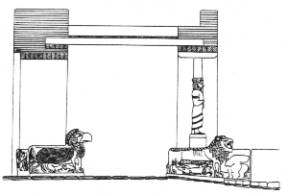
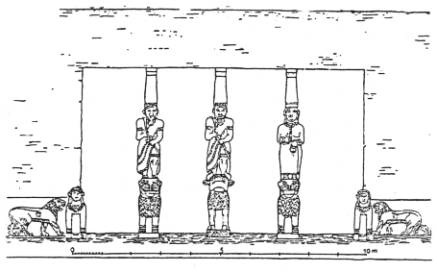
Reconstruction, Tell Halaf II,p.68.
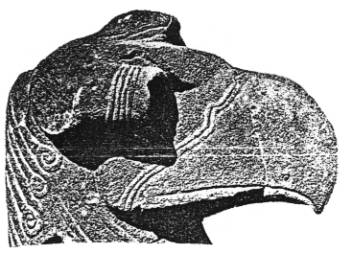
To the left and right the hunter is
seen shooting the bull and the stag.
The bull carrying the central god is
standing in a mountainous landscape where the hunter, easily recognisable by
his heavy kilt, turns his bow and arrow towards a goat eating from the tree of
life. Although the central god is the high god standing on his bull, everything
in this temple seems to stand under the sign of the great hunter.
The goddess is standing on the back
of a she-lion with a small cub sucking her between the legs. The many
stone-slabs show a scenario not so different from what could be seen in the
paradisos in the great temple of Mabbug in Roman times. They show 35 trees, 10
lions, bull, horse, goats by the tree of life, boar, leopard, eagle, ostrich, hare,
beaver, and lions fighting bulls. To that is added a lot of composite animals:
winged lion, winged lion with an eagle´s head and a scorpion´s tail, winged
lion with a human face, winged lion with both the face of a human and the face
of a lion, winged lion with two heads, winged lion with the tail of a bird and
the horns of a bull.
There is also a lot of
hunting-scenes: hunting for lions, bull, eagle, goose(?), and a giant fish. The
hunters are 11 bowmen, 8 armed with curved clubs, a weapon also carried by the
male gods. Finally there is a warrior who seems to carry the skin of a beast of
pray wrapped around his kilt (Moortgat asks if it could be a shield?[1])

Beautiful
decorations are found on the walls. The stepped pinnacle must be a symbol of the
primordial mountain. There are different variations of the snake coil. Mystical
quadrangle. Mystical rosette. Tell Halaf
II, p.73.
The composite lion-like creatures
are to be interpreted as Genii, “helping demons” (especially the winged
ones). From a much later period we have an episode told in Photios Bibliotheca, ch.203: a man saw a meteor falling from the sky in the
neighbourhood of Emesa. In that very moment a giant lion approached the spot
where it had fallen, but disappeared immediately afterwards. When the man asked
the stone what god it belonged to, it answered Gennaios, a god honoured in
Hierapolis in the bodily shape of a lion. The composite animals and humans are
the train of demons following the great hunter. The inner chambers are interesting
by the fact that they do not contain any platform or niche for the idol, but in
the biggest room was found a square stone-plate in a frame with wheels
underneath, perhaps some mobile fireplace. In our opinion the inner chambers
were dining rooms for a marzeah, serving the hunter and dining in the presence
of helping demons and the spirits of the deceased. But not only dining: a
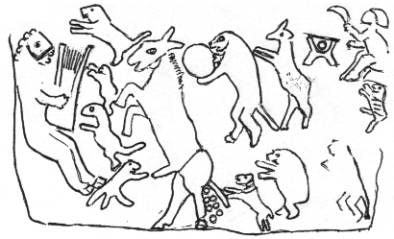
so-called “Tierkapelle” is shown on one of the slabs (III,t.100). It shows the
orgiastic changing of the participants into lions, dogs, and donkey. The donkey
even being very, very dirty. A decoration on a musical instrument from 2600
B.C. excavated in Ur shows Gilgamesh/the hunter putting two divine bulls into
submission. His followers, the panther and the lion, are bringing food and
drink, the donkey is playing music, and the bear, the scorpion, and a little
goat are dancing.
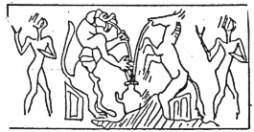
A Mesopotamian Seal shows lion and
donkey drinking together (Frankfort). Acc. to Moortgat [2]
such "Animal Music-bands", “Tierkapellen” are rather common in the
North Syrian, North Mesopotamian area in the post-Hurritic period.
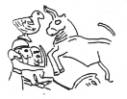
That the hunt for the bull is also a spiritual symbol is seen from the motif on one of the slabs from Tell Halaf. Note the bird of ecstasy standing ready to fly on the head of the hunter (III,t.42). A very important motif is the hunter subduing a symbol of vegetation. Either the hunter will grab around the top of a plant or branch and brutally force it downwards, or he will enter a tree, or wrestle with it (III,t.31). This is the Lycourgos-motif already dealt with.
He is like Sandan world-pillar. The
bullmen lifting the bird of ecstasy to make room for the "Knielauf"
of the sun (the picture above in the chapt. The snake…) and the Lycourgos-man
as world-pillar lifting the bird of ecstacy is almost the same motif. Ecstasy
is primordial unity lifted to allow room for the sun to shine and man´s
civilisation to develop.
Of special interest are the very
massive stone idols, almost big cubes in massive stone showing a god or a
goddess sitting on a box-like seat. The massive stone signals stability and
eternity. It is the eternal house for a spirit passed into a transcendent
status as one of the ´ilim or rephaim. All these idols have a small
stone-cup for the offering of an alcoholic drink. It is the drinking of wine or
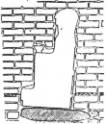
beer that bridges the gap between the dead and the living. The statue of black
basalt shown above (II,p.358,fig.8o) was originally placed in a small chapel with
an opening towards east, but later a fortress wall was erected over the place,
and the idol was covered by bricks. Under it is a small shaft with the urn and
a few gifts.