19. Gaza
A coin from Gaza shows the androgynous hunter
with a double face. He has sharp pointed ears like an animal and nose and hair
like a negro. 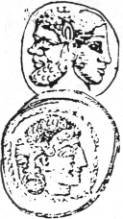 On the reverse of the second coin he
is seen doubled with the lion´s hide of Heracles on top of his head[1].
His rather uncharming appearance does not agree with the picture of the young
hunter, Hippolytos, by Procopios of Gaza in his description of public
decorations in his city. The Ecphrasis
of Procopios starts with a hymn to almighty Eros, and it is a stroke of genius
that P.Friedländer has seen the connection with the rose-festival in Gaza: ”It
is totally written out of the atmosphere of this spring- and rose-festival” [2].
Out of the blood of Adonis the roses sprouted, and the blood of Aphrodite gives
the red colour to the pale flower when she was scratched by its thorns. “And
now the rose tells the story about her love”(Ecphrasis 1,10). The pictures sung about are mainly two: Phaedra
falling in love with Hippolytos, and the chaste Hippolytos punishing the wet
nurse used as messenger by Phaedra when she declares her forbidden love to
Hippolytos. The last scene shows Hippolytos as hunter high on his horse with
the virgin hunter Daphne at his side surrounded by shepherds. At a safe
distance some frightened women are looking at the cruel punishment of the
half-naked elderly lady, who is both bitten by dogs and thrashed by a man with
a club. K.Kerenyi has pointed to the parallel between Hippolytos´ aversion to
the deeds of Aphrodite and Enkidu´s aversion to Ishtar (Apollo,1953).
On the reverse of the second coin he
is seen doubled with the lion´s hide of Heracles on top of his head[1].
His rather uncharming appearance does not agree with the picture of the young
hunter, Hippolytos, by Procopios of Gaza in his description of public
decorations in his city. The Ecphrasis
of Procopios starts with a hymn to almighty Eros, and it is a stroke of genius
that P.Friedländer has seen the connection with the rose-festival in Gaza: ”It
is totally written out of the atmosphere of this spring- and rose-festival” [2].
Out of the blood of Adonis the roses sprouted, and the blood of Aphrodite gives
the red colour to the pale flower when she was scratched by its thorns. “And
now the rose tells the story about her love”(Ecphrasis 1,10). The pictures sung about are mainly two: Phaedra
falling in love with Hippolytos, and the chaste Hippolytos punishing the wet
nurse used as messenger by Phaedra when she declares her forbidden love to
Hippolytos. The last scene shows Hippolytos as hunter high on his horse with
the virgin hunter Daphne at his side surrounded by shepherds. At a safe
distance some frightened women are looking at the cruel punishment of the
half-naked elderly lady, who is both bitten by dogs and thrashed by a man with
a club. K.Kerenyi has pointed to the parallel between Hippolytos´ aversion to
the deeds of Aphrodite and Enkidu´s aversion to Ishtar (Apollo,1953).
Hippolytos bears a name that is the
sure sign of an ecstatic:”Horse let loose”; and he is the son of an amazon, an
androgynous warrior.
Ric.A.Baer says about the
anthropology of Philo of Alexandria [3]:
“The first man originally existed in a state of unity or oneness and so long as
he remained in this state, he was like both the world and God in his singleness
(mónôsis, Op.Mund.151f)… Philo here uses the term heîs (“one”) more
explicitly to describe the inner integrity and harmony of the prôtos ánthrôpos (=”first man”)…But this
original state of oneness or singleness was interrupted by the appearance of
woman.”
This understanding of “original sin”
is found in many Oriental myths. Actaeon, the hunter, is killed because he saw
a naked woman, Attis is hunting and resting together with the great hunter,
Agdistis, and is killed because he wants to marry the nymph. Agdistis was very
strong and androgynous, but when castrated and thereby turned into a woman, he
is weakened. Orion is blinded because of a sexual sin. Theiresias for the same
reason, and both are hunters. Kombabos, Bata, Eshmun resist a woman through
self-castration. To understand this motif we must understand that the ideal
state is the consciousness of the ecstatic. His mind is united and one with
untouched nature and resting in itself. Confronted with women this unity is
disturbed by desire.
But what is he hunting? He is hunting the divine stag, the king of wild nature, the sudden epiphany of god.
In Gaza, where the god Marnas was
identified with Zeus Cretagenes (=”born in Crete”), his temple had the form of
a giant flower surrounded with concentric colonnades. Copper coins from Gaza
show the Phoenician letter mem another
symbol of the mystical centre where up and down and left and right meet and are
one.
another
symbol of the mystical centre where up and down and left and right meet and are
one.
A cross is also among the motifs
described by John of Gaza and is even seen on the forehead of the god Aion,
once a year taken up from his underground temple-chamber in Alexandria to
celebrate his birth by Kore. It is after the first cock crow in the morning
that he is brought up naked, sitting on a litter with the cross on his
forehead, covered with gold (Epiphanios.Pan.LI,22).
“In this very hour he is said to be born”, obviously together with the sun. His
being taken up from the underground, adyton, is a sunrise. And his birth
is on the day that was later used for the celebration of Christ’s birth, cf.
the child Helios in Gaza carried on the back of Atlas, see the picture below
(II, chap 13) where a cross is seen to the right.
The cross is a symbol of the centre
of the four corners of the earth. If the dimension upwards is added to the four
cardinal points we have the holy symbol of the pyramid and the pentagram. The
pentagram was also used about Jerusalem as the world mountain, as the centre of
cosmos [4].
When Pherecydes says about the primeval god, Chronos (=”Time”), that he created
offspring out of his own semen: fire, wind, and water, and put these elements
into “five corners”, then we have to think of a pyramid like the one symbolised
by the pyra of Sandan, and
definitely representing the world mountain.
In his description of the god Aion
John of Gaza has paid special attention to the hand of the god. It is raised
towards heaven, and the thumb is laid across the other four fingers because it
is much more powerful than the others and “makes the whole unstable nature
stand firm (éstêsen)”, I,168-70. In
Sumerian script the pentagram is the sign for Ub = “High Heaven”.