30. The coiling one
The coiling one (this must be the meaning
of the Hebrew name Leviathan, cf. ltn of the Ugarittexts and Sanskrit: kundalini = “the coiled one”) represents
the preformal modality of the universe, the unfragmented “one” that precedes
all creation. A similar creature is known from Greek myths: when Hera found
that Atlas´s daughters, the Hesperides, to whom she had entrusted the golden
apple-tree, growing where the chariot of the sun completes its journey, were
pilfering the apples, she set the ever-watchful snake Ladon to coil around the tree as its guardien. It was acc. to one
tradition the offspring of the double snake Typhon/Echidne[1].
In Greek religion the snake, Python, is killed by the
young god Apollo. Typhon is killed by Zeus fighting him at Mt.Kassios/ Tsaphon
in North Syria. The name Python comes from Typhon and from Tsaphon, in North
Syrian religion the holy cosmic mountain with its top in the North Star and in
archaic cosmology identical with the nightly starry vault of heaven.
In fact, the snake is a personification of primordial
totality, the holy paradise-mountain also pictured in the pyramids of
Egypt. To be stronger than Zeus, the Typhon-snake tries to eat a certain
“ephemerical fruit”(the fruit of life growing on Mt. Paradise).
In India the snake Vrtra is coiling around the world
mountain and killed by Indra.
The massive mountain or the snake coiling around itself are symbols of cosmos in its primordial state as massive darkness. In this primordial matter the sun-god, or the god of thunder, has to cut out room for the light to shine and the rain to fall. This is done with the god-weapon, the sickle-sword, used by Zeus against Typhon and by Heracles against the Hydra. A similar weapon, “the old cutting knife”, is used in Hittite myth against the monster Ullikumi, a personification of the primordial mountain cut up by the sun god and the weather god. Medusa resting in the cave is a personification of primordial rock.
The Hydra has seven heads, and in North Syrian myth the
snake Ltn has seven heads and Jamm/Jaw two tails. Also Typhon is pictured with
two tails. The seven heads are the seven-fold light of the planets + sun + moon
and the tails are the mystical double-snake. Two snakes coiling around each
other are the mystical symbol of the primal cosmic duality of male and female
fusing into one. In Egypt we have as a magical symbol the winged sun-disk with
two snake-tails hanging down. This is old ecstatic and mystical ideology: the
mystic vision of divine primordial light is reached when opposites are united
into one. The snake coiling around itself, coiling around the world mountain,
coiling around its mate (the caduceus symbol) is a symbol of primordial
mystical unity.
Creation is seen as dividing primordial unity into
opposites (ex. cutting the world-egg or world mountain into two: heaven and
earth). The dragon is the symbol of primordial inactivity before creation, and
the girl liberated from the dragon is a symbol of female force and fertility
taken out of the state of non-activity. The dragon killing is a creation-myth.
Saint George and the dragon: St.George, the martyr of
Roman times seems to be born in Lydda in Samaria, and to this town his body is
returned after death. Here his cult seems connected to a holy pillar/column[2].
One may guess that by killing the dragon, the symbol of compact totality, he is
seen as raising the world-column, thereby dividing heaven and earth. Sandan,
the Zeus of Cilicia, fighting Typhon, is also pictured as a world-pillar.
In Near Eastern myth and novels from Hellenistic times
the female life-force is conquered by the primeval bull, his herdsmen or the
robbers of chaos, and searched for and liberated by the young god. This is a
substitute for the myth of the female force being liberated from the dragon.
The goddess taken away by the bull (Europa) has in her hand a big basket of
flowers. She is a symbol of the life force adorning nature with the flowers of
spring and the rainy season.
It has exactly the same meaning when the wives and
sisters are taken from Uranus. Before the conflict with El Cronos Uranos is
united to Ge, and they form together heaven and earth united: primordial
massive totality.
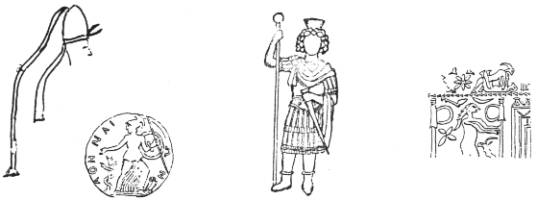
The symbol of creation is the fall of kundalini-power
from the top of the scull. This is the reason for the long streamers falling
from the top of Resheph's mitre. Athene (inversion of Anatha, in Ugarit called
Anath ltn) is the personification
of kundalini-power and is born by jumping forward from the forehead of
Zeus. On coins from the Imperial period she is followed by an ascending
double-snake[3].
The god of creation is often seen as erecting the world
pillars separating heaven and earth or he is the personification of the world
pillar. We have seen how Marduk is pictured as the world pillar rising over the
primordial ocean, in the Hellenistic period he is seen as both the world pillar
in person and holding the world pillar in his hand[4].
An old seal is showing creation as the primordial wedlock and the god of
creation erecting the pillars. Note the long hair whip falling from the top of
the scull and the plough[5].
The belief in demons is an important
part of folk religion. C.Dalrymple Belgrave[6]
has given a vivid description of daily life in the Siwa Oasis in Western Egypt
at the beginning of this century. Especially the female part of the population
seems rather keen on dabbling in witchcraft. The witches of Siwa live among
some ruined houses, their leader being a woman who is said to be 100 years old.
They are supposed to be able to summon jinns whenever they want to. The system
used for invoking jinns is only practised secretly, and by a woman. Every
evening for 44 nights she undresses, and, naked, with her hair hanging loose,
she takes a specially prepared loaf to the rubbish heap outside her house,
where she leaves it. On the 45th night a jinn will appear in the
form of an animal and ask her to prepare a dinner for his 6 brothers the
following night (the 7 demons). The next night she takes 6 loaves to the dust
heap and leaves them, and when she returns an hour later, she will find the
devil, the chief of the jinns with flaming eyes and mouth, horns and large
hooked teeth. He promises to carry out her wishes on condition that from
henceforth she will never utter the name of Allah. Women are often burdened by
many children, so another old habit is to get rid of a newborn child by
flinging it from the high walls of the city. To understand the customs of
Canaanite religion we must take such practices into consideration. At the dung
heap outside Jerusalem the sacrifices to Molok took place. The many amulets and
magical papyri calling on Syrian gods witness to the fact that a “left-hand”
practice was especially prominent in this part of the Middle East.
The god Shemal is a personification
of the left-handed magic, cf. Pap. mag.
V 96-172: prayer to a headless god also being “immortal fire”. The prayer has
to be directed to the north, the same orientation as the one used by the
Sabaeans of Harran when praying. The Mandaean book The Thousand and Twelve Questions[7]
gives a description of the two great powers (malkia), the primeval father and the primeval mother, closely
linked to right and left, the first born from above, the last mentioned from
below, and it is said about the “people of the left” “do not sign with their
perverted sign nor make a pact with their distorted oath”.
The ecstatic hunter can both be seen
as a celibate and as the opposite: Adonis was “hunter and fornicator”[8]
i.e. an orgiastic hunter. From the necropolis of the kings in Sidon comes the
“Sarcophagus of the Weeping Women” first described in O.Hamdy Bey – Th.Reinach,
Une Nécropole Royale à Sidon, 1892;
in 1983 (with full photographic coverage) by R.Fleischer, Der Klagefrauensarkophag aus Sidon. Its 4 sides show 18 mourning
women, its top a funeral procession. Most interesting are the countless
hunting-scenes on the bottom freeze with no less than 80 hunters, all with the
Phrygian mitre as their hat. As the hunting game are seen stag, wild pig,
panther, and also a single bear. It seems as if the hunter has taken over most
of the religious feelings. He seems to be everywhere.
Ecstatic traditional dance in Africa
today is often seen as culminating in obsession and the obsessed women are
called “horses of the spirit”.[9]
In the novel by Achilles Tatios the heroine is called “White mare” (Leukippe),
and the father of the hero is Hippias “Horse-like”. In the Ugarittext, “A
prayer for snakes”, the woman praying for snakes is called “mother of stallion
and mare, daughter of the wellspring and the stone… daughter of heaven and deep
sea”. The female ecstatic is in her nature one with both cosmos, nature and
horse[10].
Nobody among the gods can take away the poison from the snakebite, except Horon
"in the stronghold" (of the underworld?):
Horan arrives at his house/ And he
gets into his court/
The heat is strong like a torrent/
It streams like a stream/
Inside the house of lust… Inside she
has set the bolt:
“Open the house of lust/Open the house that I may enter/
The palace that I may get in … Give as a gift snakes…”
(Bowman-Coote).
From Minoan Crete and from the cult
of Dionysos we have pictures of a dance performed by women with snakes in their
hands, coiling up their arms. On the vase-paintings from historical time their
neck flung back indicate ecstasy. Kerenyi has paid special attention to this
ritual which combines the cult of Dionysos with the earliest cultures in Crete[11].
The Ugarit text with its repeated calling for snakes and the repeated command
to “lift the snake high” must be seen on the background of the old belief that
religious ecstasy makes the ecstatic invulnerable.