2. part: The sun hero
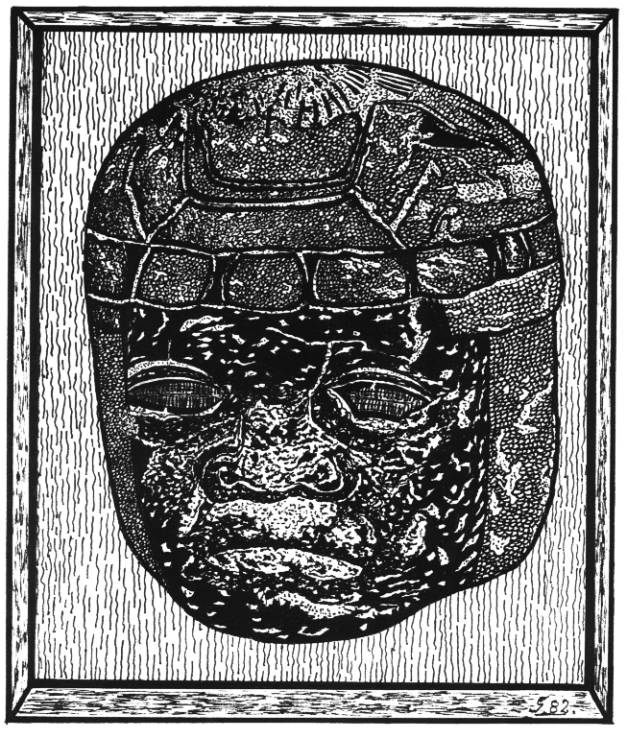
The
Olmec culture at the East coast of Mexico (800 AC) is rich on carved stones
almost an illustration to the "animated stones" invented by Uranos
acc. to Philo of Byblos.
In an article (in German), “The Glass Mountain”[1],
Otto Huth has focused on a central idea in prehistoric religion. The “Glass
Mountain” is high and steep with slippery sides, and the hero has to climb this
mountain. In doing this he only succeeds by using a horse quick as lightening,
or by using a bird or a ladder. The Glass Mountain shines with a light that
comes from within. Acc to Huth glass is
a word whose stem is closely connected with “glitter”, and German “Glanz” and “glatt”, and Huth thinks that these words originally came from a
word meaning “amber".
This means that the motif
could be much older than the use of glass, and the original meaning of the
“Glass Mountain” would then be the “Amber Mountain”, the “Glowing Mountain”,
the “Amber Island” in the midst of the North Sea.
In Egyptian cosmogony the
early earth is seen as an island emerging out of the primordial waters, and
this primordial hill is the mythological reality pictured in the pyramid. In
the pyramid the deceased is returned to primeval reality, to the paradise
mountain. The Egyptian pyramids with their gigantic polished stone surfaces
shining in the sharp sun, and the Mesopotamian stepped pyramids, are two
different variations of the primeval mountain. In a pyramid text it is said: "A
ladder to heaven is made for the king, that he can ascend to heaven”(267,Huth
p.17). Also the Mesopotamian “Stepped Pyramid” with its system of stairs is “a
ladder to heaven”. And even its smallest model, the Hebrew Betel, the stone
raised as an eternal house (Hebrew: bet)
for the presence of El (either God or a deceased soul becoming a god) can be
seen as a ladder. At the temple of Adonis in Byblos as in Betel, the centre of
the cult was a big stone-stele. In Byblos it was the picture of Gebal, the Semitic name for Byblos
meaning the “Stone”, the mythical mountain at the centre of the world, the
"Cedar Mountain".
Looking through European
folk tales Huth tries to show that the “Glass Mountain” is understood as a
3-storied mountain, and the hero’s ascent of the mountain is the soul ascending
to heaven through 3 heavens marked by the 3 great heavenly signs: sun, moon and
morning-star, or the 3 metals: gold, silver and copper. The Indian god, Visnu
climbs the cosmic mountain in 3 steps, and also in Iran there is a description
of the king ascending the 3 storied mountain. The hero ascending the cosmic
mountain is transfigured and changed into makr'anthropos.
The “Amber Mountain"
can also be a very distant island. It can be depicted as surrounded by 3
concentric channels or circular oceans: the red, black and white sea, cf the
channels surrounding the central island in Plato's description of Atlantis.
El, the Ugarit highgod
lives in Mt. Lel, and calls out "from the seven chambers, through the
eight entrances of the closed room”. Also the Cheop's pyramid has 7 chambers, 2
big and 5 smaller ones on top of the “king's chamber”. An important motif is
dealt with in G.Garbini, "The Stepped Pinnacle in Ancient Near East" [2].
This architectural motif is seen on temples, altars, ziggurats, on seals from
Mohenjo Daro, cylinders from Ur III, and goes back to Susa, 4th mill. B.C.
Part 2 is about the sun-hero travelling in the course of
the sun, breaking room in the primordial massive darkness for the sun to shine:
Ex.: Jason sailing on the Argo (“Bright One”, i.e. ship of the sun). In this
great epos told by Apollonios Rhodios we come across the scene of Apollo
appearing in divine glory over a sea covered with chaotic darkness shooting
with his bow at the two mountains of the horizon, thereby causing the sun to
rise. By this first sailing, a route is traced, creating cosmos out of a
chaotic and closed universe.
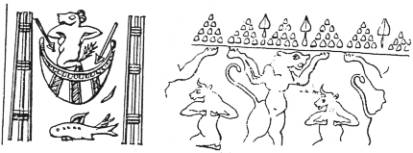
The sun hero can be the panther separating heaven and
earth, thereby creating room for the sun and
for female fertility. Early Susa[3].
The first seal shows the panther sailing with the two spears, symbols of the
Heracles-pillars. The second shows him lifting the primordial mountains.
But more often he is identified with the calf (Marduk =
“calf of Utu”). He is seen as the one who raises the two Heracles columns,
thereby securing the free course of the sun. Philo of Byblos tells us about
mighty rain-storms and forest-fires (fire and water surpassing their limits),
turning everything into chaos in a primordial universe without peras ("border"): apeiros. But then Usoos, the hunter,
sets out on the very first trip by boat, and he finally sets up the 2 steles,
thereby securing cosmos (cf that the Planctae/Symplegades were always clashing
together, but on the first journey of the Argo passing between them they were
fixed). They are a very important symbol: the cosmic paradise mountain divided
into two, thereby giving space to the world-scene: the sun, the rain, the wind,
the life to grow,- but also threatening to collapse into massive primordial
stone.