2. Moses and Mt Sinai
That the journey to God's mountain is a
spiritual journey is seen from the splendid story about Elijah travelling to
the sacred Mt Horeb in the southern deserts: after receiving a supernatural meal
he is able to travel without resting for 4o days and nights, and thereby
finally reaches the mountain.
The
40 days are somehow connected to the 40 days of Jesus fasting in the desert and
the 40 years of Israel wandering in the desert. The number 4 is the sacred
number of totality, and 10 are the numbers up to 4 added together (1+2+3+4).
A
similar play on the number 3 is seen in the temples of Catal Hüyük in the
arrangement of horns on a western wall, but also on a pillar added to the
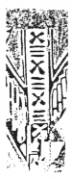
pyramids showing ecstatic ascent by uniting duality: 3 times are shown the 3
steps, and each time the steps are ended by the mystical flower representing
the number 4 (and shown 4 times). As the symbol of totality it is shown both at
the top and the bottom of the arrangement.
Two signs of the Punic goddess Tanit. (From
Hours-Miedan, Cahiers de Byrsa 1,
1951, t.5.6.7) The 3rd sign shows the world pillar rising above the twin-peaks
of the Heracles-pillars, and at its top the mystical flower:
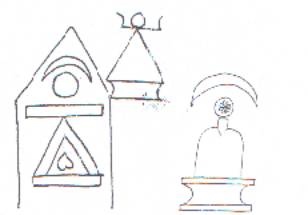
The sign of Tanit is a pyramid, and at the top the union
of sun and moon: the mystical union of the duality of night- and day-light.
Both the pyramid and the union of sun and moon are symbols of two becoming one,
symbols of mystical union. The same meaning can be seen behind the heart turned
upside down. Another version of the Tanit-sign is the pyramid, and on top of it
the sun coming into the universe through the gate of the two Heracles-pillars.
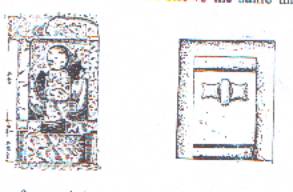
An idol for the goddess Allat from Ramm in North Arabia
shows the same union of sun and moon, but at the center of the symbol the holy
cube. ( R.Savignac, RB 43 1934,p.584,
fig. 7 cf. the quadrangle idol ibd.
587, fig. 10 also from Ramm.)
There is a constant play on the number
four and the four corners being united to one. 4 is the holy number of the
world mountain in the center of the universe, the Saphon = the
“out-look”-mountain, the culmination of the temptations of Jesus, Matt 4. But
not only the quadrangle also the cube and the pyramid. The pyramid and the
pentangle is four with the dimension upward added to the four.
The station before Mt Sinaj is called Rephidim (raphad = “stretch out”, rephida = the back of a couch, Latin = reclinatorium, perhaps it stands for the
physical rest/trance required for setting the spirit free). Here Israel is
attacked by the Amaleqites. They seem to be attacking during the night, for
Joshua is given the command to choose some men and meet the attack, and when morning breaks Moses
will stand on the hilltop raising his arms to heaven. His arms are supported by
Aron and Hur, and so he is able to keep them in a raised position until sunset. The raised arms are not
only a sign of prayer, they are raised at dawn and lowered at sunset: the sun
warrior has to keep heaven and earth separated for the light to shine,
therefore his is accompanied by the two Dioscuric helpers who are
personifications of the Heracles-pillars, and often they are pictured as
Atlas-figures with their raised arms supporting the heavenly vault.
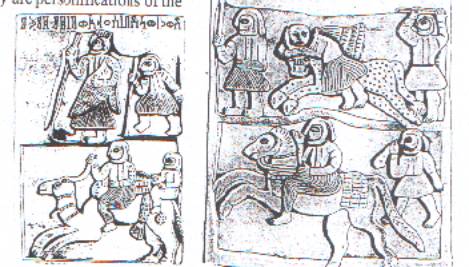
A very interesting grave-stele from South Arabia (after
D.H. Müller, ZDGM 30,1876,t.by p.114)
shows the deceased on his last journey followed by a servant or helping spirit.
On the third scene the head of the deceased placed between the horns of the
bull form the sign of mystical light:
the sun in the crescent moon and, like the typical sun-hero, he is
followed by two helpers, all three forming a kind of trinity. The two helpers are forming the gate of
the sun by holding up the heavenly vault with their two sticks. They are
personifications of the
Heracles-columns. The bull is full of dots probably the stars of heaven: The
high god, the bull, the symbol of heaven, is accompanied by the dioscuric pair
of divine brothers, shown as opposites, one riding a camel, one a horse.
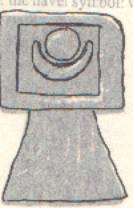
An altar from South Arabia shows the cube, the great
symbol of primordial unity marked with another symbol of unity, the sun resting
in the crescent moon placed on the top of the frustum of a pyramid. The pyramid
is marked with the symbol of the tree of life [1].
The cube is certainly an important symbol.
Another altar carries the symbol of primordial mystical
light at the top of the pyramid. The pyramid is the ladder to heaven, to
mystical light. In South Arabia “the crescent moon & the disc of the
sun" is a very old and very often used symbol on altars and steles. The crescent moon is often
seen resting on a pyramid as
its foundation [2]. D.Nielsen
draws attention to the monthly conjugation of sun and moon in primitive myth seen as a wedding [3].
I am not able to see this as the right explanation.


The picture above shows the upper part of an altar from
Sirwah (South Arabia). A very old remnant of pre-Moslem cult are some
stone-steles found in South Arabia. They date from the 8th cent.B.C. In the
Arabian tongue they are called qyf =“circling
around". They are world mountains seen as the world axis, the cosmic
center, where there is mystical ascent to heaven. Therefore the top of the qyf carries the symbol of the mystical
light: the duality of sun-light and the light of the moon coming into one.
Certainly the circling of the qyf, symbol
of the world-centre, is the forerunner of the circling of the Kaaba in Mecca. (A.Jamme: “Inscriptions des alentours de Mareb”, Cahiers de Byrsa 5,1955, pp.265f.
Augustus brought an obelisk from Heliopolis in Egypt to Rome and erected it on
the spina, i.e. in the centre of the circling horserace at Circus
Maximus.) Two others were erected at his mausoleum. The small stele in the
centre of the big one is a doubling of the navel symbol: we look at the centre
in the centre.
The pyramid-shaped altar is often with a dice-shaped top. The compact dice is the symbol of primordial totality before duality coming into existence.
South Arabian altar, now
in the possession of the
Louvre
Mus.Paris, Grohmann
fig.87
The square and the cubic dimensions are symbols of
primordial totality: in Babylon the great temple, Etemenanki, had cubic
dimensions. Its name means “House - Basis of Heaven & Earth”. It had the
dimensions 15 GAP for side, front and height.
For different attempts at reconstructing its dimensions,
see O.E. Ravn, Herodots Beskrivelse af
Babylon, 1939pp.50-5, pl.14f.
In the Song of Deborah (assumed to
belong to the earliest parts of the Old Test.) Yhvh “went forth from Seir ...
from the fields of Edom”(Judg 5,4f), “rose up from Seir ... shone forth from
Mount Paran”, Deut. 33,2; cf. Hab. 3,3: “God comes from Teman ... from Mount
Paran”. (Teman is one of the sons of Esau, Gen. 36,11 & 16.) All these
epiphanies are parallels to the phrase of Gods coming from Sinai. So it seems
that Mount Sinai must be situated somewhere in or south of Edom.
In two temples in ancient Nubia we
find lists of a number of territories belonging to the Shasu-bedouins. One of these regions is called Seir. Another name
which figures on the list is “land of the Shasu Jhw”[4].
In this phrase Jhw is clearly a toponym[5].
Midian, the land of Moses and Jetro must be this area from the mountains of Seir
down to old Madyan, east of the Akabah Bay.
In the old story about Hanno´s
expedition, the Punic fleet comes to the “Horn in the West”, after that to a
coast smelling of incense, finally to the “Horn in the South”. Between these
two locations it passes the mighty pillar of fire reaching the sky and called
“Chariot of the Gods”. Acc. to the novel “Marvellous Things beyond Thule”, the
main character of the novel finally comes to the island of the moon. At the end
of the journey the traveller moves into some sort of mythological landscape,
for his journey to the end of the world is also a spiritual journey towards
apotheosis/the paradise mountain. Acc. to Phoenician belief the drink of
immortality was contained in the bowl at the top of the world tree, the bowl of
the crescent moon: the Israelites finally come to the desert of Sin (the moon)
where they receives a sort of ambrosia, a food falling from heaven. Acc. to
another Middle Eastern belief, ambrosia, the food of the gods, was produced on
the moon. Israel has truly come to the land of the gods, Elim, Exod 15,27
clearly pictured as a paradise with wells of life and trees of life, 12 wells
and 70 palm trees. The Sinai mountain itself is the place where man transcends
to the sphere of God and God descends to the sphere of man. The journey through
the desert to the hidden/forbidden mountain of God is a spiritual journey, the
journey of man towards an ultimate goal, a meeting face to face with god.
Before our inner eye we have to recall the shape of the typical Phoenician semeion,
the world pillar = the ladder to climb the heavens, and at its top the crescent
moon. The journey towards the holy mountain is also an ascension towards the
peak of earthly existence, and the fire connecting the top of the mountain with
the highest sky is the mystical fire, the splendour and glory connected to
mystical vision, but also the normal bonfire always stretching its flames and
smoke upwards as if it wanted to reach the sky.
The burning bush: Normally fire will
consume the vegetation, but in divine unity, in the mystical centre of the
universe these two opposites are held together in balance. It is exactly the
same motif as the burning tree in Tyre.
Mt Sinai is a symbol of a place
where all the strife and pain, discord and fights of earthly existence is
dissolved into a higher union, a supernatural harmony. As when a climber
finally reaches the top and feels his heart and mind raised high above all
earthly matters and sorrows. The supernatural elements in the story about Elijah
tracking through the desert show, that it is impossible to distinguish between
what is fact and what is fiction, what is vision and what is reality in this
“event”. It is a sacred motif: to travel
towards the holy Mountain of God, a motif becoming the very symbol of
religious life. The mountain itself is hidden somewhere in an unknown
dimension, untouchable, with the column of fire from its top reaching the
stars. It is the location where eternity touches time. An old symbol of the
mystical centre of everything, as old as mankind. The centre from where life
eternally goes out, is created and to where it finally returns. It is eternity
reflected in the eternity of the massive rock, in the bedrock lying unmoved for
millions of years.
In Gen 1 creation is seen as the
tracing of borderlines and limits in a primordial universe without boundaries.
By this setting of barriers duality comes into existence:
1.day: between light and darkness.
2.day: between the waters over the
vault and the waters below.
3.day: between sea and dry land.
4.day: sun and moon.
In
the Middle East the great duality is between summer heat and the water of life
giving life to the vegetation, but also threatening with wild, chaotic
flooding. In the philosophy of Anaximander these extremes of heat and flooding
were held together in the divine “apeiros”
(=without border). The world
mountain in the centre of the universe is the location of primordial unity.
The two pillars which are the first
splitting up of the unity are often seen as primordial twins or brothers of
opposite nature and character fighting each other: Kain and Abel.
But duality comes already with the
fruit from the tree giving “knowledge of both good and evil”. Adam and Eve
tasting the fruit become aware of the most profound duality in life: between
Good and Evil. And between male and female - they discover their nakedness.
2a. The Shepherd and the Seven Sisters
Acc.
to Philo of Byblos, El Cronos had 7 daughters with Astarte, together with the two
sons, Eros and Pothos (“Love and Lust”), seen as important cosmic forces. In
the Ugarit texts Krt loses his family, 7-8 brothers and 7 wives. He is ripped
of his royal power (Gibson’s transl. CTA 14,i,23). Job loses 7 sons and 3
daughters. He is ripped of his royal power 29,9ff. The key to both the
Ugarit-poem about Krt and the book of Job is the important fertility symbol:
the graces, the charites. The Krt-story starts with Krt losing all his women;
but with a giant army he proceeds to ‘Udm and demands princess Huraj as his
wife. She gives him 7 sons and 8 daughters. All the names of the girls are
given, but only few of the sons are mentioned. Like Job he is accused of
injustice, and is on the point of dying. In both stories there is an
Elhu/Elihu. Also Job is given new sons (7) and daughters (3), but only the
names of the daughters are mentioned: Jemima (a name containing the word for
“water”), Kezia (used for the production of aromatics), Keren-Happuk (“horn for
make-up”) and they are highly praised for their beauty. The names of the Greek
charites, Aglaia, Eufrosyne,Thalia, show that they represent fertility and
beauty. Acc. to the big Baal Epos, Baal in Ugarit has 7-8 servants called
“boars” and 3 daughters, only the daughters mentioned by name.
As
Baal gets his weapons from the divine smith and El Cronos in Byblos from the
divine inventor, Tautos, so the divine smith, Hephaistos, has to produce new
weapons for Achilleus before the crucial battle with Hector (= Aktor, Aktaeon).
Hector has black hair, Achilleus has fair hair. He is the young god of
spring-time, and his double, Patrocles, is the Adonis-type whose death is
hailed with a weeping of almost cosmic dimensions, even the goddess Thetis and
33 nereides are participating in the
great weeping for the dead youth: ”He sprouted like a proud plant” (Iliad, beginning of the 18th song).
But the most important motif is Achilleus losing his
woman in the first song, and therefore withdrawing from the battle, but in the
19th song he gets 7 women, and as the 8th Brisëis. After this he goes back into
action and chases poor Hector round and round (like the movements of the sun).
Both Job, Krt and Achilleus represent the sun-warrior who is bereaved of his
graces, descends to the realm of death, but returns with fertility and grace
reborn.
In the 21st song there is the usual fight
against the chaotic sea. Achilleus, the sun-warrior, is attacked by the river
Scamandros, who tries to drown him, but at the last moment he is saved by
Hephaistos creating a giant fire to stop the flooding. The cosmic balance
between water and heat is a very important prehistoric motif, and the main
motif of the Ugarit-epos about Baal fighting cosmic flooding and summer-heat.
The sun-warrior creates order in a chaotic universe, cf. the shield of
Achilleus, which is clearly a cosmic IMAGO (Iliad
18th song).
As
Patrocles fighting and dying as Achilleus’s double, clad in his armour, is
mourned for in a mourning of cosmic dimensions, so Krt is lamented both by the
Phoenix-bird, Hol, and Mt.Saphon
(acc. to M.Dahood [6]). The
Hol-bird is also mentioned in Job 29,18. It is part of the symbolism
surrounding the sun-warrior.
2b. The Shepherd and the
three girls
Jane Harrison[7]
brings the following picture of the three dancing “daughters of dew” in Athens.
(Also the daughter of Baal are called “daughters of dew and fog”, CTA 3,C,5ff.)
The next pict. shows the three charites led by Hermes in dance while the bull
man, Pan, is piping. Harrison directs our attention to the story about the
three goddesses led by Hermes to the shepherd Paris. This motif was so common
in the art of the Antique world that Harrison asks: “Did not the myth itself in
some sense rise out of the already existing art form, an art form in which
Paris had no place, in which the golden apple was not? That form was the
ancient type of Hermes leading the three Korai or Charites” (ibd., p.297 with
the picture below of Hermes leading the three goddesses. They are pictured as
perfectly identical and Hermes is carrying a huge and rather irrelevant sheep.
He is the shepherd leading the three girls in dance.).

The three Horai were originally
goddesses watering the earth with the life giving rain and thereby bringing forth
flowers and fruits. In Athens they were two; Thallo bringing forth flowers and
Carpo bringing fruits. Acc. to Hesiod they were three presiding over the order
of cosmos: Eunomia, Dike and Irene. In the early Christian text “The
Shepherd of Hermas” the shepherd is followed by 7 girls, personifications
of different virtues. On Mt Helicon Apollo, the god of spring, is leading the
dance of three times three Musai.
Hiding among the shepherds, the divine child, Krisna,
escapes the persecution of the chaos-king. He is very fond of the gopas and dances with them. In the same
way Moses hides with Jetro in the desert, helping his seven shepherd-daughters,
marrying one of them. Also Apollo has to be born in secret, hiding from the
chaos-dragon (cf. Rev 12). He is born
under a great light among many flowers and cared for and washed by goddesses.
In the Homerian Hymn to Apollo he is followed by the "goddesses of the
year", the charites, Hebe, Harmonia & Afrodite who form a chorus,
dancing with the god leading the chorus. As we shall see, there are mostly 3
women following the shepherd of spring and sunshine (3 graces, the horai). Baal is followed by his 3
daughters and often called Hadu, the shepherd. The girls following the young
god are often personifications of the forces bringing fertility and beauty to
nature. Baal's daughters are symbols of the rain and dew and fog.
a) Male
children being killed by the evil king ruling (to prevent one of them from
taking over the kingdom) is a feature common the Exodus-story, Matt 2 and the
myth of the birth of Krisna.
b) Moses
finally saved by his being adopted by the daughter of the evil king Pharaoh is
paralleled in Phoenician myth by the pregnant wife of the highgod being given
to Dagon, the brother of El Cronos, and her child finally being the successor
of the evil king El Cronos on the heavenly throne.
Myth and
history mix in a way that makes it quite impossible to separate the two. The
symbol and the mythical language is the way of the folk religion to try to find
suitable expression for the ineffable. The same pattern is repeated again and
again and all lines in this great pattern run together in the story of Jesus,
persecuted by the evil tyrant Herod growing up to become the Good Shepherd
sacrificed but sought and bevailed by the women.
2c. The child exposed to the river or the wilderness
In
a large article, Donald B.Redford[8]
has collected 32 variants of “The literary motif of the exposed child (cf. Exod
2,1-10)”. This motif occurs in ancient Egypt, Persia, Mesopotamia, Greece, as
well as in Rome. Strangely enough, he does not mention the important
Cretan-Minoan variant of the theme: the Zeus-child is hidden from Cronos, the
demonic divine King, and is nursed by the goat Amalthea. In our opinion the
motif is so old and wide-spread that it must go back to the oldest period of
agriculture. It is connected with the struggle for kingship-of-heaven motif:
after the killing of the high-god, the goddess must fly and hide her child from
the demonic god in a sphere which does not belong to him, but to the high-god
(the bucolic environment with shepherds & goats, the environment dominated by
the life-fluid). Mother and child fly and hide in the sea. (Leucothea flies
from Lykurgos and hides herself and the Dionysos-child at the bottom of the
sea. During her flight from Typhon, the Syrian goddess comes to the Euphrates
and hides there with her child, Eros.) Or they hide in the rush-grown marshes
(Isis and Horus hide from Seth). The child may also be committed to the river
in a small basket or box (a late version of the Horus-legend, dealt with by
Redford p.223).
The child may
also be exposed to the wilderness and grow up among shepherds and be nursed by
a cow or a goat. For Perseus and Romolus and Remus the two motifs are combined:
the child saved by the sea/ the river and in the bucolic environment, both
experiencing the sailing in the box/the trough and the hidden upbringing among
shepherds. Sargon's birth-legend is meant to legitimate the king as the son of
the god of life.
It is characteristic of the stories about Moses that
they contain the exposure of the child to the life-fluid of the Nile as well as
the hidden life among shepherds in the wilderness (with Jetro).
Redford has not been able to see this origin of the
motif in the fight between the god of life and the god of chaos and death. He
argues that the motif of the child exposed to the river arose in the
Euphrates-Tigris area, the child who is exposed to the mountains is, acc to R.,
a motif from Armenia or from the northern part of Zagros.