3. Petra and the two tablets inscribed with the world
order
 In a niche on the highs surrounding
Petra we find the world-mountain, the massive block of stone standing between
the two Heracles-stelai and flanked by the semeion, the world-pillar with the crescent
moon.
In a niche on the highs surrounding
Petra we find the world-mountain, the massive block of stone standing between
the two Heracles-stelai and flanked by the semeion, the world-pillar with the crescent
moon.
The song of Deborah (Judg. 5) is
mostly seen as belonging to the oldest layers of tradition in the Old Test.:
Here the Lord is seen as coming out of the mountains of Seir and he is called JHVH zeh Sinai. This use of zeh is not common in classical Hebrew as pointed
out by E.A.Knauf[1], but common
in Arabic (dzeh =<*du: Du-Shara).
The altars and obelisks situated on
the mountain massive surrounding Petra show that all the Shara-mountains are
considered a holy landscape. Petra is the old center of a cult honouring the
holy mountain which is primordial omphalos and paradise, but also this
primordial unity split into two, the two world pillars. On seals belonging to
the Hittite king we find the important symbol of the two pillars supporting the
sunbird/the winged disc of the sun. The rosette almost always with 8 petals
inscribed in the sunbird shows that it is the mystical unity of all the light
of heaven, not only the sunlight. Between the two world pillars are often seen
the undivided mountain with the two handles so well known from the Sumerian
world-pillars. In a way the same motif is found much later in Nabataean art
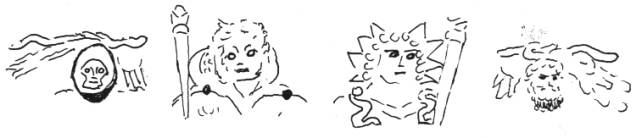
(from Jebel Druze, Nelson Glueck, Deities
and Dolphins,1965,pl.138): the sunbird at the top uniting the female light
of the moon with the male light of the sun and flanked to the right and left by the two
contrasting twins (the symbol of duality). Note that they are both by their
haircut and beards made into contrasts. (One with a close-cut beard and hair
and one with untrimmed hairdo). A snake is coiling in a branch over the head of
each “twin”, they are the double snake which when raised, is a symbol of
ecstatic union, but here split into duality and coiling flat along the
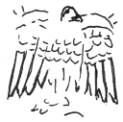
horizontal branches. The eagle at the top of this arrangement, is the mystical
bird of Baalshamen, the unity of all diversity. It is also in Nabataean art
seen on the top of the head of the deceased. The sun has two snakes coiling up
his breast. As a traveller on the route of the sun to paradise he is also a
traveller on the road to risen “kundalini-power”:
Mt Sinai has been
identified with a lot of different locations as listed by J.J.Hobbs[2].
The problem is that acc to the books of Moses it was forbidden to the
Israelites even to draw near the place, so it cannot have been a goal of
pilgrimage in the early times, as suggested by some scholars. Its location was
unknown, also to the early settlers of the promised land. It was a mythical
mountain. E.Anati has found many indications that Mt.Karkom in the Negev was honoured
as a holy mountain[3], but his
many thousand findings must be dated to a period much earlier than the Exodus
from Egypt. Most important is the fact that Moses is linked to the Midian
priest, Jetro. Certainly he has some connection with the Midian tribes who were
one of the main elements in what later became the Nabataeans. Therefore the
traditions connected to Seir about the two stelai, one of clay, and one of
stone, able to survive universal fire and universal flood, and therefore able
to preserve wisdom from time immemorial, and the tradition of the gate of the
sun certainly being the reason for the two impressive obelisks cut out of the
mountain top south of Petra, all this proves that the two tablets in which the
ten commandments were carved and given to Moses at sunset[4]
are to be understood on the basis of local traditions from the Seir-Midian
area. The most important element in Midian-Nabataean religion seems to be the
massive rock: out of this rectangular stone the god Dusares was born. The rock was
the cultic representation of the cubic, primordial, massive darkness split by
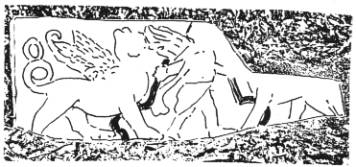
the new-born Dusares, as seen on the two sculptures (below) showing a winged,
strong child separating the two serpents who, intertwined, were the symbol of
massive darkness. He is pictured as a very strong baby grasping two snakes
rising from the earth between two winged lions. The lions are also putting
their paw on the snake thereby helping the god in keeping them apart. The
picture wants to show the god as the master of the helping lion-demons. Another
stone slab shows the same picture of the god as a winged child keeping two
sphinxes apart with snakes formed as scimitars. The winged sphinxes have tails
that are coiling back into themselves, creating the form of 8 – a very unnatural shape for a
leopard´s tail. The sphinxes symbolise death and massive darkness kept at a
distance by the kundalini power used as the scimitar splitting up primordial
massive matter. The coiled tail makes the sphinx not only a symbol of death,
but also the symbol of kundalini in its lowest aspect as massive matter
closed/coiled around itself. Dusares is the sun hero creating a path for the
light in primordial massive darkness.
Dusares is a god of the sun warrior-type creating space for the
sun to run its course. In the chapter mentioned above, where Moses receives the
two tablets, he receives the promise of God that he will follow Moses on the
road through the desert and the unknown land. The God making the “king's
highway” through the desert safe, providing water, is the typical sun-warrior
who passes Moses at dawn and by his glory (Hebrew: kabod) makes the face of Moses shine.

A Mesopotamian tradition tells about
Zisuthros (Zis & Uthra = “soul”), who hid the writings describing “the
beginning, the middle, the end” before the great flood. They were found again
after the flood[5]. Zis-uthra
is also called Atra-Hasis and Zius-udra. He is Zas/Kassios defeating
Typhon/Jam, the heavy flooding of winter rain.
Acc to Josephos[6]
the descendants of Seth inscribed their knowledge on two stelai, one of clay to
withstand world wide burnings (ekpyrôsis),
the other of stone to withstand cosmic floods. The stone stele still exists
in the “land of Seiris”. Gnostic texts
also talk about the “Stelai of Seth”[7].
There is an old tradition connected with the land of Seir about the two stelai
inscribed with old wisdom. Manetho (ap. Syncellus 72) also talks about stelai
situated in the land of “Seriadike”, inscribed with a holy language by Thot,
and after the flood translated by Agathodaemon.
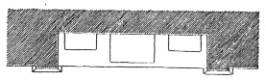
A holy symbol very
typical of the Seir-Petra area is the three slabs of stone: a big one flanked
by two smaller. It is the massive world mountain and the split mountain
inscribed with the laws of cosmos. G.Dalman[8]
brings this example from Wâdi Mûsa. A.Jeremias[9]
has paid attention to the role played by the two mountains, Garizim and Ebal:
“The two mountain tops G. and E. represent, according to the old cosmic
symbolism, the twin peaks of the world mountain … or both halves of the world …
as Blessing and Damnation”. All the commandments of the law have to be written
on stelai erected on one of these twin peaks, Ebal[10].

The famous Greek writer, Euhemeros,
was a diplomat in the service of the Macedonian king, so it is very likely that
he has learnt from Syrian traditions when he introduced his theory of the gods
as originally being mere humans, but later, because of their fame, worshipped
as gods. We know that Melqart´s grave was shown in Tyre, and his bones
transferred to Gades. Bel’s grave was shown in Babylon, Adonis’s in Byblos.
Euhemeros (FGH, F 2 & 63) tells
us, that after its departure from South Arabia his ship, after sailing several
days, reached the point where the sun stands at high noon. Here were some
islands in the middle of the vast Oceanos. One was called Panchaia and was
completely dedicated to the gods, and here on a mountain ridge was erected a
very high temple for Zeus Triphylios built by himself while he was still among
humans and governed the whole earth. In this sanctuary there was a golden stele
with an inscription recounting the most important deeds accomplished by Uranos,
Cronos and Zeus: Uranos was an astronomer watching the movements of the sky and
the stars from the top of the mountain called after him “Seat of Uranos”. He
was a very modest and kind man. After him Cronos reigned as king, and later
Zeus. He went to Babylon where he took the name of Bel, and from there he
reached the island of Panchaia, where he put up an altar to honour his
grandfather, and Pan showed him the mountain called “Seat of Uranos”. From
there he looked out over the whole earth and the universe. When he came back
through Syria, he visited a local king, Kassios, after whom Mt Kassios is
named, and defeated a local prince in Cilicia (probably Typhon). Through his
many visits to numerous nations, he was greatly honoured, and finally
proclaimed a god.
What we have here is the typical Near Eastern notion of the top of
the world mountain from where you can see all the world, and even heaven. This
holy mountain is more or less identified with the Highgod, also called
Hypsuranios. It is his seat because he is the personification of it. He is kind
and good to all, but often dethroned by a younger god, the hunter, who is even
seen burning him, lying on the mountain.[11]
The eagle-man as the symbol of
unity/ecstasy is blessing the primordial brothers as the symbol of duality.
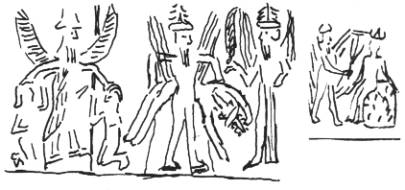
Zeus-Bel is the sun warrior
travelling through the world, finally coming to the mystic mountain with the
inscriptions. The title of Euhemeros´s book, "Holy Inscription",
shows that these inscriptions made on the golden stele and on the mountain are
the vital centre of the whole story. The inscription made by Uranos was a
description of the mechanism of the heavenly movements, the world order. The
local prince is probably Typhon defeated by Kass/Zas/Sandan, with the help of
Zeus.
The world pillar or world axis is
the representation of world order. When Plato describes the ideal society,
Atlantis, this country has as its centre a holy Orychalkos-pillar on a holy island, situated on an island inside
yet another island. On the pillar the old laws by which the 10 kings of
Atlantis have to govern are inscribed.
But all stress can also be put on
the two Hercules-pillars forming the gate of the sun: Apollonios of
Tyana says that he read the holy inscriptions on the Hercules pillars put up in
the temple of Melqart-Hercules in Gades, but the Egyptian Heracles did not
allow him to reveal the content. Heracles made these inscriptions “when he was
in the house of the Moerai (“fate”), that no strife should rise among the
elements, nor should they dishonour the love they have for each other”. It is
the eternal laws of cosmos Heracles has written on the pillars.
"Such pillars, on which the ordinances
of Heaven … the decreta astrorum (Manetho
Apotelesm.V 2,3) were inscribed, and
which were found by Sanchunjathon in the Adyton
(most holy chamber) of Phoenician temples, and from which he took the
genuine teaching of Taaut, were also found by Apollonios, acc to Philostratus
(V,5)” says Movers (p.97).
Strabo (with reference to
Poseidonios) mentions that copper plates were put up in the temple of Gades “8
yards high” (III,5,5), but they were only inscribed with the costs of building
the temple.
Most important is the tradition of
Taaut mentioned by Movers. Philo of Byblos is translating an older work made by
a Jeu-priest, Sanchunjathon, and S. draws upon the inscriptions made by the
god, Taaut (the Egyptian god Thot), on some Ammuneôn
found in the temples. So at least it is told by Philo. Now these Ammuneon must
be the well known hammanim. This
cult-object also mentioned in the Bible must be “sun pillars”, the Heracles
pillars, sometimes also the world pillar seen as a pillar of fire pictured in
the fire burning on the altar[12].
Procop.de b.vand, 2,10 conveys the interesting information that by the
town of Tigisis in North Africa there were two stelai made of white stones and
inscribed with Phoenician letters. Two tablets of destiny are mentioned by Nonnos
XII,1ff. They are located “by the sunset” and inscribed by Phanes. The first
contains the story about Uranos, Cronos, Zeus, and Ophion fighting about the
kingdom of heaven, the other is about the creation of man and the great flood.
But here the motif is enlarged with other tablets foretelling the future.
The most important symbol adorning
the many memorials hewn into the rocks surrounding Petra is the stepped
pinnacle, often divided into two halves. It is the symbol of the split world
mountain, the symbol of resurrection: during the night the sun is resting in
the realm of the dead, but in the early morning it will be born again and rise
above the paradise mountain in the far east, thereby cutting the mountain into
two with its golden saw. The sun rising above the twin peaks of the split world
mountain is a very important Egyptian symbol.
The Nabataeans
got their god Dusares from the Edom tribe. The name of the god means “He from
Shara”, the mountains surrounding the old Edomite capital Rekem/Petra. Characteristic
for this god is that his name is not mentioned. He has no picture, but is
present in a black stone with the dimensions 4 times 2 times 1. This black
box-shaped symbol with mystical dimensions reminds us of the holy of holies in
the temple of Salomon, the cubic chamber at the end of the biggest chamber
called hekal = “throne-room”. The
cubic form is also found in the Caaba in Mekka. The black cubic form is a
symbol of primordial massive totality closed around itself, the nightly sky,
the mountain of darkness black and towering. The meteor fallen from the sky is
in its heavy blackness a lump fallen from this mountain of eternity. The god
who lives in the stone is identical with the god who lives in the great
mountain-massive surrounding Petra. The Se'ir mountain is an earthly trace of
the psycho-cosmic mountain also seen as a ladder to high heaven, cf the coins
from Roman times showing the holy stone topped by seven flat discs together
forming a pillar on top of the stone. A.B.Cook (Zeus III,p.908) asks if it is loaves offered on an altar? But in my
opinion it is the world pillar, the ladder to zenith with its seven stages of
ascension – one for each of the seven planets, also the Cheops pyramid has two
main chambers and on the top of the king's chamber five minor rooms for each of
the 5 planets. The pyramid is both a model of the primordial mountain and the
ladder to heaven. The ladder symbolism is also stressed by a real ladder
leading to the base of the altar. The two minor stones flanking the symbol are
the Heracles-pillars with the characteristic disc at the top (for carrying the
heaven-ceiling).

Cook, III, fig.759, fig.757, fig.760, fig.761
This three-fold symbol consisting of the world mountain
between the split world mountain = the gate of the sun is seen on a lot of
Nabataean monuments[13].
This symbol is also the key to Solomon's temple with the two pillars Jakin and Boaz on each side of the entrance to the closed debir (Hebrew for the inner chamber).
Here was the cherubic throne of God wrapped in eternal darkness[14],
cf. the phrase “the throne of Dusares” probably the mystical square black stone[15].
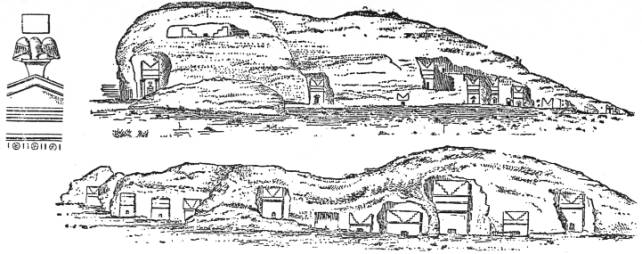
The symbol of the split world-mountain in the east over
which the sun rises is the key to the Nabataean graves as seen clearly from the
Nabataean graves in Medáin Salih (half way to Mecca, the picture from
C.M.Doughty): a split stepped pyramid is flanking the small grave on top of the
ridge, at the bottom a much bigger monument, also crowned with the split
stepped pyramid and between the two halves the eagle is rising. The gate of the
sun is the split world mountain or the
two Heracles pillars, I.Browning mentions the two detached pillars “The Faroun
pillars” in Petra[16].
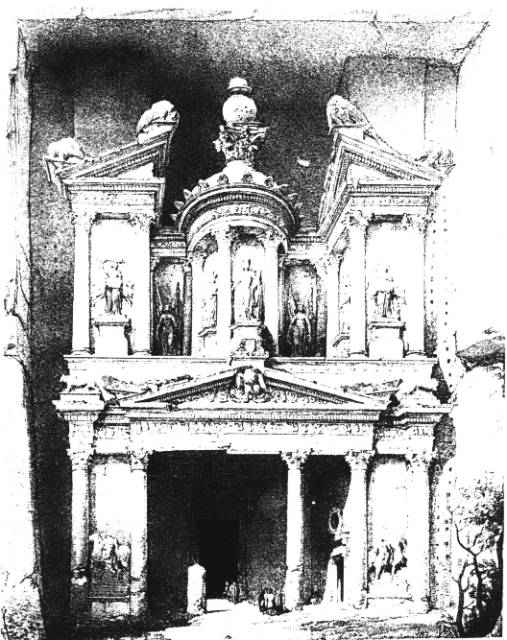
A tripartite
symbol can also be seen among the grave-monuments in Petra. On the great al-Khazneh, at the
entrance to the holy city of Petra, the second floor is roofed with a split
pyramid, and between the two halves a round
tower like building, a so-called tholos.
Lars-Ivar Ringbom has shown that the tholos is a symbol of the mystical centre
of the world, paradise as axis mundi[17]. The round
world-pillar flanked by the two halves of a split pyramid is a symbol of unity
flanked with the symbols of duality. The symbol of unity carries the goddess of
fertility and plenty (with the horn of plenty), the symbol of duality carries
the goddesses of division with an axe in their hands.
The eagle, the horse and the winged Nike are all
important symbols in the Syrian Sol
Invictus religion. Obviously, the split is the space where Nike can fly upwards
on her wings.
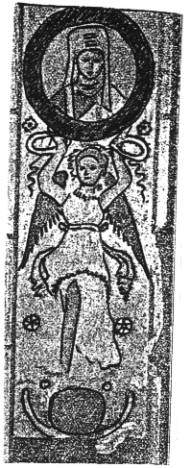 Nike, the goddess that gives victory
with wreathes of victory in her hands lifting the deceased high above the top
of the world pillar marked by the unity of sun, moon and morning and evening
star (From a grave in Palmyra. The motif crowning three girls lifting three
rings of apotheosis is Achilleus at the court of Scyros, dressed in women’s
clothes, i.e. as a symbol of mystic androgyny.)
Nike, the goddess that gives victory
with wreathes of victory in her hands lifting the deceased high above the top
of the world pillar marked by the unity of sun, moon and morning and evening
star (From a grave in Palmyra. The motif crowning three girls lifting three
rings of apotheosis is Achilleus at the court of Scyros, dressed in women’s
clothes, i.e. as a symbol of mystic androgyny.)
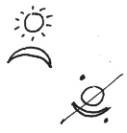
The moon receives its light from the
sun, which means that the enlightened part is always the part closest to the
sun, turned towards the sun: the sun resting in the bowl of the crescent moon
is an impossible constellation – the horns of the crescent will always be
turned away from the sun. The symbol so
often used as a symbol of the unity of all light is mere speculation, a sign
never observed.
The many coins from the Nabataean
area showing the triune symbol of the world mountain standing between the two
halves of the split world mountain, indicates that the tholos is the united
world pillar standing between the symbols of the split world pillar. The split
symbol bear on its two halves an amazon with an axe, and in the centre, on the
tholos, is a woman with a horn of plenty. The hunter with the axe is the symbol
of heat destroying the vegetation, the horn of plenty is the symbol of life and
vegetation in abundance. This symbolism is here combined with the symbolism of
holy primordial unity, and creation as the splitting into two of this unity
(and unity and duality forming together a sort of divine trinity). Crowning the
roof are two obelisks hewn into the solid rock, and together with the split
“world mountain” forming two majestic pillars on each side of the entrance to
the dark tomb; at their foundation they are guarded by the divine twins so
typical of Arabian religion, and a most important symbol of duality. The idea
of this design comes close to the design of the temple of Solomon: the two
pillars, Jakin and Boaz, and behind them the inner sanctuary whose cubical form
shows that it is a symbol of primordial massive darkness, like the black stone
of Dusares.
The mountains surrounding Petra were
looked upon as part of the Seir-mountain complex as part of the primordial
mountain in the centre of the world. Isis was, acc to Hellenistic sources, from
Seirios Ge and she is called Seirias[18].
Seir is the land of holy origin, and the long narrow chasm (in modern Arabic
called the Siq, a 1,2km long gorge hemmed in by cliffs going up to a height of
100m) leading to the capital of the Nabataeans was the primordial split cutting
reality into two, giving room to the splendid oasis of Petra. In the inner
chamber cut into the holy, mystical mountain the dead were resting, waiting
like Dusares, the sun, to be born again out of the rock from which the town got
its name like Tyre from Tsor = “rock”, the myth of Tyre is centred in the
Ambrosian rocks with the mystical, burning world tree in their centre.
But the “true centre” must be
Jerusalem with the Dome of the Rock, or the rock of Calvary where the cross was
erected, and where the scull of Adam was said to be buried! M.Rosen-Ayalon[19]
has proved the paradise motifs filling the Dome of the Rock, perhaps the most
beautiful tholos-building in the world. The world tree with the winged disc at
the top and the well of life at its root is here a multitude of winged trees
sprouting out of preciously adorned jars, and filling the walls with an
abundance of green leaves. "And it shall come to pass by the end of the
days that the mountain with the house of the Lord shall be made standing firm (nakôn of the stem kvn, the term. techn. for the worldpillar & the planet Saturn)
on top of the mountains", Is 2,2. Mt Zion will stand forward as the
worldpillar in the cosmic centre. From it cosmic order and the final revelation
will spread, 2,3ff.
The religion of Petra is the cult of
the holy stone. Out of it the Lord Dusares is born. The holy stone is a symbol
of eternity and the primordial mountain, a symbol of the cosmic mountain of the
night in Ugarit called Lel (cf.: Hebrew layla
= “night”).
The same paradox as the birth of the
sun god Dusares from massive stone is hailed in the song of Solomon at the
consecration of the temple: “God has set the sun in the sky, but for himself he
has chosen to dwell in the darkness”.
Toufic Fahd[20]
is right when he says that it is not impossible that the cubic form of the
cella of the Ka’ba in Mecca is a reproduction of the form of the sacred stone.
The building clothed in the precious black cloth is the magnified form of the
stone, p.119f. There is a kind of identity between the whole building and the
famous black stone set near the eastern corner and kissed by the believers. He
also deals with the legend of Isaf and Na’ila (p.115), young lovers who were
petrified as a punishment for their making love to each other in the interior
of the Ka’ba. The Ka’ba is a symbol of primordial union including the union of
male and female gender.
In Phoenician religion the Baityl is
a holy standing stone worshipped as “the House of God” (Bet = “house” & El
= “God”). On the heights surrounding Petra we found the Baityl standing almost
in the dark interior of the holy mountain massive, flanked with the two pillars
of the sun-gate, an arrangement very similar to the temple of Solomon with the
cubic Debir (the inner sanctuary) as the ultimate source of reality, the
primordial centre, the mystery and the entrance to it flanked with the two
free-standing pillars, Jakin and Boaz. Now, obviously the deserts around the
Seir mountains is a better place to seek the origin of the Old Testament belief
in JHVH than the tablets found in Ugarit.
The idea of Mt Sinai as somehow
connected to the symbolism of the moon (Sin: Babylonian-Semitic name for the
moon) and an ascent to heaven is in our opinion quite relevant. Also the
Babylonian word, Tiamat (the chaotic sea) can be found in the region bordering
on the Red Sea, Tihama[21].
Nowhere do we find such likeness as between the cultic stage
in Jerusalem and in Petra. In Jerusalem the dark cubic chamber, in Petra the
dark, square stone obviously placed in the rear chamber in the mighty Kasr el
Bint temple. The back-wall of this temple is divided into three rooms fiting
the tripartite symbol, the black stone flanked by the two Heracles-pillars. Two
standing pillars of impressive dimensions are found to the south of the Temenos
at whose western end Kasr el Bint is situated. In front of Kasr el Bint, a
great altar like the holocaust-altar in Jerusalem, and like the Nicanor-gate in
Jerusalem, a great eastern gate leads into the Temenos. The east-west
orientation of entrance and adyton is
the same as in Jerusalem.
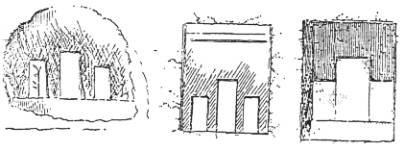
The typical tri-partite
symbol. From C.M.Doughty, Travels in
Arabia Deserta, 1921.I.p.120 fig.1-3.
On the top of the surrounding mountain is the typical
“high place": an altar situated on the highest mountain ridge. A little
southeast of it, two giant obelisks created by cutting away all the rock around
the 20 feet high stone pillars. As I.Browning says: a truly Herculian task.