7. Baalbek-Heliopolis
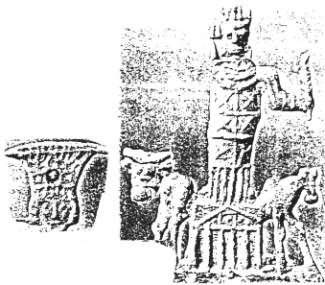 We have seen how the two world
pillars in the Jemdet Nasr cult huts were guarded by young calves, and that the
bull-man was the guardian of the world-pillars. This idea helps us to understand
the image of Jupiter Heliopolitanus: he is pictured as the world pillar guarded
by the two calves. A German expedition digging in the water pools at Aîn
el-Goug (1901-2) brought to light several small figurines in lead. One of them[1]
shows very clearly Jupiter H. as the enormous pillar towering high over the
roof of the temple and guarded by the calves. When Macrobius and Lucian (de dea 5) says that his cult image came
from Heliopolis in Egypt by way of Assyria, it can not be true. It is typically
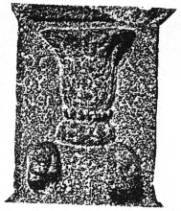
Syrian. The polos of the god is
broken but is seen clearly in the next picture. It seems to have the shape of
an open lotus (Hajjar,fig.110,232,234,313), or is adorned with a lotus as a
third eye over the forehead of the god (fig.302). A slab with a kalathos/polos as the holy symbol is
shown by H.Seyrig (SYRIA 36,1959
fig.1,p.39) it certainly has the shape of a flower. Jupiter H. was a sun god
seen with the whip of the chariot-driver in his hand.
We have seen how the two world
pillars in the Jemdet Nasr cult huts were guarded by young calves, and that the
bull-man was the guardian of the world-pillars. This idea helps us to understand
the image of Jupiter Heliopolitanus: he is pictured as the world pillar guarded
by the two calves. A German expedition digging in the water pools at Aîn
el-Goug (1901-2) brought to light several small figurines in lead. One of them[1]
shows very clearly Jupiter H. as the enormous pillar towering high over the
roof of the temple and guarded by the calves. When Macrobius and Lucian (de dea 5) says that his cult image came
from Heliopolis in Egypt by way of Assyria, it can not be true. It is typically
Syrian. The polos of the god is
broken but is seen clearly in the next picture. It seems to have the shape of
an open lotus (Hajjar,fig.110,232,234,313), or is adorned with a lotus as a
third eye over the forehead of the god (fig.302). A slab with a kalathos/polos as the holy symbol is
shown by H.Seyrig (SYRIA 36,1959
fig.1,p.39) it certainly has the shape of a flower. Jupiter H. was a sun god
seen with the whip of the chariot-driver in his hand.
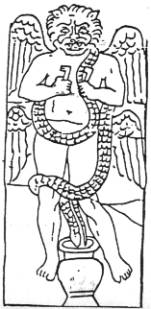
Like the sun he had completed his journey from the far west (Egypt) to the rise in the east (Assyria), but in a strange way the journey in the course of the sun was also a journey upwards to raised kundalini, reaching the lotus of 1000 petals over the head of the god. One of the lead figures is rather blurred, but acc to Hajjar it shows, inside the temple gate, a vast stump of a pillar with the snake coiling around it, the world pillar with the ascending kundalini-power. Now we are able to solve the mystery of the Saturn-Aion cult figure found in the temples belonging to the mysteries of Mithras. He has the same pillar-like appearance as the cult image in Baalbek, but has a snake coiling around his body (mostly 7 coils can be counted), rising to put its head on the forehead of the god (the god is shown with a lion´s head), exactly where the “third eye” is thought to be situated.
It is written by Philo
that El Cronos in Byblos, after “travelling through (peri-iôn) the world” (I,10,32) after the end of his life, was
divinized as the planet Saturn (I,10,44). The same could be said about Mithras.
After killing the bull (a parallel to El Cronos murdering the high god, Uranos)
he travels in the chariot of Sol/the sun, and finally reaches the place of
Saturn. Perhaps he even becomes Saturn, for the snake often seen travelling
along with Mithras is the kundalini-snake coiling up the body of Saturn. The
travel in the sun´s course is also the mystical journey upwards along the world
pillar to vision and heaven. As Resheph in Byblos finally becomes the obelisk,
the model of the world pillar, so Mithras finally becomes one with Saturn, and
Jupiter H., after travelling from west to east becomes the world pillar,
becomes macro-anthropos.
As the name of the town suggests,
Jupiter Heliopolitanus is a sun god. But the sun god is only one of the many
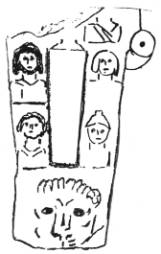
busts adorning his Ephod. He is, in his completed state, the pillar of fire,
mystical light; as seen from the picture below, he is the union of Sol &
Luna and the old god, Saturn and 5 flowers, perhaps representing the 5 planets.
He has a globular ball of light, not only on his forehead, but also in the
kalathos.
1. 2.
2.
1.pict.: Bronze from Graz (A.B.Cook,I,p.572).
2.pict.: Fragm. of marble statuette (Hajjar,
fig.209): Jupiter H. as the union of the seven lights, 5 planets & sun
& moon. We have also shown some examples of Saturn Aion: Note that he has
the same double pair of wings, “two as if fluttering and two as if relaxed” as
El Cronos acc to Philo (I,10,36).
3. 4.
4. 5.
5.
3.pict.: From Ostia, now in the Vatican Mus.
Drawn by G.Zoega.
4.pict.: Relief from Rome, Aion fig.56, in Lex.Icon.
5.pict.: Relief from Ostia, SYRIA 27.1950,fig.2.
In the last picture the snake is
coiling round the body of the god, but the stress in not laid on its ascent to
the third eye, but on its drinking from an ecstasy giving drink.
The final proof of our thesis that
the geographical journey in the course of the sun was identical with the
ecstatic journey upwards by raising the kundalini-power is this picture of
Triptolemos (“the triple warrior” – we have often seen this symbol, the triple
sun hero) in his chariot drawn by the double snake, found near Byblos[2].
The chariot has the shape of the crescent moon. Acc to the myth at Eleusis,
Triptolemos was given the chariot to travel all over the world to teach the
nations the art of agriculture.
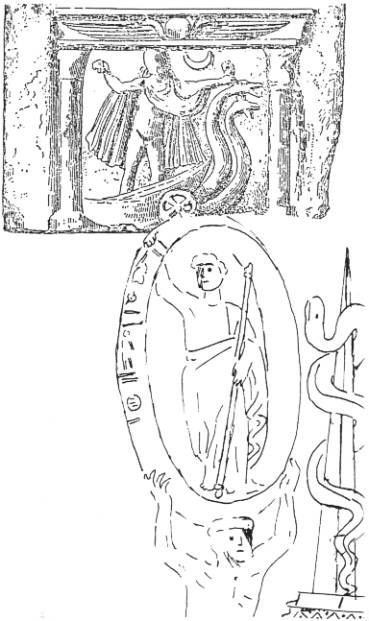
Another picture of Aion
(silver from Parabiago, D.Levi,"Aion", Hesperia 13,1944,p.287 fig.12f.) shows the snake coiling up an
obelisk as the symbol of the world pillar, but the staff in the hand of the god
is similar to the staff held by the god Aion above and probably another symbol
of the worldpillar.
Juppiter
Heliopolitanus/Baalbek is a Syrian sun god, but much more than that: he is the
personified world pillar also seen as the ladder to the mystical light, the
unity of all lights. Many heavenly stars and heavenly bodies (the sun with
golden hair, the crescent moon with the morning and evening star on its horns)
are here coming together to form a center covered with the pattern of the
mystical quadrangle.
His
servant Mercury is pictured so naked that his androgyny is very clearly seen.
The pictures are some of the small figures of lead found near the temple.
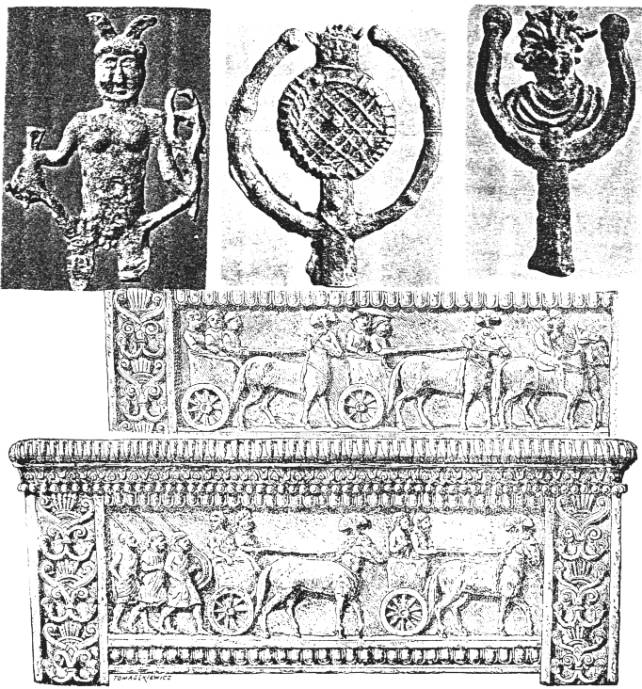
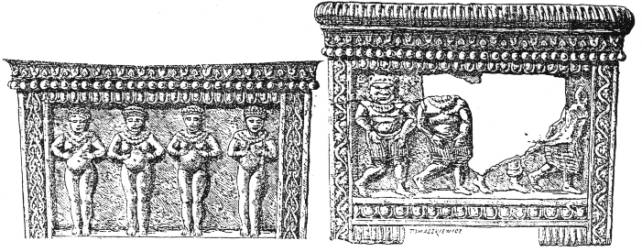
A
sarcophagus found in a sepulchral chamber at Amathus on Cyprus shows 4 chariots
guided by a pair of Dioscuric horse-men. They are the morning- and evening star
leading the travel in the sun’s course to the top of heaven or paradise. Notice
the piloi-caps the characteristic head-wear of the divine twins. Eternal life
is reached by joining the sun’s movement. Daily it dies/sinks in the sea in the
far West but is eternally reborn/renewed during its nightly journey.
But
the journey to heaven is closely connected to a union of male with female. At
one end of the coffin 4 stark naked
goddesses, at the other 4 men pictured as Bes, the male hunter, in Cyprus also
known as Pygmalion. The men put their hands on their loins a gesture close to
indecency and parallel to the women puffing up their breasts. The journey to
heaven is seen in the archaic way as the ecstatic union of the male and the
female god.