10. Jerusalem
J.Morgenstern[1]
has shown the important structure in Tyre with an old transcendent god
Saturn-Baalshamem and a young active god as theos
epiphanês, the young god being closely connected with the sun and the sunrise.
The old god is linked to the world mountain = the Saturn-pillar, the young god
is linked to the split mountain = the two Heracles pillars. Morgenstern thinks
that this structure has also influenced the cult on Mt Zion through the temple
of Solomon built with the help of Hiram of Tyre. With its system of gates the
temple was oriented towards the sunrise. At spring and autumn equinox the sun
would rise and send its light through the gates, between the two copper
pillars, Jakin and Boaz, into the Holy of Holies. It was seen as the coming of
the Lord to his temple after a night of darkness and chaos, the victory of the
Kabod, the Glory of the Lord.
But the kabod-ceremony was obviously
already celebrated in the Tent in Silo, where Eli’s daughter-in-law names her
son Ikabod = “Where is kabod?” in her despair at the removal of the Ark as
pointed out by T.N.D.Mettinger [2].
And the symbolism of the three pillars is also typical of the area of Midian
and Seir, where Moses has his first encounter with God. So when it is told that
the cult of Melqart in Tyre was reformed at the time of Solomon, it is obvious
that the borrowing is the other way around: from Jerusalem to Tyre and not from
Tyre to Jerusalem.
On the second evening of the feast
of Tabernacles the leading men of Israel would gather in the temple-court of
the women. They would dance with torches in their hands all night until
sunrise. Some of them were excellent jugglers and could keep five torches
flying through the air simultaneously. When dawn was approaching, two priest
with silver-trumpets were standing ready at the top of the staircase leading to
the inner courts, and with the first sight of the sun they would start blowing,
moving down the stairs through the dancing crowd, out through the eastern gate
to greet the coming of the glory of the Lord.
Now, it is obvious that the original
meaning of the Yom Kippur ritual was to clean the temple, and especially the
throne constituted by the two cherubs and the Ark of the Covenant as its
footstool. The many sins of Israel are seen as dirt clinging to the sanctuary,
and God has withdrawn to the transcendent world. But by the blood of the divine
bull, the cherubs and the footstool are cleansed and prepared for the presence
of the Lord coming on the second morning of the feast of Tabernacles.
“The blood poured out as forgiveness
of sins” touches upon the same symbolism: the celebration of the Eucharist in
the early church is a cultic cleansing followed by the epiphany of the Lord
witnessed by the maranatha-call (a
cultic cry with the meaning: ”come Lord”) and the hosianna-call (= “save”) from Jesus´s coming as Lord to Jerusalem and the temple on Palm Sunday. Bjørn
Sandvik [3]
has proved that the “Eucharist is a celebration in advance of the escatological
coming of the Judge” of the living and dead. In the ritual, Apost.Const.VII,26,
the Hosianna-call is followed by the words: ”God the Lord has become visible
among us”, cf. the prayer in the Acts of Thomas 50: “Come and partake with us
in this Eucharist celebrated in your name” [4].
God has withdrawn to the
transcendent world (Hos 5,15), he is hiding his countenance. Darkness rules the
earth. But in the Kabod-ceremony he is coming with the bright glory of the dawn
to make his solemn entrance into the temple through the primordial gate (Ps 24)
to rule as Lord of the universe from the throne on his holy Mt Zion at the
navel of cosmos. Then sounds the cultic call JHVH mlk “Jhvh is king”:
“The Lord has shown he is king, he
has set the universe into order (tikken
- with the Greek trans.,Symm,Hier,Syr. trans.,Targ.), it will not be moved,
with justice will he judge the nations…for
he comes, he comes to judge the earth with justice”, Ps 96,10.13. “For to
his temple in an instant comes the Lord you seek, and the angel of the covenant”,
Mal 3,1.”Listen, you shepherd of Israel…you that throne over the cherubs, break
forth (hofia´ means to “shine forth”
like the sun, and in the background is felt the idea of epiphany, acc. to
S.Mowinckel,[5]) in glory
before Ephraim, Benjamin and Manassa, wake up your hero-strength, come to
salvation for us”, Ps 80,2f.(Cf. with the Hosianna-call by the entrance of
Jesus into the temple through the Golden Gate, the eastern gate to the
temple-area close to Kedron and the Mount of Olives). All these calls, “break
forth”, “wake up”, “come” are calling for divine epiphany in the glory of the
rising sun.
To this tradition of epiphany must
also be counted the “fullness” Ez 43,5; “the filling up” of the locality with
the symbols of divine presence, the smoke of incense, glory, or roaring sound.
The presence of the Spirit Ez 43,5. The falling on one´s face, but being raised
up to standing before the throne of God 43,3+5 cf. 3,23f. Mettinger [6]
mentions as “aspects of a theophanic ritual”: incense, Shofar signals, the
proclamation of the Jhvh-name, the jubilation of the cult-community (teru´a).
Characteristic of the New Testament
Christology is, that this Old Testament theophanic tradition and divine
enthronement ritual is transferred to Jesus. The disciples beheld his Glory, he
comes to the temple from the east across the Mount of Olives, he identifies
with the shecinah =the divine
presence in the temple, Matt 23,37ff., Luke 13,34f. And therefore his death and
resurrection can be compared with the destruction and rebuilding of the temple,
Mark 14,58; 15,29. He has got the power to be judge over all living and dead,
Matt 25,31ff, a role up till then exclusively played by God [7].
He has risen high above all heavens to fill the All with his Glory (Eph 4,10
with a clear echo of Is 6,3).
Dan 7 with the description of the
“coming of one looking like a Son of Man with the clouds” is a description of
apotheosis, and must be compared with other descriptions of how the prophet
Ezekiel and other prophets are ascending to the heavenly sphere to the council
of God (Hebrew: sod, cf. the thrones
erected Dan. 7,9) Jer 23,18.22; Amos 3,7 as proved by H.Gese[8].
In this connection Ezekiel is spoken to as “Son of Man” by the heavenly
creatures. Compare this with the same way of addressing a prophet in Dan 8,17.
He is mere “man” stepping into the circle of angels.
“Three days” is the time it takes to
travel through the realm of death, the time Jesus has to stay in Sheol, but it
can also be used about his travel to
teleiosis, a journey during which he has to act as the sun hero clearing
the road of demons, Luke 13,32f and accompanied by the Dioscouric pair, the
“Sons of Thunder”(J.Rendel Harris, Boanerges,
1913), later together with Peter called the three “pillars”. In Ugarit 3 days
are the time it takes the rephaim to travel from the realm of death to the land
of the living. In Hos 6,1-3 there are two days of hard tribulations until the
third day: ”On the third day he will raise us up, so we can live before his
countenance”. In the background the journey of the sun warriors through
struggles and labours to erection before the throne of the highgod in paradise
(with its earthly reflection on Mt. Zion).
Now it is important to understand
that Matt 16,17-17,9 finds its explanation on the background of the Yom
Kippur-day (10th of Tishri) and the following feast of Tabernacles
(15-22nd of T.,“6 days later”, Matt 17,1). Motifs from this feast are
a) ´even shetiyyah, the “corner-stone”, the
stone in the centre of the world, standing firm against the attacks of chaos.
For its role during Yom Kippur, see Mishna
Yoma 5,2.
b) Peter gets the
power to forgive sins. Israel´s sins are forgiven at Yom Kippur.
c) Jesus is the
sacrifice making atonement, Matt 16,21,cf. Marc 8,31, where the word “rejected”
used about the cornerstone, Ps 118,22; Matt 21,42 is also used about Jesus.
d) Jesus shining as
the sun. The coming of the Glory of the Lord on the second morning of the feast
of Tabernacles/huts, cf. Peter’s wish to build huts.
e) The illuminated
cloud. The cloud of incense filling the sanctuary hiding God´s presence, Is
6,4.
f) As with the
theophanic scenes in the O.T. the disciples fall to the ground, but are raised
up.
g) God has eudokia (“well-pleasing”) in the Son.
Mostly this word is used about God choosing Zion as his abode.
The cleansing of the temple at Yom
Kippur is a total renewal. The temple is seen as ruined by the powers of chaos,
but is created anew from the ´even
shetiyya. This symbolism of the “corner stone” is also touched upon in Zech
3,9 and 4,7b-10: it bears the seven eyes of God, that is, it is an imago of the world mountain =the
heavenly vault with the seven wandering lights (the planets), and inscribed by
God with the destiny of the people: “On a single day (Yom Kippur) will he wipe
out the guilt of Israel”. It is, like Peter, the corner stone for a new temple,
and is laid down by Zerubbabel, who is painted in the colours of a sun hero:
standing face to face with the primordial massive rock, he will turn it into a
smooth road, 4,7a.
The cleansing of the temple is to
Jesus both a most concrete task, Matt 21,12ff and a total rebuilding, John
2,19.
His sacrifice is for the cleansing
of the spiritual temple he is going to build from human hearts. H.Sahlin[9]
has rightly stressed that Acts 2, with the “roaring” and the “filling” of the
house and the fiery phenomena, has to be understood on the background of the
theophanic tradition from the O.T.:
“the train of
his cloak filled the whole temple”, Is 6,1
“and the house was filled with
smoke”, Is 6,4
“The Glory of the Lord filled the
Tabernacle”, Exod 40,34f
“the cloud filled the house of the
Lord”, 1.Kings 8,10
“the cloud filled the inner courtyard… and the roaring of the wings of the cherubs was heard”, Ez 10,3-5.
When Paul speaks about the pleroma, “it pleased God to let the
whole fullness take up its abode” (the word used about God´s “pleasing” is, as
in Matt 17, eudokia) Col 1,19, this
has to be seen on the same background and not on the background of Stoic and
Gnostic thinking as J.Ernst (Pleroma und
Pleroma Christi,1970) thinks. The normal translation of the Hebrew Qedushah (=Trishagion):
“Holy,holy,holy…All the world is full of his glory” Is 6,3, is wrong. The
Hebrew text does not have adj. male´, but
nomen, melo´, “fullness”. This is the
explanation of the Greek word, pleroma, “all the world is fullness of his
glory”.
Acts 2 has the elements, theophany
and giving of the Spirit. Ez. 1-3 has the elements, theophany, giving of the
Spirit, and raising up in the presence of the Lord.
Modern studies have underlined the
great importance of the Council of God in O.T. (F.M.Cross, “The Council of
Yahweh in Second Isaiah”, JNES 12,1953,pp.274-8.
R.E.Brown, “The Pre-Christian Semitic Concept of Mystery”, CBQ 20,1958,pp.417-20. H.W.Robinson, “The Council of Yahweh”, JTS 45, 1944, pp.151-7). The prophets
had access to this higher sphere as a source of information, the false prophets
had not stood in Jahveh´s council (Jer 23,18.22). This council is the circle of
the sons of God.
In a temple niche in Hazor dating
from the late Bronze Age Y.Yadin found a slightly curved row of ten stelai, and
a sitting god with a drinking vessel in his hand and a moon sickle on his
breast. On one of the stelai was the relief of two hands stretched up towards
the primordial mystical light (the unity of sun, moon, and star). G.W.Ahlström
(“Heaven on Earth - At Hazor and
Arad”,[10])
has interpreted this as the earthly symbol of “the assembly of the gods”, a
well known phrase from the Ugarit texts (phr
(bn)ilm cf. the Accadian puhur ilânî).
They are the O.T. “the sons of God” and “the assembly (qahal) of the holy”, “the council of God”, “the sons of the Most
High”, “all those standing around Him”.
In the Qumran community there was
already in this life a “present participation in angelic life” [11]
on the high plains of the paradise: “And you shall be an angel of countenance
in the sanctuary”(I QSb 4,24-26), “an abode for the Glory (kabod) of his kingdom” (4 Q 510,1,3-4).
When the Glory arrives and takes up
its abode in the sanctuary the believer is raised up as an angel standing
before the face of God. But perhaps already the 70 elderly picked out by Moses
are seen as an earthly manifestation of the council of God, Num 11,24ff.:
a) Theophany - the
Lord comes, veiled in the cloud.
b) The elderly are
arranged standing in a circle around the tent. Note the word sebibot, cf the phrase kol sebibin “all those standing around
(God)”.
c) God lets the
Spirit fall upon them, and they all experience prophetic rapture.
The belief in eternal life is not a
borrowing from Iran, but a genuine Semitic development. The only place where
there is eternal life is in the presence of God, on his mountain, standing
before his countenance.
When one reads the Mandaean Canonical Prayerbook, it is seen at once
that the purpose of the baptism is to make the candidate standing firm in
eternity, “like a stone pillar in the storm” [12].
Adam-Juhana [13]“was signed
with a great seal and set up for ever and ever”. As in early Christianity
“sealing” is closely linked to this firmatio,
this setting up as firm and standing: “secure, seal and guard the soul of N.
and establish it”[14].
An important role is played by the shkinta,
the hut of green vegetation, where the saved one is set up and made firm in
eternity: “Between mountains twain … a shkinta did Yawar found, and chosen
righteous were established therein”[15].
The hut is built on the twin mountain of paradise, also called the mountains
full of sweet smell[16].
“Life” is the name of the highest god in some Mandaean texts, like sol invictus in the classical Syrian
religion, “Life” is hailed as victorious: “Life is renowned and victorious, and
victorious the man who went hence”[17].
“thou wast victorious, Manda-d-Hiia, and thou leadest all thy friends to
victory”[18]. The
victory is the same as in Rev 2-3, a victory over the earthly labours and
struggles of life: “Thou hast proven thyself by (thy sojourn on?) earth, and
thy destiny leapt upwards from its struggles” [19].
“In my Father’s Glory I stand” (qajjam
– also used as the Mandaean word for baptism). In baptism you are set up in the
presence of the god of Life as one of his sons.
The rite of raising up/making firm
is also known in gnosticism where it is referred to as (in Greek) stêrizô, and in early Christianity it
hides behind confirmatio. Epiphanius
is amused at the Manichaeans with the following words: ”Silly is also the
teaching of the Manichaeans, that the souls, that is to say, the manes (Latin for the spirits), all
sprung from a pillar of light, form a unity, and that they, when separated from
the body, are formed back to this single substance, this same pillar.” (Anchor. 48).
The background of this strange
belief is the world pillar and the old belief that the sun hero by following
the course of the sun, finally comes to Saturn, Kvn, the “Firmly Grounded”. The
Greek word kiôn = pillar must be a Semitic loanword.
In the Syrian language the word for baptism is derived from the word for pillar
and must be translated “to raise up and make firm” (´md)[20]. From the
Qumran texts: “on a place of standing, thou hast set me” (fragm. transl. by
Holm Nielsen, Hodayoth[21]).
The morning and evening prayers of the Essenes/Therapeutes are found in Philo
of Alexandria, de cont. vit. 27: in
the morning they would pray that the sunrise would “fill them” (cf. above what
we have said about the fullness of the Glory filling the earth, and God´s
presence filling the temple). In the evening they would pray that the soul “may
reach its own synedrium and council” (the council of sons of God surrounding
his throne). After the nightly ritual of Exodus they were “set up together with (systathéntes) the Father and Creator of all things”, ibd. 90.
10.a. The visions of Zechariah
The first vision is a vision closely linked to the
sunset in the deep abyss in the west and the fiery red, white, dark, and brown
clouds surrounding it. The “myrtle” (1,8) is the herb of life growing where the
sun enters the realm of death. The last vision is a vision of sunrise above the
twin peaks in the east: the copper mountains are the world mountain split into
two to allow the sun to rise, 6,1.
Most of the visions have the
Zion-ideology as their background: Mt Zion is the firm rock in the centre of
the universe. The four horns beaten with the axe are the attack of the nations
from the four corners of the world on the holy mountain of God, a motif quite
often met with in the Psalms, 2,1-4. The next vision 2,5-17 describes how the
people pour into Jerusalem to seek the protection and blessing of the holy
mountain. For that purpose the measurements of the holy city are greatly
increased until it is like open land. Then the Lord “will come and take up his
abode in their midst” 2,14. He has “again chosen Jerusalem” as his dwelling
place 2,15.
Important is the hierogamic formula:
”Be jubilant and rejoice, daughter of Zion, for look, I come” 2,14, cf. 9,9; Is
62,11; Zeph 3,14; Is 12,6 - obviously a formula from some lost ritual. Is 12,6
seems closely linked to the making of the beaten track of the sun. In Zech 4,7
this motif the beaten track/ the road made even/the passage for the sun returns
as the mighty mountain is made into a plain for Zerubbabel.
But to these visions of a
“Zion-mystery” of the coming of the Lord to his holy mountain is linked a priestly
initiation, which, in some aspects, is a forerunner of the early Christian
baptismal ritual. “The Lord shall threaten you, Satan” (3,2) cf. in the credo the renunciation of the devil.
Then the devestio, the taking off of
the old shabby clothes, followed by an investio
in clean clothes as a symbol of the guilt taken away (cf. the white
baptismal alba). The short
instruction mentioning “the paths of the Lord” could be compared with the
baptismal instruction about the “two roads”, Didakê 1,1. Finally the high priest is “one of those standing here” on the holy Mt. Zion,
3,7 - that is, the angels standing before God.
Now, the purpose of both Mandaean
and early Christian baptism is to make the candidate “a standing one”. An old
Jewish tradition says that at the anointing the kings were signed by a circle,
O, the priests with an X, cf the early Christian “sealing” with the cross. It
seems likely that baptism is a democratization of a priestly initiation. During
a visit in Uppsala prof. E.Segelberg kindly offered me his important article,
"Evangelium Veritatis - a confirmation homily and its relation to the Odes
of Solomon", [22].
The Gospel of Truth found among the
Nag Hammadi scriptures could very well be a translation of the gospel written
by the early gnostic, Valentine. Segelberg finds the following traces of early
ritual in the text:
Conversio
et exorcismus (33,19-21)
devestio et investio (20,30-37)
unctio et insufflatio (30,34)
confirmatio
(19,30) et erectio (30,19-23)
Gnosticism is a typically
spiritualistic sect: the forgiveness of sins has totally disappeared behind the
mystery of how to achieve divine nature: eternal standing. "It placed him
upon his feet, because he had not yet risen” (erectio). “For when they had been
confirmed (raised up) they learned to contemplate”, cf from the Odes of Solomon, the earliest Christian
hymn book (2nd cent.A.C.): “and (the Spirit) raised me on high: and made me to
stand on my feet in the high place of the Lord. Before his perfection and his
glory”(36,1f., transl. by Segelberg).
10.b. Conclusions
Early in this book we came across an Ugarit
text describing a nocturnal ritual with 7 sacrifices and a bird. We have seen
that the journey to the transcendent world is a journey in seven stages, and we
have seen the semeion-pole with seven
discs and at the top the bird of ecstasy. Now this journey to the mountain of
El can also be seen as a journey in the course of the sun. In a nightly officium the believer is seen as
travelling with the sun through darkness and death to the standing on the
mountain of God. This is the background of the through-death-to-life motifs in
the Psalms.
In Syrian and Babylonian cosmology
Saturn is seen as the sun of the night. Saturn, the world pillar, is the end of
the sun´s journey. (The reason for this must be speculations about the most
active and the most static of
the wandering lights of heaven.) The end of the journey is “standing firmly
grounded” on the eternal rock as the obelisk, the miniature of the world
pillar.
In the Christian use of the
standing-symbolism it is not so much the picture of standing stones, but angels
standing before God we have to call to mind.
In Ps 121 the
pilgrimage up to Jerusalem is described as a climbing of high mountains. The
right interpretation of the psalm is put forward by P.H.Pollock[23]:
the dangers of mountain climbing are that the foot can stumble or slip, that
one is exposed to the burning of the sun on the rocks (and the pale shine of
the moon making people into lunatics). The psalm is asking God for help in the
mountain climbing. It is no mere coincidence that this psalm stands as the
introduction to the psalms of pilgrimage. The pilgrimage is an ascension to the
top of God’s holy mountain, and the goal is linked to eternity by the last
verse: eternal life is linked to the singer´s going in and out of the gates and
forecourts. The journey to Jerusalem is a spiritual journey to paradise, and
God´s caring for the pilgrim in his ascent grows to eternal preservation on all
roads in life and death.
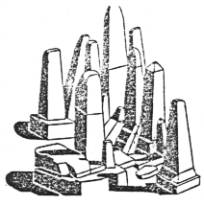 The most typical feature of the
temple of Resheph in Byblos was the many upright stones in the temple yard. We know
from Philo that Resheph was identified with the planet Saturn/Cronos, in West
Semitic called Kvn = “firmly established”, “standing firmly”, probably an old
name for the world pillar, for in Greek we find the name kion for a column.
The most typical feature of the
temple of Resheph in Byblos was the many upright stones in the temple yard. We know
from Philo that Resheph was identified with the planet Saturn/Cronos, in West
Semitic called Kvn = “firmly established”, “standing firmly”, probably an old
name for the world pillar, for in Greek we find the name kion for a column.
That Resheph is the world pillar
separating heaven and earth is also seen from the fact that a renewed victory
over Uranos is won after El Cronos has ruled for 32 years. The Sed-festival in
Egypt was celebrated by Pharaoh after 32 years' reign by putting up the Djed-pillar = the world column. And
Resheph-El Cronos was often pictured with the two Hercules-pillars in his hands
or with the sickle-sword, the weapon that separates heaven and earth, the
weapon also used by Zeus-Sandan when he attacked Typhon, the monster which is
the symbol of primordial totality.
G.Widengren has compared the
earliest Christian baptismal ritual and the Mandaean baptismal ritual, both
ending with the uprising of the baptismal candidate to eternal standing before
the countenance of God, with a a)Sumerian ritual ending with the erection of a
statue of the initiated among the gods of the temple and with b) the
description of Apuleius of Lucius standing on a platform and hailed as and
dressed like the sun after his nocturnal journey in the path of the sun[24].
The background of all these ideas is
a very old myth about the journey in the sun´s path to eternity at the top of
the unshakable world-mountain at the top of the vault of heaven. El Cronos with
his double pair of wings is the one leading the gods (planets) in this flight
(acc. to Philo), cf. the description in Plato´s Phaidros. But also Baal is
carried by the sun to the “grave of the gods” inside the cosmic Saphon
mountain, where he finally erects his throne, also the “gods”, ílnim, are mentioned at the end of the
Baal-epos as gathered round the sun. They are the deceased following the sun in
its path.
10.c. Jakin & Boaz
The stele is a model of the cosmic mountain. On
the North African Saturn-stele, Saturn is seen resting at the top; the “second
floor” are the two Hercules columns and the “first floor”/ the base shows the
sacrificial bull, the symbol of primordial totality.
We have tried to trace the Near
Eastern folk religion. Folk religion is not so much a religion in opposition to
the official religion as a certain structure of thinking, determining the plot
in both myth and fairy tale, making the highgod split up in a young and an old
god and his opponents taking the head or the hide of a lion on their shoulders;
and again and again folk religion paints the picture of the mystical, immovable
mountain of god and the journey to it.
Saturn/Baalshamem and
Melqart in Tyre are the sungod split up in his static and active aspect.
Actually, the same can be seen in the God of Jerusalem. His numen as mountain
is split up in Jakin and Boaz, the two pillars forming the gate of the sun,
where Ja-kin is the kvn-aspect, and
Bo-´az must be seen in connection with the sun hero, the morning star, in the
Nabataean-North Arabian area called ´Azizu = “the strong one”.
In Ugarit we meet
them as the two mountains at the edge of the world, Targhuzaz and Sharrumag,
acc to de Moor[25] after the two Anatolian gods, Tarkun(zai) and Sharruma, in our opinion the
sun hero and the demon god.
Already in Anatolia
there is a tendency to see the two pillars as contrasting symbols of the high
god and the sun hero, as seen by A.B.Cook (Zeus,
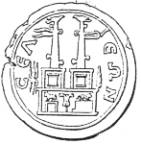
II, p.492, fig.381). From Salonina in Lycia, from the time of emperor Caracalla
there are coins showing two wooden pillars, one dedicated to Zeus (bull and
thunder weapon), the other to Heracles (with club and lion). Mostly the pillar
of Heracles is bigger than that of Zeus:
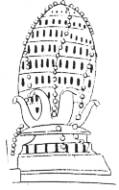
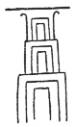
On the top of the
pillars at the temple were metal works in the form of a lily (1.Kings 7,21).
The world pillar ending in a mystical flower is typical of the cult in
Baalbeck, as we have seen. The seven chains hanging from the capitals, 1. Kings
7,17 are also well known decorations, as can be seen from a picture of the omphalos-stone of Apollo (Cook II, p.
171, fig.117. Amphora from Ruvo. Baumeister, Denkmähler II,
1009f., fig.1215).
Morgenstern has stood
alone with his interpretation of the meaning of the cult of pillars in Tyre.
But the reason could be that scholars have not yet discovered what immense
diffusion the symbolism of the two pillars has as the symbol of duality, the
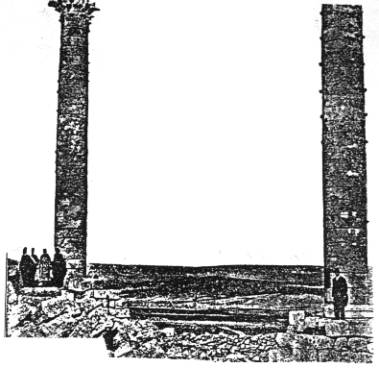
gate of the sun. Also at the great temple in Mabbug were two enormous pillars,
acc to tradition set up by Dionysos when travelling to the land of the
Ethiopians (Lucian, de dea) and in
Edessa. (See below the two enormous free-standing columns.). In Antioch,
Tiberius put up two great stelai for Zethos and Amphion (John Malala X, p.160).
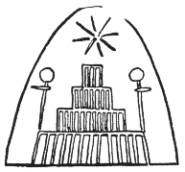
On Mesopotamian seals they can be placed on one of the platforms of the
ziggurat with the mystical 8-petalled flower or star at the top.[26].
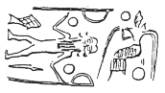
Or Gilgamesh is seen erecting the gate in the primordial sea with the highgod
Ea as the spender of the moisture of life in the background[27].
The symbol of the
Germanic Dioscuri were two rods: they were called Raos and Raptos =“reed” &
“raft”[28].
Naturally these motifs are also found among the Mandaeans: “Adatan and Jadatan
sitting by the gate of Life.” The Paronomasia marks them out as the primordial
twins. The world pillar = the pillar of fire: the light-ether (Ayar-Rba) is
called “Rod of upstanding…by which the whole edifice is held together” (Drower,
Canonical Prayerbook, p.175). The
new-born sun hero is called ´Usfar, “the little child who dwelleth upon pure
springs of light”, “Any demon... will be thrashed by ´Usfar... beaten with the
mace of water by which fire was beaten out and extinguished; and by the
strength of Mân, the healer” (pp.11f.). ´Usfar is a “cutting instrument”
crushing the demons, acc. to Drower. Note the water-against-fire symbolism.
These rather late
examples are to my mind, the best proof of how widespread these motifs were in
the thinking of the Middle East and how profoundly they influenced the very
structure of religious thinking.
The many Saturn-stelai from North Africa show the symbols
of Phoenician religion. On many of them the deceased is seen standing in a
gate, the gate of the sun. Now the big and rather exciting question is: With
the orientation of the temple of Jerusalem, with Jakin and Boaz forming the
gate of the sun, is there also a symbolism of apotheosis tied to the gate of
the sun on Zion?
There is actually such a gate, the Nicanor-gate (Nicanor = “the victorious”) made of
highly polished Corinthian bronze, the Eastern gate to the temple area much bigger
than the many other gates.
Nicanor is perhaps a historical person. An ossuar is
found on Mt Scopus carrying an inscription: “The bones of Nicanor from
Alexandria, who made the doors” (See the note in Der Toseftatraktat Jom hak-Kippurim, ed. Göran Larsson, 1980,
p.156n63.) The Nicanor-gate was the great gate on top of the 15 semicircular
steps leading from the court of the women to the court of the men and the
priests. Acc. to tradition the Psalms 120-134 were sung on the 15 steps. They
speak about an ascension beginning far from Jerusalem in tribulations: the
singer is a stranger among unfriendly people. But he lifts his eyes to the holy
mountains of God and finally he is among the priests in the tempel receiving
eternal blessing. One may assume that the eating from the showbreads in the
presence of God is a kind of apotheosis. And this was the privilege of the
priest. Cf. the Eastern gate of the temple, Ez 44,3 where only the king of
Israel may sit and eat in the presence of the Lord.
Julian Morgenstern (“The Gates of Righteousness”, HUCA 6,1929,pp.1ff.) thinks that it is
possible to follow an ancient gate-ritual back to the “Gate of Justice”, Ps
118, and the “Gate of Eternity”, Ps 24,3ff.
During the rule of the crusaders the “Golden Gate” was
opened twice a year on Palm Sunday and Exaltatio Crucis (the 14th of September)
to give room to a procession into the old temple-area. Acc. to Morgenstern this
is the last trace of an old ritual, a procession around spring and autumn
equinox. Not only the procession, but also the Glory (Hebrew: kabod) of the Lord comes through the
gate at sunrise to be enthroned on the throne of cherubim in the dark back-room
of the Hecal (“Throne-room”) to reign as king of the universe. In late Jewish
tradition the “Presence” (Shecinah) of the Lord went into exile through this
gate. Acc. to Josephus, de bello jud. VI,5,3, shortly before the
Jewish war broke out on the 8th of Xantikos (Nisan) this gate opened itself at midnight
although it normally took 20 men to open it, and it was kept closed with bolts
of iron.
Of special importance is the research of M.Ravndal Hauge
("Some Aspects of the Motif: the
City facing Death” of Ps 68,21, SJOT,
1988, pp.1-29). On several occasions in the Old Testament an “I” goes from
death to life, from the valleys at the bottom of Mt.Zion to the city walls in a
procession, Ps 118, and this motif is felt through the story in Is 26,1-27,1
& the sickness of king Ezekiya Is 38/2.Kings 20. The king’s sickness leads
him to the gate of the realm of death (38,10), but he gets a promise of
healing, and “on the third day he will ascend to the temple of Yhvh”. Both
versions stress this ascension as “the relevant ending of a story, starting in
the deathbed” (Hauge, p.27). The king is pictured as the “just one” going in
through the gates (Ps 118,20) belonging to Jhvh, cf. Is 26,2: “Open the gates,
that the just nation can enter, the nation who keeps itself faithful”. “Trust
in Yhvh in eternity, for by Jah-Yhvh is a rock of eternity”. He prepares an
even road for the just (v.7). (The sun's road made even for the sun hero to run
his course) The opposite of the temple rock is “the low places with carcasses
and ashes of fat” Jer 31,40,cf. Ps 68,14 “heaps of ashes”. In Is 29,4 the city
of Jerusalem is calling to God from the ashes, and it is saved. Some scholars
think that the child sacrifice to Molok was an early JHVH-cult, but
J.A.Montgomery[29] has shown
that Zion is the Paradise mountain, and the valley of Hinnom, where the child
sacrifice took place, is Sheol (the home of the dead spirits, cf. the
Refaim-valley, Jos 15,8.). Acc to the old Near Eastern world view, the Paradise
mountain has at its foot the entrance to the underworld. The top of Mt. Zion is
the place of life, survival and the place of God, the valley of the
"spirits" is the place of ashes, dung heaps, Satan and death.
The final goal of the procession of the festivals of
Sukkoth was the high towering pyramid of the holocaust altar. Today the Omar mosque
is built over the socalled Eben Shetiyya, “the foundation- stone of the earth”.
It is today the only part of the mountain seen above the esplanade built as the
big platform for Herod's temple. What part of the old temple complex did this
stone support? It is obviously not the Holy of holies. It must have been
situated farther west close to the western edge of the esplanade. Of course it
must have been some important part of the temple: the holocaust altar. At the
old top of Mt Moria Abraham presented the “tied
up” Isaac (in Hebrew called the ´akedah).
Every sacrifice on this holy spot would call this act to God's remembrance.
The brazen altar was a stepped pyramid, the front of
which measured 16 yards for the lower step, 14 for middle step, and 12 for the
upper, the whole structure resting on a platform called heq ha ´ars (“bosom of the earth”). Today the only
remnant is the naked rock seen in the Omar mosque. It is possible to descend
into a cave just under the ´eben shetijja. The man descending into the rock
itself becomes one with the ´eben shetijja, “the corner stone” of cosmos, Ps
118,22.
Every day during the Sukkot-festival the people would
circle round the altar saying: “Oh Jhvh Help!” Acc. to rabbi Jehudah they
called out: “Ani wehu, Help!”(Mishna Sukka IV,5). Ani wehu had the
same arithmetical value as Oh Jhvh, and it had the meaning: “I and He”, and was
a formula expressing an intimate relationship between God and his people.
G.Klein[30],
thinks that it is a mystical formula, and he compares it with the bridal
mysticism of the Gnostic Marcos, who would say to the women he initiated:
“Prepare to receive me as the bride receives the groom, that you may be me, and
I you”. In the Gospel of Eve referred to by Epiphanios a man tells about a
vision: he saw a small and a tall man (micro- & macro-anthropos) saying: “I
am you, and you are I, I you, you I and everywhere I am sown, and when you
collect me, you collect yourself”. In Pistis
Sophia Jesus says: “I am them and they are me” (C.Schmidt's transl.1905, p.148).
The Jewish formula Ani weHu is the
Jewish parallel to the Hindu: Tat twam
asi. O.Weinrich has treated this Hindu “formula of identity” and its
parallels[31]. The Jewish
formula has its origin in the hierogamic atmosphere of the Sukkot-festival, cf.
Cant 6,3: “I am my friend's, and my friend is mine”. This “mystical formula of
identity” is already used by Simon Magus in Apophasis Megale: “I and you one”
(ap. Hippolytos). The characteristic unity of motifs a) the formula of identity
(“I in you and you in me”), b) divine love, c) revelation of the divine name
and d) God taking up his abode in the believer found in John 14,20-23 &
17,21-26 is Jewish Shekinah-symbolism with its origin in the theophanic
tradition linked with the Sukkoth-festival. The temple itself is the Sukkah
(originally the bridal hut) of God built on the Paradise mountain. To this hut
God comes in the sunrise on the second morning of the Sukkoth-festival to take
up his abode on Zion. On the second evening people would gather to dance in the
women's temple court.
When the tourist comes to
Jerusalem, he is shown the empty tomb of Jesus, the room for the Last Supper,
the church built over the site of the house of the High Priest, Caiphas, where
Peter wept at the crowing of the cock, but it is impossible to estimate the
historical validity of these traditions. They are a universe created by faith
and religion. A help for the fragile human mind in its effort to go back and visualize and feel; a door
opening up to something great, divine and incomprehensible, turning Mt. Zion
into a sacred mountain.
Urim and
Tummim are the two “tablets of destiny”. As the Mesopotamian god Marduc carries
the "tablets of destiny" on his chest, so are these two items
determining destiny worn as part of the official garment of the high priest[32].
Uri is the call at dawn, Tummim means "those who have perfection" at
the end of the sun´s journey, “those who have completed” their journey. U.
& T. are the symbols of polarity, of East and West, of dawn and sunset, a
new version of two stelai inscribed with the world's destiny.