12. The old god and the young hero
El in Ugarit has his dwelling somewhere in the outskirts
of the universe on Mt. Lel, only reached after a long journey. But this resting
place can in a strange way be present in the stele, the Betel-stone. The
Betel-stone raised by Jacob is explicitly named as the “house of El = God”[1].
It pictures the Highgod as the eternal rock of whom the sun hero is born
(Example: Mithras de petra natus =
born of the stone) to start his running along the path he clears for the sun.
The sun warrior is called the “calf” and when Ieroboam puts up a golden calf
next to the Betel-stone, it is the young god emanated from the old. Everywhere
in the West Semitic area we find the highgod split up into two: the old Father
of Eternity and the young Sun Hero.
|
Tyre: |
Baalsjamem |
Melqart |
|
Sidon: |
Chronos |
|
|
Ugarit: |
The “bull” El, “Father of Years” |
Baal, the “bull-calf (´gl) |
|
Is 9,6: |
“Father of Eternity” (´ad) |
“El gibbor
= “hero” |
|
Dan 7,9: |
“The Ancient of Days w. white, woolly hair” |
“The Son of Man” |
|
Egypt: |
Djed-Osiris |
Horus |
|
Pherecydes: |
Chronos = “Time” |
Zas |
|
Betel: |
Betel |
a golden calf shining in the sun |
|
Gaza: |
Aldémios or Aldos acc to Movers halad = “time” |
Marna = Zeus Cretagenes |
|
Beiruth: |
Aion & Beroe (Nonnos 41,83ff.) |
|
|
Tarsus: |
Baal Tars as Zeus Olympios |
Sandan as Heracles |
The sun hero is he who prepares a
road through chaos and wilderness. (In India Varuna creates a “broad path” for
the sun.) He leads on the road to paradise, cf that the calf is hailed by the
call: “The God who led us out of Egypt”[2].
The calf is cast by Aaron as an answer to the people demanding a god “who can
walk in front of us” (Exod 32,1). The dance is probably circling around in the
circle of the sun and the episode finishes with the promise that God will send
his angel “to walk in front … to the land which flows with milk and honey”,
33,2f., chasing hostile nations off the route. Finally God himself promises to
“lead you to the final goal”, by walking before them, 33,19.14. All this about
the road and the walk cannot be explained by the short way from the eastern
delta to Southern Palestine. It is the symbolism of the sun warrior as the
breaker of way through the wilderness creating the episode, cf the talk about
the kabod, the glory of God, 33,18.22.
The killing of the divine bull
releases the waters of life – but here with great irony: The dust from the
crushed calf is mixed into the drinking water.
In Gen 28 Jacob is the sun hero,
note the symbolism of the road in v.15 & 20.
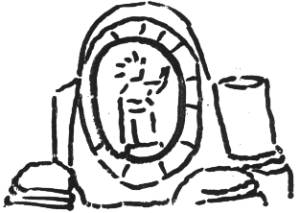 Under the emperor Elagabal the
Syrian sol invictus religion becomes
the state religion of the Roman empire. The cult image was a black meteor stone
with magic signs inscribed on the surface. Elagabal must be translated “El of
the Stone”. The black betel-stone is the divine numen in its static state, the
old god. The young god again and again born out of the stone/the paradise
mountain is the emperor also called Heliogabal. The picture shows a
betel-shaped idol standing between columns in a small temple (SYRIA XL, 1963, pl.1). Helios surrounded
by the zodiac is coming out of the rock. From Beroia (Aleppo) comes a coin that
shows a bearded giant standing on 3 horned and winged lions and with the
inscription Beroi-Aion (= “eternity”). He receives a laurel wreath from Nike,
the goddess of victory. On the reverse a picture of the emperor Trajan with
laurel wreath on his head.[3]
Under the emperor Elagabal the
Syrian sol invictus religion becomes
the state religion of the Roman empire. The cult image was a black meteor stone
with magic signs inscribed on the surface. Elagabal must be translated “El of
the Stone”. The black betel-stone is the divine numen in its static state, the
old god. The young god again and again born out of the stone/the paradise
mountain is the emperor also called Heliogabal. The picture shows a
betel-shaped idol standing between columns in a small temple (SYRIA XL, 1963, pl.1). Helios surrounded
by the zodiac is coming out of the rock. From Beroia (Aleppo) comes a coin that
shows a bearded giant standing on 3 horned and winged lions and with the
inscription Beroi-Aion (= “eternity”). He receives a laurel wreath from Nike,
the goddess of victory. On the reverse a picture of the emperor Trajan with
laurel wreath on his head.[3]