13. The god as old as time
El in Ugarit is called ´ab snm “Father of Years”. The most common epithet is tr “bull”. R.Dusseaud has called our attention to the important
fact that Baal never enjoys that epithet but is called “the bullcalf”[1].
Widengren[2]
has proved that “The bull El” is found also in the Mandaean texts as
Taurel-Uthra “The man who dwells by the hidden place of the water” – an obvious
parallel to El´s epithet in the Ugarit texts “He who dwells by the double
fountainhead of the waters”. But Taurel-Uthra is also, as proved by Widengren,
represented as an Aion-god:
“It (the head) for the 366 skinas is
called Anan-Nsab, but also Taurel-Uthra” (Lidzbarski, Ginza, p.144,26f.).
We would like to support the
argument of Widengren with another quotation from Mandaean scripture: the
Mandaean macr´anthropos Adam-Shaq-Ziwa is baptised with 360 baptisms and seals
himself with 360 names, is baptised extra 7 times by which operations his body
took form sending out light for thousands of thousand of years being alone in
the universe, before the cosmogonic processes began. This macrocosmic Adam is
primeval reality containing both time, year- and week-cycle[3].
Acc. to J.A.Montgomery[4]
the Hellenistic god Aión has a Semitic origin cf. Gen 21,33: ”El Olam”=
“God of Eternity”. A certain Mochos writes that acc. to Phoenician cosmogony
the first principles were “ether” and “air” (Damascius, de primis princ. 125 ter. Ruelle), and out of it Ulomos
(“eternity”) was born. Augustin tells us that the inhabitants of Cartage called
Saturn “the old one” (senex) and were
afraid to pronounce the name of the planet (de
cons. ev. 1,16). Before Muhammad the Arabs honoured a statue of the god
Hobal put up in the Kaba. He was pictured as an old man, and 360 idols were put
up around him and in his hand he held 7 arrows, symbols of the days of the week
(Pococke, Specimen hist. Arab.,
pp.97ff., ed. White). Perhaps he was identical with Aud “eternity” (ibd. 102,
137ff.), cf. Is 9,6: Abi-´ad =
“Father of Eternity”. Movers mentions an oath from an old Arab poet: “I swore
by the blood smeared Aud and by the pillars of Seir”[5].
The West Semitic
highgod was “endless time”, and this god was also acc to Movers called Belithan
of ´ithan (= “constant,
everlasting”). Strabo mentions the memorial of Belithan in Babylon (XVI 1,) and
the Punic promontory Ammon-Baal-Ithon (XVII,3). Xerxes destroyed the
memorial,by Aelian called the memorial of “the old Bel”(var. hist.XIII 3). Movers has also drawn attention to the Chaldaean
Oracles calling Chronos aiônion and
both “young and elderly”(Proclos. Plat.in
Tim. III 40,21).
The epithet of El in
Ugarit “Father of years” is by Widengren compared with the Mandaean resh alma (Lidzbarski, Ginza 371,25 & 375,5,) which can be
translated “Head of the World” as well as “Head of endless time”.
P.Friedländer [6]
has tried to reconstruct the following picture of a painting in Gaza on the
basis of the descriptive poem of John of Gaza: We find the Dioscuric pair
Hesperos and Phosphoros and the mystical bird Phoenix (Johs. 208ff.): “the
swift bird of the sun, whom eternity gives everlasting youth”. This triangle:
The divine brothers, morning and evening star as opposites and the giant bird
as the symbol of mystical union is a very common Syrian religious symbol, and
we will return to it later.
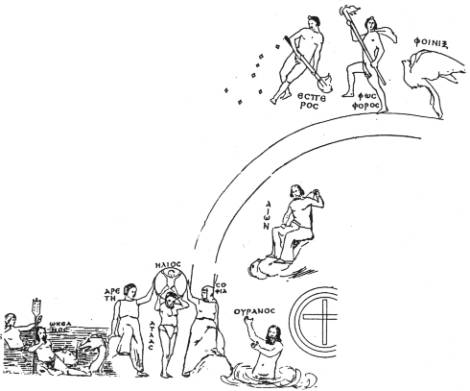 Under it we find Aión sitting on a
mountain “Olympos” and called “sower of… years” (137). He is the highgod
sitting on the world mountain, but looking down on the birth of the young sun
hero “Helios”. The child is by Uranos (“Heaven”) handed over to the two women
Arete and Sophia (“virtue and wisdom”) who put the child on the back of Atlas.
The world-column Atlas surrounded by the minor “supporters” Arete and Sophia is certainly a new
variation of the world-pillar flanked by the two Heracles-pillars, symbols of
cosmic law and order. They are the world-pillars separating the sea of Uranos
from the sea of Oceanos.
Under it we find Aión sitting on a
mountain “Olympos” and called “sower of… years” (137). He is the highgod
sitting on the world mountain, but looking down on the birth of the young sun
hero “Helios”. The child is by Uranos (“Heaven”) handed over to the two women
Arete and Sophia (“virtue and wisdom”) who put the child on the back of Atlas.
The world-column Atlas surrounded by the minor “supporters” Arete and Sophia is certainly a new
variation of the world-pillar flanked by the two Heracles-pillars, symbols of
cosmic law and order. They are the world-pillars separating the sea of Uranos
from the sea of Oceanos.
Acc. to a certain
Hieronimus (quoted by Damascius, de
primis princ. 123bis), at the beginning the first existence was water and
slime, then earth, and born from these elements the Dragon with a head as a bull and a lion and in he middle on the
body a face as a god and with wings on its shoulders. Together with him and
with him constituting a androgynous primeval principle was also a female
goddess, Ananke-Adrasteia - in unphysical embrace of the male god. Now the
dragon called itself “Chronos, never growing old” and “Heracles”. A.Ed.Chaignet
[7]
thinks that this Hieronimus was the one mentioned in Josephus antiq. jud.1, 3, 6, 9 -an Egyptian who
was the author of a Phoenician History.
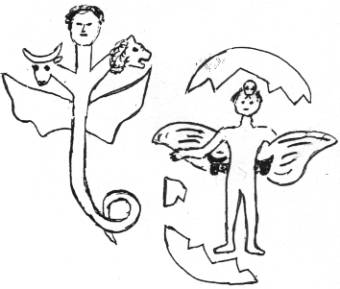 The idea of 4 main species united to
a primeval creature is also found in the biblical idea of the cherubim. But in
the Phoenician idea, the three heads are united to a snake's body together with
the wings of the bird. The snake shaped body shows that this primeval creature
is seen as pure kundalini-energy. This primeval god produces an egg containing
male and female elements plus a multitude of different seeds plus the god shown
to the right with bull's heads attached to his flanks and on his head a snake
monster similar “to all kind of wild animals”. The god with “the golden wings”
emerging from the cosmic egg is the sunrise as “the wings of the glow of dawn”,
the sun-warrior as the pillar separating heaven and earth originally being
united in the cosmic egg separating the two halves so that light can expand,
and like the world-pillar in Baalbek he is guarded by the two bulls with the
snake twisting along his body. We have here the two gods of Tyre: The mystical
god of eternity and time Chronos, and the young god, Heracles-Melqart. The
complex monsters are more Semitic than Hellenic[8].
The idea of 4 main species united to
a primeval creature is also found in the biblical idea of the cherubim. But in
the Phoenician idea, the three heads are united to a snake's body together with
the wings of the bird. The snake shaped body shows that this primeval creature
is seen as pure kundalini-energy. This primeval god produces an egg containing
male and female elements plus a multitude of different seeds plus the god shown
to the right with bull's heads attached to his flanks and on his head a snake
monster similar “to all kind of wild animals”. The god with “the golden wings”
emerging from the cosmic egg is the sunrise as “the wings of the glow of dawn”,
the sun-warrior as the pillar separating heaven and earth originally being
united in the cosmic egg separating the two halves so that light can expand,
and like the world-pillar in Baalbek he is guarded by the two bulls with the
snake twisting along his body. We have here the two gods of Tyre: The mystical
god of eternity and time Chronos, and the young god, Heracles-Melqart. The
complex monsters are more Semitic than Hellenic[8].
A.Alföldi [9]
has dealt with the development from the oriental idea of Aion to the Roman cult
of the divine emperor. On many North African coins from the Roman period we
find a picture of the young sun god and on the reverse an old bearded god of
the Baal-type. The young god is often seen with three halos around his head.
This tripartite halo is by Alföldi seen
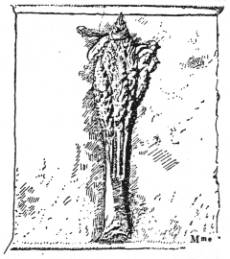
in connection with the three stages of the sun in the Malak-bel altar in the
Museum of Capitol. It shows first the rising sun as a shepherd carrying a lamb
on his back born out of a pine decorated with a streamer: the sun-hero is born
among shepherds. He is the son of the highgod, the god of the woods and the
vegetation, du Mesnil du Buisson, Tess.,
p.116, fig.70:
 Second the sun is mounting his
chariot as the sun of the clear day. Third the sun as the sinking evening sun =
Saturn. The obverse of the coins shows the sun in his tripartite nature, the
reverse the sun of the night, Baal-Saturn. When both are armed with the trident
of Neptun it must mean that the young and the old god is one, and A. quotes
Servius Aen. I,729: Belus, the first
king of Assyria was both Saturn and Sun, and he quotes Martianus Capella 1,70
who describes the coming of Saturnus Frugiferus Aion to the assembly of the
gods: He carries in his right hand the Ouroberos-snake and the fact that the
god in spite of his age can be seen as a little boy shows that it is Saturn-Sun
our North African writer describes.
Second the sun is mounting his
chariot as the sun of the clear day. Third the sun as the sinking evening sun =
Saturn. The obverse of the coins shows the sun in his tripartite nature, the
reverse the sun of the night, Baal-Saturn. When both are armed with the trident
of Neptun it must mean that the young and the old god is one, and A. quotes
Servius Aen. I,729: Belus, the first
king of Assyria was both Saturn and Sun, and he quotes Martianus Capella 1,70
who describes the coming of Saturnus Frugiferus Aion to the assembly of the
gods: He carries in his right hand the Ouroberos-snake and the fact that the
god in spite of his age can be seen as a little boy shows that it is Saturn-Sun
our North African writer describes.
The fact that the God
of eternity can be reborn as a young man is also by Alföldi found as the
background for Dan.7, where the “Old of days” with white hair leaves the
kingdom to someone younger: The Son of Man. This must be compared with Rev
1,18: the vision of the same god with hair as white as snow and with the
sevenfold light in his hand presenting himself with the word: “I am the first
and the last and he who lives, and I was dead, but lo I live in eternity of
eternities”. Alföldi does not mention the Mithraeic Aion with keys in his hand
and Nonnos´s description of how the old white-haired god Aion with “the keys of
birth” is relieved by the young god Dionysos. Alföldi has also drawn attention
to the “old one” with the boy puer
exoriens, a pair often mentioned in the liturgical texts of the old church
from the late Roman empire. Acc. to Kantorowicz[10]
the Orthodox church makes use of this symbolism in the feast for the old
Simeon´s encounter with the divine child. Simeon sees the child Jesus as the
“Old of days” and K. points to the Aion-cult in Egypt as a possible background.
It is certainly true that Alexandria and
the cult of Aion there is the background for the saeculum -ideology used by the Roman emperors. But the similar
Christian ideas must be rooted in old Syrio-Palaestinian folk-religion.
It is well known that
the Nabataean celebration of the birth of Dusares has a parallel in Alexandria,
where the birth of Aión was celebrated in the same night (between the 5th &
6th of January). F.Cumont[11]
thinks that the birth of Dusares must be understood similar to the birth of
Aion and mentions a text presented to the scientific world by R.Eisler [12]:
An Arab author from the 10th cent. A.C. (Pseudo Ibn Wahshijja) mentions as a
feast of the Nabataeans a celebration of the “Birth of Time” (Milad az-Zaman). The possibility of some
influence from Sabaean-Hermetic gnosticism on this late author can not be
excluded [13]. But the
graves in Medain Saleh call mostly upon Dusares to punish future
grave-molesters, and one of the inscriptions talks about MR ´LM: “Lord of Aión”, so we have good reason to assume that
Dusares is a god of the Aión type. Dusares is an epithet (“He from Shara”). His
real name is acc. to du Mesnil du Buisson [14]
A´ara. He is probably the god called Theos Ares by Suidas:”The god Ares in
Petra in Arabia”. In Imtan a stele was consecrated to “Dusara A´ara… dwelling
in Bosra”[15]. J.Pirenne[16]
underlines that Dusares is a variant of the old Semitic Highgod El=al-´Ilah
whose name means simply “The God” and has the Bet-el as his “sign/relic/house”.
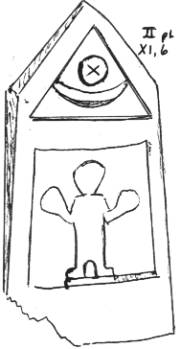
Dusares is the “Lord of Time” and this is acc to Pirenne affirmed by a small
calendar also found among the graves at Medain Saleh and having some similarity
with a small relief of the god from the same location[17].
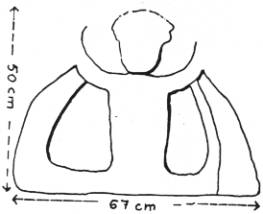
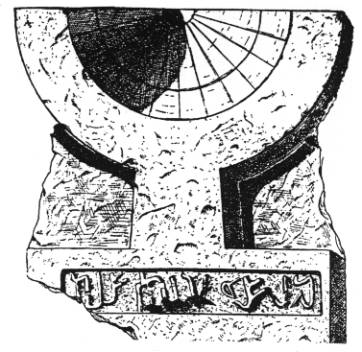
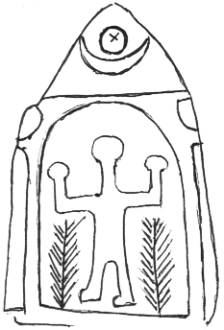
This and similar
figures are acc. to Pirenne the god made into a symbol of the sun, the moon and
the morning star united in the top of the world pillar. In Islam simplified
into the symbol: the star in the crescent moon. Pirenne does not mention the
symbolism of the world mountain: the world pillar and the two Heracles-pillars
here almost melting together in the breast of the god.
“Helios and Selene”
was acc. to Horapollo (Hierogl.1,1)
the sign for “Aion”[18].
From Palmyra come several coins where Baalshamin is shown as opposite to
another god, Malakbel, and always Baalshamin is shown with a lot of hair and
beard in contrast to the other god shown as a beardless youth (from du Mesnil du
Buisson, Tess., fig. 320.318 are
taken the examples below). Some even show Baalshamin as world pillar with
kalathos and a thick wreath of locks. Also the North African Baal-Saturn has an
abundant amount of hair and a bushy beard, below right, from Tinga, Mauritania
(Falbe-Lindberg-Müller, p.146, no.231f.). The hairy appearance shows that also
Ammon from the Shiwa oasis is understood as the old high god (ibd. Suppl.pl.
I):

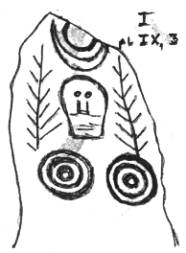
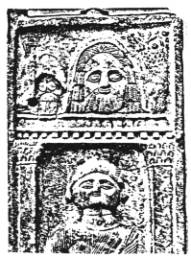
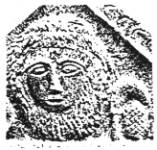
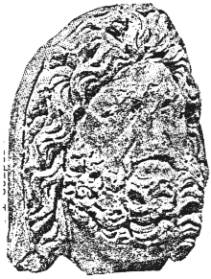
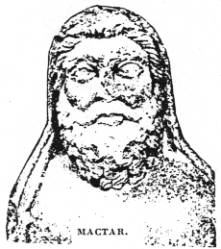
The North African
Saturn is often carrying a veil and an uncut hairdo (see the pictures below
from M.Leglay, Saturne Africain.
Monuments 1,1961,pl.VIII,3;II,4;VI,2 & 3,III). The long hair marks the
god as an ecstatic, and the hand often supporting his forehead shows the great
visions he has. He is often seen in a resting, dreaming position (dreaming the
world order, see below), or he is shown with cymbal and pinecone or a big bowl
of wine in his hand, and in some pictures he has enlarged eyes: wide open they
seem to look past the spectator into a higher world.
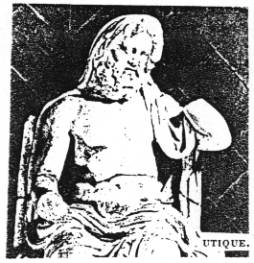
We have found in the
Hellenistic period a transcendent high god who is represented as a visionary, a
mystic, and one with primordial totality (the bull) and the blue sky (the veil)
and a younger, active god, the sun warrior, his messenger. We can find these
two gods in Anatolian Hellenistic religion as Theos or Zeus Hypsistos and the
Divine Angel, his messenger. Remember how Barnabas was taken for Zeus and Paul
for Hermes. In Palmyra as Bel and Malakbel = “Bel´s angel”. In the New Test. it
is only in Heb 3,1 Jesus is called apostle, but in Syrian Christianity the
“apostle” of God plays an important role both in the mainstream Christianity
and in Gnostic sects [19].
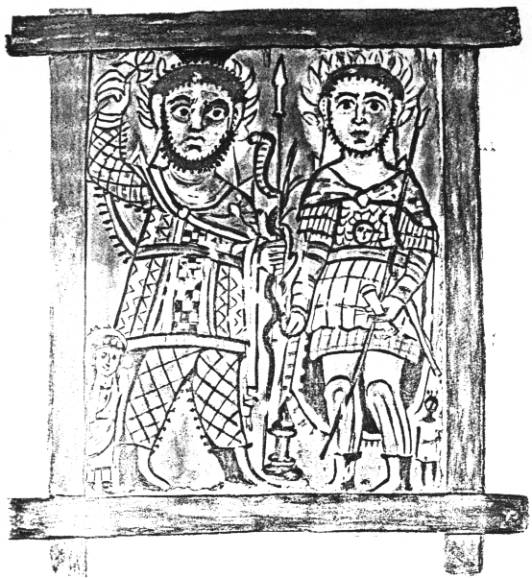
In Fayoum, Egypt a painting from the Roman period has been discovered. The
motif is two gods and a quite small goddess and an even smaller negro. That the
three of them are gods can be seen from the pink aureole surrounding their
faces. The god to the left is armed with spear and double axe, and his hair and
beard is rather wild compared with the other god, but the most impressive is
his great staring eyes. He is the Saturn of the North African iconography. He
is the world pillar, which can be seen from the kalathos making him
support the upper part of the frame and the snake not coiling up his body but
more discretely coiling up his spear. To the right a god surely to be
identified with Helios, to judge from the round Helios-head on his armour. He
is carrying a scroll – he is the philosophic Melqart. Coins from Tyre shows an owl carrying a crooked staff, and on
the reverse Melqart riding the hippocamp (sea monster) across the Great Sea
towards the sunset. This “Helios-Melqart” is accompanied by an Ethiopian,
showing that he comes from the land of the sun, where the nearness of the sun
burns the people to dark complexion, cf the name of the sun hero Kadmos meaning “the man from the east”. (In the
mysteries of Mithras, the name Mithras is the name of the god from the land of
the sunrise.) On the painting the old god Saturn and the young active sun hero
have become two brothers. In Egypt the name of this sun hero is Heron. That he
is also thought of as a king can be seen from the purple paludamentum he wears. Melk-qart means “king of the city”. The
other god carries a blue cloak, cf the North African Saturn carrying the blue
veil and the Oceanus/Saturn of the mysteries of Mithras a red-blue[20].
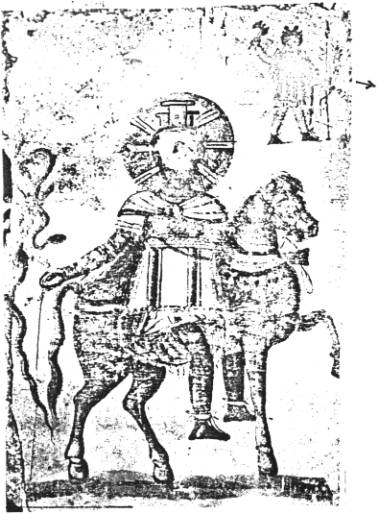
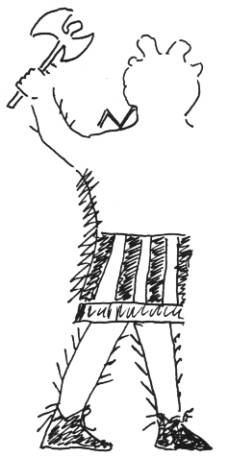
The next picture is also Egyptian, from Pnepheros´ temple in Theadelphi. It
shows Heron, the sun hero who has reached the tree of life with the snake, and
in the background the high god with the same weapons as before, but this time
also sprouting with vegetation. The sun hero has the triple arrangement on his
head of the world pillar flanked with the two Heracles-pillars. (The two
pictures below are from F.Cumont, "Un dieu supposé, associé a Héron en
Egypt", in: Melanges Syriens offer a
Rene Dusseaud.) The snake coiling up the spear is acc. to Cumont not the
uraeus-snake, but perhaps the snake of Asclepios or Sabazios [21].
But all four snakes are witnesses to the old kundalini-icon.
The philosopher
Maximus of Tyre (2.cent A.C.) says: there is great praise of the traveller who
has seen the marvels of Egypt, the Ganges river, and the ruins of Babylon, and
Homer gives Odysseus the name of a wise man due to his long travels. But all
this is only earthly and transient. For what could be compared with the view
offering itself to the philosopher? With a dream most real (by the help of
Zeus), where the body does not participate, but where the soul wanders over the
sea, travels through the whole world and in a flight through all aerial spaces,
where it accompanies the sun and the moon in their circles, and where it is
united to the dances of the choir of stars, almost makes itself the partner of
Zeus in ruling and creating order in everything: “Oh dreams full of
truth”(XXII,6,Dübner).
 In the background are felt the
travels of the sun hero, Melqart, the philosopher, who creates world-order in
the universe by clearing the path of the sun and setting up the pillars. He is
the great ideal of the philosopher, but he is one with the high god,
Saturn/Baalshamim, cf the following quotation from Maximus: ”God always
grounded (firmly erected) in the same place (katà chôran hidryménos) guides heaven and the whole order of the
celestial bodies” (XIV,8). Hidrymenos must here be the translation into Greek of
Semitic kvn = “ground firmly, erect
to firm standing”. The Hebrew name for a priest, cohen, is from the same stem and means “he who stands (before
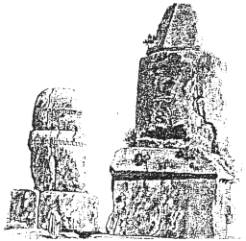
God)”. Above Phoenician graves outside Arad (E.Renan, Mission de Phénicie,pl.XI.) They must be understood as models of
the world mountain. At the bottom the massive cube, symbol of earth, the pillar
as symbol of the world pillar and the pyramidion at the top, a symbol of the
top of the world mountain. The Maenander pattern must symbolize the dance of
the sun. Bardesanes (Syrian Christian author from the 2.cent.A.C. quoted
Stob.I.3) tells us that in a mountain of vast dimensions in the centre of the
world, there is a cave made by nature. In it is found a statue of a god, 10-12
yards high: it is a standing man with both arms stretched out as if crucified.
The right half of the person is a man, the left a woman. On the right part of
the breast there is a picture of the sun, on the left a picture of the moon.
And under the arms is pictured the whole multitude of angels and whatever else
could be found in the world, mountains, rivers, animals, plants. This picture
was given by God to his son as a model when he had to create the world. The
material from which this model is made is unknown. It is neither stone nor
metal, and it is similar to some very hard sorts of wood, but it is not wood,
for by the slightest scratch blood will flow, and when it is hot, the pillar
will be full of sweat. If you penetrate deeper into the cave, you will be
surrounded by total darkness, but at the end there is a door, and from
underneath water gushes forth. He who has led a clean life can enter the door
and will reach a cool, refreshing spring. (The world mountain with the well of
life).
In the background are felt the
travels of the sun hero, Melqart, the philosopher, who creates world-order in
the universe by clearing the path of the sun and setting up the pillars. He is
the great ideal of the philosopher, but he is one with the high god,
Saturn/Baalshamim, cf the following quotation from Maximus: ”God always
grounded (firmly erected) in the same place (katà chôran hidryménos) guides heaven and the whole order of the
celestial bodies” (XIV,8). Hidrymenos must here be the translation into Greek of
Semitic kvn = “ground firmly, erect
to firm standing”. The Hebrew name for a priest, cohen, is from the same stem and means “he who stands (before
God)”. Above Phoenician graves outside Arad (E.Renan, Mission de Phénicie,pl.XI.) They must be understood as models of
the world mountain. At the bottom the massive cube, symbol of earth, the pillar
as symbol of the world pillar and the pyramidion at the top, a symbol of the
top of the world mountain. The Maenander pattern must symbolize the dance of
the sun. Bardesanes (Syrian Christian author from the 2.cent.A.C. quoted
Stob.I.3) tells us that in a mountain of vast dimensions in the centre of the
world, there is a cave made by nature. In it is found a statue of a god, 10-12
yards high: it is a standing man with both arms stretched out as if crucified.
The right half of the person is a man, the left a woman. On the right part of
the breast there is a picture of the sun, on the left a picture of the moon.
And under the arms is pictured the whole multitude of angels and whatever else
could be found in the world, mountains, rivers, animals, plants. This picture
was given by God to his son as a model when he had to create the world. The
material from which this model is made is unknown. It is neither stone nor
metal, and it is similar to some very hard sorts of wood, but it is not wood,
for by the slightest scratch blood will flow, and when it is hot, the pillar
will be full of sweat. If you penetrate deeper into the cave, you will be
surrounded by total darkness, but at the end there is a door, and from
underneath water gushes forth. He who has led a clean life can enter the door
and will reach a cool, refreshing spring. (The world mountain with the well of
life).
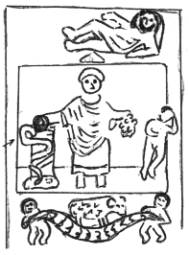
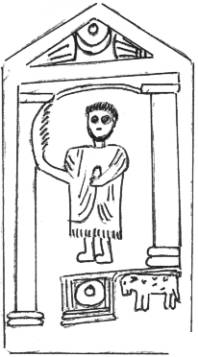
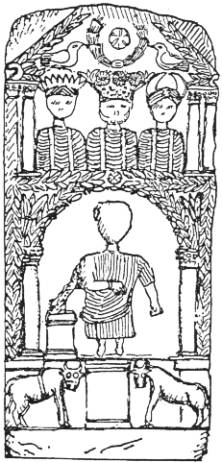
M.Leglay has
published pictures of the many stelai dedicated to Saturn in North Africa (Saturne Africain, Monuments I-II, 1961-6
& Histoire, 1966, pl. IIf.). The
typical stele is a miniature of the universe. At the top Saturn with sun and
moon (or the divine twins as horsemen, the morning and evening star riding from
east to west), on the ground level the bull going to be sacrificed, in the
middle the gate of the sun (the two Heracles-pillars), and in the gate the
sponsor of the stele standing, offering incense on a small altar. We will show
a few examples (Monuments II, pl.
XXVII,5;I, pl.XVI,4;II pl.XXII,1, I pl.XVIII,6) The first shows the veiled
Saturn resting. Underneath the sponsor offering incense to a pillar-like altar
with the coiling snake, and with the other hand offering grapes to a young Amor
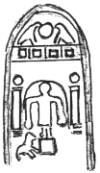
(the symbolism of fire contra vegetation). Some stelai show the sponsor
standing on the altar as part of the pillar of incense going up to heaven. He
becomes one with the pillar even to a degree where he is stylised into a symbol
of the triple world pillars, the central pillar flanked with the two
Heracles-pillars (II, pl. XL,5), or the
smoke from the incense mingles with his figure (du Mesnil du Buisson, Tess.,
p.205). The last picture (from Palmyra) shows the sponsor standing on a base,
the base of the world pillar guarded by the two bullocks.
The novel about
Alexander the Great is pieced together from different sources of which the
letters are mostly seen as the oldest part (100 B.C. acc. to B.P.Reardon[22].
The letter sent by A. to his mother is interesting seen from our purpose: by
the river Atlas it was no longer possible to see neither earth nor heaven. They
sail on to the city of the sun on an island. After walking for seven days they
come to a very high mountain (after passing through the meadow of Nysa) III,28.
The mountain is, acc to Reardon[23],
the world mountain. On the mountain was a round temple with 100 pillars of
sapphire building a circle. Everywhere there were reliefs of a Dionysiac train,
and at the centre of the temple a man on a couch, a golden chain of 100 pounds,
and a golden wreath. A. could not see what the man looked like, for he was
completely covered.
This veiled god
resting at the top of the world mountain is certainly Saturn surrounded by the
columns or obelisks constituting his essence as “the standing one”, the firmly
grounded. We have already seen the symbolism of the wreath of victory. The
chain of Saturn is mentioned by Epiphanios (Anchor.
104) “The devotees of Cronos admit that the god is kept imprisoned by iron
chains”.