14.The Syrian cavalier god
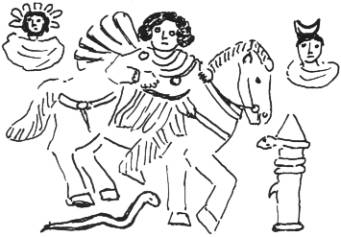
On a stone slab from Hama the sun
hero is seen riding towards a pillar with a snake coiling around it. Although
he is shown galloping along with a cloak flying from his shoulders, he is followed
by an obviously very speedy snake (Beirut Mus., Goodenough, Jewish Symbols, V, fig.162).
The symbolism is
ecstatic: his travel towards the world pillar, the centre of the world, is a
spiritual journey, a rising of kundalini-power. The other picture (Rostovtzeff,
Dura Europos. VI, pl.XXX, 1) shows
his arrival at an incense altar, also the symbol of the world pillar, and here
he is greeted by the god who is the highgod, the personification of the world
pillar, Saturn.

The incense altar is
the end of his spiritual journey, and he is crowned with the Wreath of Victory
by a bird (eagle?). A coin from Lydia from the period of the emperor Hadrian [1]
shows the sun hero reaching the gate of paradise, here, like in Tyre, marked
with the double pillar of fire-alter and holy vegetation: the cavalier god
reaching the sun´s gate is also the motif in a picture of Heron [2].
It shows the god riding through a gate marked by the sun-bird hovering over his
head, and behind him a snake is standing on its tail.
From Khirbet
el-Hamman comes a stone relief with the cavalier god approaching the fire-altar
(symbol of the pillar of fire, the world pillar) and greeted by a woman holding
out the Wreath of Victory and a shallow bowl of libation, symbol of the water
of life (Rostovtzeff, Dura VI,pl.
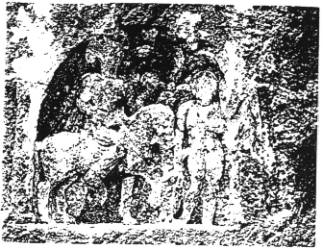
XXX,3; see below). The second picture is a very worn down relief from Ferzol
(Photo Beirut Mus., SYRIA 19,1938.
Goodenough, V, fig.165 [3].)
It shows the cavalier god marked out as the sun warrior by the mighty aura
around his head. He has reached the palm tree, symbol of the tree of life,
where the highgod carrying heavy clusters of dates is standing, naked (?).
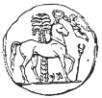 A coin from Carthage shows only the
horse of the sun reaching the holy date palm and being crowned with the Wreath
of Victory. That it is the journey to the transcendent world is also seen from
the caduceus, (Falbe-Lindberg-Müller, II, p.77, no.28). Other coins show the
horse as a winged Pegasus (no.127) or with the sign of mystical light:
double-snake around the disc of the sun (no.132,143,146), the disc of the sun
in the crescent moon (183,154), or the mystical rosette (122). Once the horse
is standing between the club of Heracles and the palm tree (19): the club shows
that it belongs to Heracles-Melqart.
A coin from Carthage shows only the
horse of the sun reaching the holy date palm and being crowned with the Wreath
of Victory. That it is the journey to the transcendent world is also seen from
the caduceus, (Falbe-Lindberg-Müller, II, p.77, no.28). Other coins show the
horse as a winged Pegasus (no.127) or with the sign of mystical light:
double-snake around the disc of the sun (no.132,143,146), the disc of the sun
in the crescent moon (183,154), or the mystical rosette (122). Once the horse
is standing between the club of Heracles and the palm tree (19): the club shows
that it belongs to Heracles-Melqart.
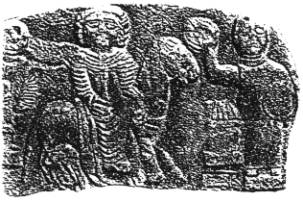
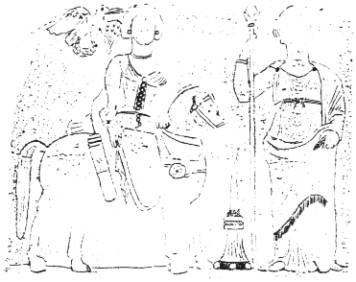
The sun hero is often
called by the Latin name, Genius (Semitic: Genneas/Ginnaja/GNJ´), and is often shown with the incense altar and the
wreath-carrying eagle. (The picture below is from Djoubb el djarrah, east of
Homs, SYRIA 26, 1949, pl. XI) This
eagle is well known from the iconography of Palmyra, where a (deceased?) priest
is seen resting where the sun shines (eternally?) while this very same eagle is
presenting him with the “Wreath of Victory”. H.Seyrig[4]
says that the eagle and the wreath may probably be seen as a symbol of
“heavenly investiture”. In Dura the eagle is seen flying toward
Jarhibol-Malcha, on a graffiti called Nicator
(Greek: “Victor”), while a Victoria
is seen approaching from the other side to crown the god.
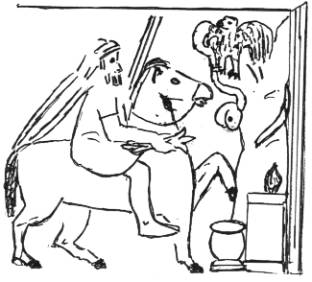
The second picture is
a small stele bought at the flee-market in Constantinople in 1914 (Cook II,pl.
19). An Anatolian god (Theos Hypsistos or Zeus Sabazios) is seen on a horse
with the forelegs in a position often characteristic of the horse of the
cavalier god approaching the tree of life, with the snake coiling up its trunk,
the eagle at the top, and at the foot the juice of life in a crater. It stands
besides a fire-altar: the horse is approaching the gate of the sun consisting
of the gateposts expressing the duality of fire and vegetation. C.Hopkins[5]
has shown that the horse-man with the flying cloak on a horse with this
specific position of the legs carrying a huge scabbard is either a god or a
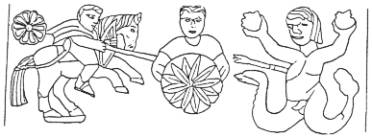
divine king. F.Cumont has suggested that the “Giant-columns” from Roman Gaul
with a horse-man at the top fighting a man with snake feet is a motif with
Syrian roots.[6] These
columns were originally octogon with pictures of the 7 gods of the planets
& Fortuna.
The horse-man is in
my opinion the sun hero who, after travelling in the course of the sun, has
ascended to heaven, above the fortune dictated by the planets and stars. The
fight with the giant is the usual fight with the monster of primordial
totality, Typhon.
Clermont-Ganneau[7]
has published a picture of a relief from Soueida, now destroyed in the Druse
uprising. It shows the sun hero on his horse, fighting the Typhon monster with
his bow. A gem from Byblos (Dunand 68) shows the mystical kundalini-symbol as a
winged snake with a double tail and a bird's head:
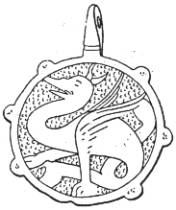
In Hellenistic Syria we come across a mounted god. He is riding along with his cloak blown
out by the wind, and often with a great quiver hanging behind his right thigh.
He is travelling in the course of the sun to paradise or apotheosis. His
journey is the journey to heaven, therefore we find him galloping towards the
world pillar symbolized by a pillar-like altar for burning incense, with the
snake normally coiling around the world pillar, ascending to the top of the
altar. The mystical meaning of the journey is underlined by the horseman as the
union of sun and moon (the slab from Hama).
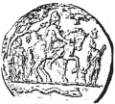 Coins from the
Hellenistic period show Mithras as the mounted god reaching the double world
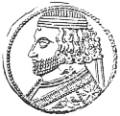
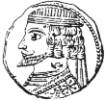
pillar of fire and vegetation, the sacred gate to paradise (Cumont,MMM p.190,218.A.C.). Coins from the cent
B.C. show Persian kings with a very special sign of royal dignity: a ring
circling their necks, and leading the circle movement a snake’s head or a
winged horse (Jac. de Morgan, Numismatique
de la Perse, pp.132 & 137, fig.18 & 20).
Coins from the
Hellenistic period show Mithras as the mounted god reaching the double world
pillar of fire and vegetation, the sacred gate to paradise (Cumont,MMM p.190,218.A.C.). Coins from the cent
B.C. show Persian kings with a very special sign of royal dignity: a ring
circling their necks, and leading the circle movement a snake’s head or a
winged horse (Jac. de Morgan, Numismatique
de la Perse, pp.132 & 137, fig.18 & 20).


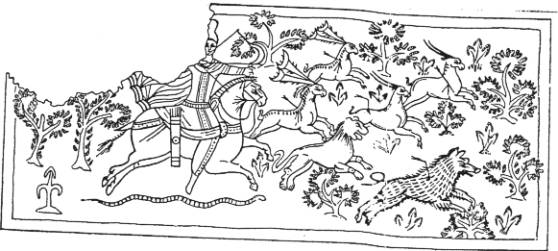
This interpretation makes it possible to understand the next scene: Mithras is galloping
along with the snake and the lion hunting down two stags and two goats. A very
important coin from Tyre shows Melqarts-Heracles hunting 4 stags. On his
journey to the country of the sun, India, the apostle Thomas gets hold of 4
wild donkeys for pulling his car to the final point of destiny. On some
pictures belonging to the Mithras cult we see Mithras running to catch up with
the sun's quadriga. Hunting the divine stag with the mystical light between its
horns is a symbol of seeking mystical experience = journey to paradise in the
sun's course, or even in its quadriga. Hunting the 4 stags is taking control
over the powers that can lead you to mystical vision/journey to paradise
(Fresco, the Mithraeum in Dura).