16. Dura Europos
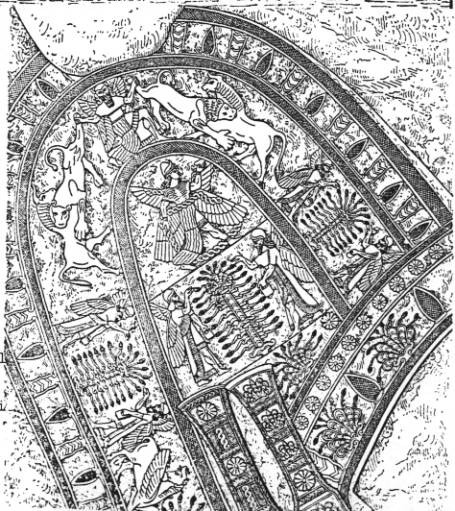
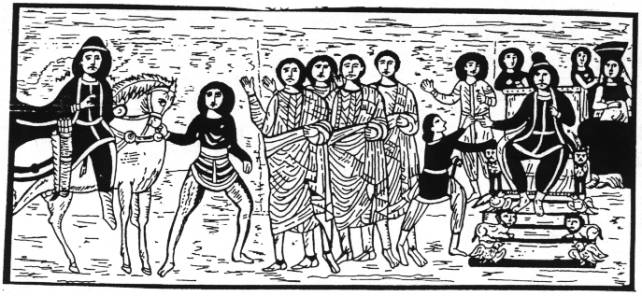
We will concentrate on the Jewish synagogue and its famous pictures. Several pictures on the ceiling showed a bull being attacked by a lion. In the picture of Mordocai on horseback approaching the throne of Esther and the Persian king. Goodenough has already recognised the type of the Syrian Cavalier God, and in the men dressed in white clothes greeting him, Goodenough recognised those who had already reached apotheosis. To this could be added that the throne of the high king (acc. to Goodenough dressed in the same attire as God sitting on his throne in the central scene above the large wine-tree) is a small stepped Ziggurat/mountain of god, and the queen sitting next to him makes the apotheosis into an androgynous state. In the description of the flood by Berossos, it all ends on a mountain where Xis-uthros and his wife, his daughter and his captain, two couples, are taken up to eternal life[1].
The greeting gesture
could be compared with the gesture of the same group in the picture above from
Palmyra.
The same “ideas” have
governed the interpretation of Sura 17,1 in the Koran, resulting in the
tradition about Muhammad travelling to Mt. Zion, and from there up to the
throne of God on the back of Alborac.
Goodenough has also
shown how Moses is transformed into Heracles, his staff being changed into a
club. He is the sun hero leading Israel out of Egypt, out of darkness. Egypt is
shown as a pitch- dark world behind an open gate (the gate of the underworld).
The pillar of smoke and the pillar of fire have become two Heracles pillars
standing next to the “Egyptian gate”. They are marked out as opposites: black
and red. The pillar-symbols are important: also Moses himself is seen as the pillar
supporting the vault.
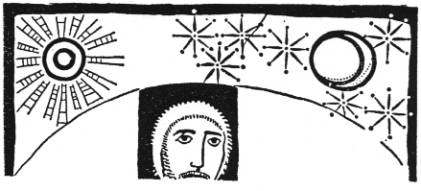
C.H.Kraeling, Synagogue
236,fig. 61
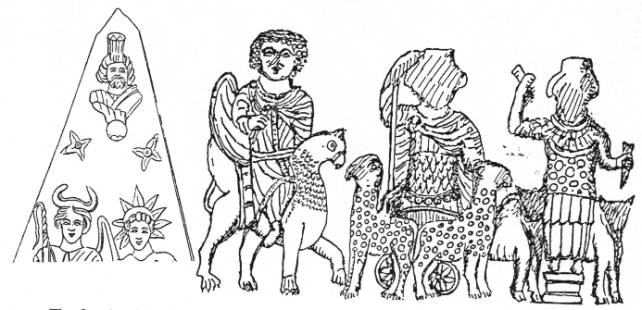
On North African
stelai Saturn is seen between sun and moon. They are the duality united in Kvn,
the world pillar. On a fragment of the typical Jupiter Dolichenus (a North
Syrian location) plate is seen the bearded Saturn with polos at the top of the
pyramid uniting the duality of sun and moon (Cook,Zeus II,fig.491). Also Moses is the centre of sun, moon and seven
stars. He is, as shown by Goodenough, seen as approaching the light, but has only
a small remnant of a shadow. But also in the three pictures of Moses placed
together with the dead Moses in a composition beside the niche of the Thora
shrine, he is shown as a pillar with a square-like construction over his head.
He is the triple sun hero, finally being changed into the mystical world
pillar.
The triple sun is
also seen in a picture of the three gods, Malakbel, Dusares, and Juppiter
Baalbeck (du Mesnil du Buisson, Tess.).
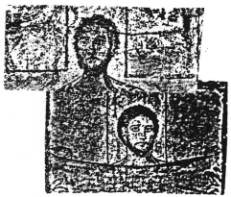
The three pictures of Moses show him as the young, green life-giving column,
the mature reader of the law - red as the strong, burning sun and at last, as
the dead Moses, the black pillar supporting the vault.
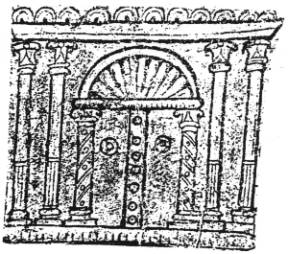 The facade of the small temple over
the Torah shrine has a gate supported by three pillars. Two Heracles-like
pillars, and at the centre a pillar with seven discs as its only decoration
(the semeion as symbol of the world
pillar and of mystical ascent), cf the picture of the closed heavenly temple
behind the seven walls. Important is also the “valley of death” in contrast to
the “valley of life” (this is the interpretation by Goodenough): the valley of
death is flanked by the split world mountain, the valley of life by the united
world-mountain. The picture-cycle dedicated to Ezekiel shows first the valley of
the dead with the split mountain bathed in sunlight, then the valley of life
where the dead are coming to life again bathed in a mystical reddish light. The
split mountain is this visible world where death rules, but behind it there is
the mystical primordial unity enlightened by the supernatural fiery light.
The facade of the small temple over
the Torah shrine has a gate supported by three pillars. Two Heracles-like
pillars, and at the centre a pillar with seven discs as its only decoration
(the semeion as symbol of the world
pillar and of mystical ascent), cf the picture of the closed heavenly temple
behind the seven walls. Important is also the “valley of death” in contrast to
the “valley of life” (this is the interpretation by Goodenough): the valley of
death is flanked by the split world mountain, the valley of life by the united
world-mountain. The picture-cycle dedicated to Ezekiel shows first the valley of
the dead with the split mountain bathed in sunlight, then the valley of life
where the dead are coming to life again bathed in a mystical reddish light. The
split mountain is this visible world where death rules, but behind it there is
the mystical primordial unity enlightened by the supernatural fiery light.
The main scene is the
large wine over the Torah niche, and at the top God enthroned with a woman on
his right hand and a man on his left (androgynous polarity). Below David is
sitting in the vine like Orpheus taming the wild animals with his play on a
harp (a lion and a bird are seen among the leaves). Also Resheph with the lute
was identified with Orpheus[2].
The scene is obviously a mystical one as proved by Goodenough, and the vine is
the symbol of the "sober intoxication" treated in the famous book by
Hans Lewy, Sobria Ebrietas, 1929. In
the hymns of David the community lifts their hearts and souls to ecstasy before
the throne of god. But perhaps even more than that, for the man sitting on the
throne is dressed in exactly the same red Persian costume as the Persian king
and as Mordocai. We are dealing with
a mysticism which experienced unity even with God himself.
In Dura we are
perhaps dealing with a synagogue belonging to the Essene party. We know that
they considered the entrance into heaven as something that “had to be fought
for”[3].
The gate out of Egypt is adorned with two statues of Nike with wreaths of
victory standing on the cosmic globe and the war god Ares. This design seems to
indicate “a sort of mystery which led to the victory of eternal life”[4].
The background is the ideology of the sun hero who struggles to reach paradise
and the tree of life, Rev 2,7. He has already gone through death and shall not
be touched by it a second time 2,11, but be enthroned with God 2,26ff &
3,21, he shall be clad in the white clothes of light 3,5, taste the ambrosian
food of the angels 2,17, and have part in the holy Jhvh-name (ibd) and become a
pillar 3,12. He is “he who has victory”[5].
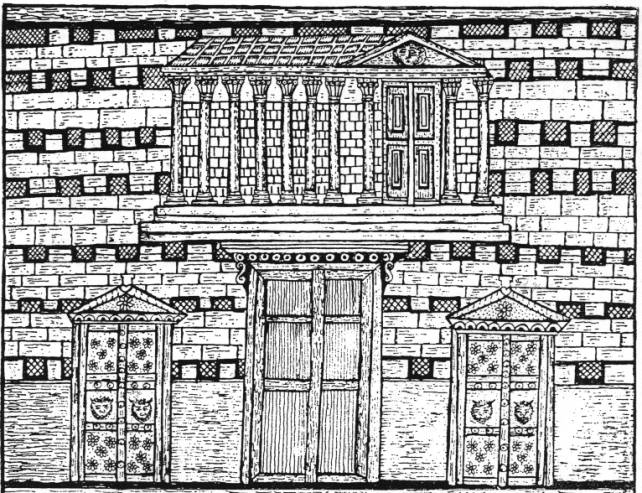
The closed temple behind seven walls in Dura
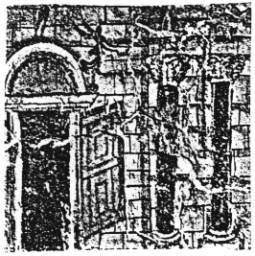
The gate leading out of Egypt in Dura. Outside the pillar of fire and
the pillar of smoke as Heraclespillars
In
the synagogue of Dura Europos there is a picture of the closed temple surrounded
by seven walls each of different colour, and outside the walls a central
entrance flanked by two doors: an ascension through the seven heavens is linked
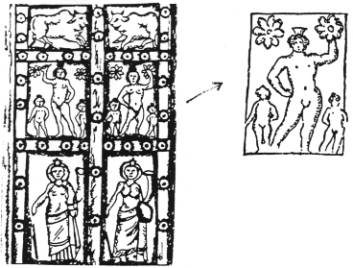
to a symbolism pictured in the 3 doors. Duality (the 2 lion doors) contra unity
(the central bull door). On the central door Adam is painted as the sun warrior
holding the holy rosette in his hand and followed by the typical sun warrior's
Dioscouric helpers (here Cain and Abel). He stands between the divine
sacrificial bull and Eve depicted as Gaia, the earth-goddess with the horn of
plenty. Adam-man is the sun warrior bringing the bull-sacrifice and celebrating
holy wedlock with the "mother of all living”, thereby completing his
journey to heaven. Herodot tells us that the tower of Babel had 8 stories and
on the top a woman would spend the night as bride for the god. She has to be an indigenous (epichôríôn).
Jesus
is pictured as the sun warrior. He is born among shepherds, hidden from the
king of chaos. He has to journey the magical three days until he reaches the
top of the universe (Jerusalem), clearing the way of demons. He is followed by
the Boanerges. He is the shepherd, the lamb with Jerusalem as his bride. He is
also the ideal man, “the Son of Man”, like Adam in Dura.
The
holy bride is a symbol of the town, country or earth (therefore indigenous). In
the Far East, in the country of Pandaia with Nysa & Mt. Meros, Heracles
takes his daughter Pandaia (“All-earth”) as his bride[6].
The
small calathos on the head of Adam indicates that he is seen as world pillar.