20. Alexander the Great and
his forerunners
Semiramis was, acc. to Ktesias ap.
Diodor, exposed in the desert after being born by Derceto in Ashkalon. In the
desert she was nourished by pigeons who brought her milk and cheese from the
herd of the king. The leader of the shepherds gets news about this marvel and
adopts her. She grows up as a shepherdess.
As the Queen
of Ninive she erects stelai of triumph at the end of the inhabited earth in
inner Scytia, where Alexander, much later, saw them and read the inscription.
In this her androgynous nature is described: nature had prepared a female´s
body for her, but her deeds were like the greatest among men. She provides
water in the wildernes: “I have made the unfruitful earth fruit-bearing by watering
it with my rivers…I have made an even road with instruments of iron through
inaccessible mountains. I have opened a road for my chariots, where even the
wild animals have never trodden … And among all this labour I also found time
for pleasure and joy”. (The sun hero clears a road through inaccessible
chaos-land.)
She even
conquers Ethiopia and reaches India with her army, and is the founder of cities
like Ecbatana, Babylon and Semiramokarta in Armenia. Finally she is taken up to
heaven. In the Ugarit texts this mythical campaign is carried out by Baal: ”He
marched from town to town, turned from city to city. Sixty-six towns he seized,
seventy-seven cities, Ba´lu struck eighty, Ba´lu expelled ninety…”[1].
He makes his voice heard right through to “the people in the east”[2],
and his enemies have to take shelter in the forests and mountain caves (areas
in the periphery of the cosmos created by Baal).
Acc to Gudea
of Lagash, his god, Ningirsu, “has opened the road for him from the Upper to
the Nether Sea” and “in Amanus, the cedar mountain” he was able to cut down
giant cedar trees. The Assyrian god, Assur, is shown as a bowman in the burning
disc of the sun. He is obviously a god of the Resheph type. The king is closely
linked to Assur, and often shown as the great hunter hunting lions and wild
bulls. Sargon boasts of his pushing forward to the far west, where he “forced
the western countries into submission, and conquered the four parts of the
world.”[3].
He even crossed over the “Western Sea” and erected his stelai in the west[4].
Salmanasser II (860-25) erected a “picture of his rule, bearing his name for
the eternity… by the sea”, and he also ascended and cut down cedars on the
Hamani (Amanus) mountain[5].
The most important Assyrian god was
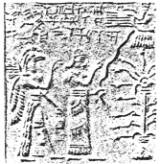
Assur, often pictured as an archer, and one with the mystical fire-bird. The
king is often seen standing by the tree of life grasping one of the snake-tails
hanging down from the fire-bird hovering over the top of the sacred tree.
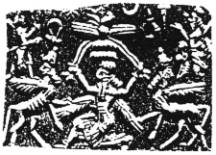
(N.W.palace in Nimrod). A seal impression[6]
shows a man in “Knielauf” (= running very fast), grasping both tails of the
double snake hanging down from the bird, here shown as uniting the light of the
sun and the moon. The running man is the sun hero followed by his two Dioscuric
helpers. A relief from Kuyundjik shows king Sancherib as an archer clad in the
star spangled cloak of the sky, and sitting on a kind of cosmic throne
picturing the three heavens held up by three rows of Atlas-like figures. The
king is macr´anthropos. In the same palace dug out by H.Rassam was pictured the
magnificent lion-hunt performed by the king: he is seen driving round in a kind
of arena fenced in by tent-canvas, shooting lions which are brought to the
arena in cages and let loose. He is obviously hailed as the great hunter, and
he openly boasts of his cruelty and the atrocities performed by his troops. The
Sumerian king is more human: “As Utu (the sun) in the evening has haste to
reach his house, so I completed a journey of 15 doublehours…with Utu…my brother
and friend …I was drinking in the palace founded by An (“Heaven”, i.e. the
highgod)… I was sitting with my bride, the virgin Inanna (the goddess)… with
food and drink… on a shining throne…”[7]
The sun hero type boasts more of his travels or military campaigns right to the
end of the world, and his opening roads in the wilderness: ”As I was able to
enjoy my power, I moved my foot, and hurried along the roads of the country,
and made firm the highways”[8].
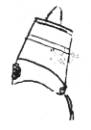
The very special hat only worn by the Assyrian king has a big rosette as a
third eye on the forehead:
Later it is
Alexander who is described as Gilgamesh[9].
To
understand the sacred kingship ideology used by Alexander we have to look at
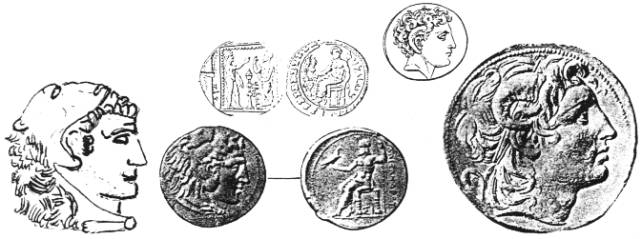
the coins that were issued. Below is shown the tetradrachme from Byblos: on the
adverse Alexander as Heracles with the hide of the lion as a helmet on his
head, and on the reverse Zeus Olympios with an eagle in his hand and the
inscription ALEXANDROU, a pattern already well-known from the Persian period in
Tarsus: on the adverse the young, active god, Sandan-Heracles (standing naked
behind an incense-burner) and on the reverse the older high god Baal Tarz
sitting in the same posture as Zeus Olympios, but with an ear of corn in his
hand.[10]
Ammianus
Marcellinus[11] calls
Sandan “ex Aethio profectus”.
Eyssenhardt makes the correction “ex
Aethiopia profectus”. Alexander wants to go to the land of the rising of
the sun (India, in some Greek traditions Aethiopia: on his journey to Aethiopia
Dionysos erected the two gigantic pillars in Mabbug). He wants to visit Siwa
because Heracles was said to have visited it, and he calls his son with Barsine
Heracles, and seems even on certain occasions to have dressed out as Ammon with
a ram´s horns on his head, as Heracles with a lion's hide and a club, as Artemis
(as the great hunter Melqart is androgynous), and as Hermes, the Divine Angel
or Messenger[12].
The oracle
of Siwa also honoured a younger god identified with Dionysos, and Alexander was
also identified with this god. A coin from Cyrene shows Alexander as the young
Dionysos from Siwa[13].
Both Heracles and Dionysos were honoured as leaders of a mythical campaign
towards India, probably taking over this role from a Near Eastern Baal.
Alexander´s return from India was made into a Dionysiac procession: the king
himself was lying on a big platform on a wagon together with some close friends
feasting and drinking, and all along the route jars of wine were put up. When
he arrived at his home at big drinking contest was held, and the winner died
happily after taking in no less than 13 litres of wine. The king himself seems
to have consumed a considerable amount of alcohol, and this could have
contributed to his sudden death by fever. His attempt to cross through the
Gedrosian desert was against every good reason and mounted to a military
catastrophe. But it was part of the ideology: the sun hero passing through the
terrible wilderness, the world in its untouched chaotic stage digging wells
along the road or providing water.
The
foundation myth of the oracle of Siwa tells that Dionysos was leading his army
through Libya, and the army was near to dying from thirst when a ram suddenly
showed up and guided the army to a place with water, and in honour of this
ram-god the temple was built[14].
Diodor has preserved some traditions connected with the name Thymoites, son of
Thymoites. This can only be the Near Eastern god, Thammuz/Dumuzi (Berossos
mentions two Dumuzis, the shepherd and the fisherman). In Diodor the miltary campaign is led by both Dionysos
and Athene (Baal and Anat, like Anat killing the bitch, “Fire”, so Athene has
killed a female monster setting the woods on fire from Phrygia over Libanon to
North Africa.) Dionysos is leading his army forward in “waterless land infested
with wild animals” III, 72,2, that is chaos.
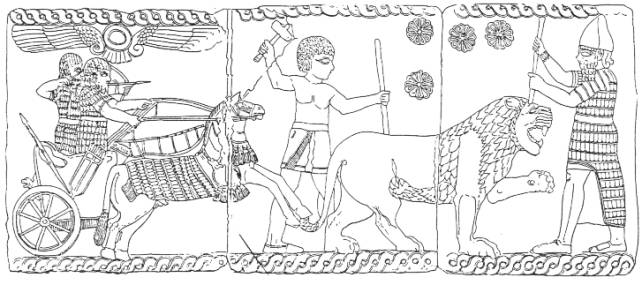
A Hittite
motif shows the king as sun hero assisted by the winged disc, fighting his way
marked out by the snake coils, clearing the route of wild animals. In his fight
with the lion-monster he is assisted by the Heracles-like young hunter, naked
except for the kilt, armed with a primitive axe. He is hitting the lion in its
third eye, thereby laming its magical force.
The tradition preserved by Diodor is structured as the usual
struggle for the kingdom of heaven motif: Ammon has to flee to Crete because of
his affair with Amaltheia, being unfaithful to his wife, Rhea. She calls in her
brother Saturn, who takes over the kingdom, but, when defeated, burns his
residence (cf. the same thing done by Sardanapal). The background is the usual
feast of Saturnalia or Sacaeans, where the queen is taken over by the king of
chaos. The interregnum of Saturn is meant to serve the promotion of
fertility: Ammon had to abdicate because of lack of grain[15].
Dionysos is the year and cosmic order reborn: it is stressed that his army went forward with order, fighting all rascals. The child Dionysos is begotten in the Ceraunian mountains at the Horn of Hesperos III 68,2 – presumably the Punic city of Cerne (from the Semitic word for “horn”). He grows up on an island, Nysa, situated in the Tritonos river (in inner Libya). The island had high cliffs all along its coast and could only be visited through a valley leading from the coast inward and forming a gate called the “Nysaean Gate”. Here we find the typical inaccessible paradise mountain, which can also be a paradise island, and the gate of the sun. On the island the climate was such that people would live very long, and the whole island was full of fruit trees and wild grapes, and there were wellsprings all along the valley, and at its end a big cave. Surrounding the cave were rocks in all kinds of colours known from art, and in front of the cave fruit trees and evergreen trees full of nests. A wonderful harmony of birds singing would fill the air, a music surpassing all artistic play.
As it can be
seen from this description, the paradise island is the perfect model for all
art, for all that is felt as beautiful and moving on earth.
The
dark-skinned Prince, Memnon, was coming from the land of Cissia in the sunrise
to help Priam. The Phrygians still show the straight road, with campsites every
fifteen miles or so, by which Memnon, after he had subjugated all the
intervening nations, marched to Troy[16].
Krt in the
Ugarit texts moves forward with an army of 3 million men and demands a wife by
whose help the graces can be born, the grace and fruitfulness of nature reborn.
Heracles´s
moving forward the whole way to India is also described as the advancing of the
sun hero´s army. “He cleanses the land and sea from evil animals”[17],
and installs his many sons as kings. His daughter is given 365 villages, which
is a tribute for every day[18]:
the fruitfulness of the whole year is secured. She is only 8 years old as she
gives birth to her father´s son (cf the young virgin, Anat, and Semiramis too
young to be married to Ninos), and is given a mighty army by her father, Arrian
Ind.8. Heracles comes from west and moves toward east. It is even more
typical that a sun warrior moves towards the west like Nebucadnezar, who, acc
to a Babylonian tradition, led his weapons even to the pillars of Hercules (by
the Gibraltar[19]), where he
conquered great parts of Iberia and Libya[20].
In
2.Kings19,23f. the Assyrian king is described as a sun warrior: with his
countless number of war chariots he is mounting the paradisegardens of Lebanon,
digging out wells and crossing the streams in the far west.
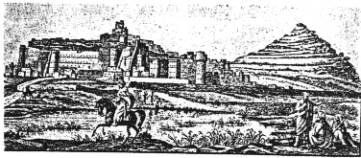 Diodor of Sicily seems rather well
informed about the Siwa oasis. The inhabitants of the oasis were living in
villages, but had in their midst an acropolis surrounded by a triple wall.
There is a second temple for the god standing somewhat outside the acropolis in
the shade of many trees, and not far from it a well called “Well of the Sun”.
An old drawing taken from Maspero, Histoire
Ancienne, III, p.552 shows right in front of us the well (today Ain el
Hamman), a little farther back the characteristic high walls of the city, and
in the background a mountain, presumably the old acropolis.
Diodor of Sicily seems rather well
informed about the Siwa oasis. The inhabitants of the oasis were living in
villages, but had in their midst an acropolis surrounded by a triple wall.
There is a second temple for the god standing somewhat outside the acropolis in
the shade of many trees, and not far from it a well called “Well of the Sun”.
An old drawing taken from Maspero, Histoire
Ancienne, III, p.552 shows right in front of us the well (today Ain el
Hamman), a little farther back the characteristic high walls of the city, and
in the background a mountain, presumably the old acropolis.
Herodot was
told in Thebes that the foundation of the oracle was due to two women abducted
from Thebes by Phoenicians, one of them sold to Hellas, the other to Libya. A
great search was conducted for the two, but in vain, and only several years
later they learned about their destiny, II 54.
Exactly the
same is told about Europa in Tyre: she was abducted, and the citizens of Tyre
each year celebrated the memory of her abduction and called the evening it
happened Kaké Opsiné (“Evil dusk”).
Also Jo is searched for once a year in Anthioch by Orontes, where people at the
time of the year when she disappeared go from door to door knocking[21].
The abduction of the female goddess is, as we have seen, a very important motif
in Phoenician religion.
That
Phonician slavetraders should have organised abductions of women as deep in the
southern part of Egypt as Thebes seems a little unlikely, and the prophetesses
of Dodona, who confirmed that the two oracles were founded at the same time,
gave another story: two black pigeons were sent out from Thebes. One came to
Libya, the other to Dodona, where is rested in an oak tree and ordered in a
human voice that an oracle for Zeus should be established on this spot. The
same thing happened in Libya, II 55. The pigeon is an important symbol of the
Syrian goddess, but most decisive is the way the idol took part in a method of
divination: the idol[22]
was carried in a golden boat by 80 priests, and they would take the direction
the god urged them to take. Exactly the same is told about the divination guided by the god in Mabbug. He drives his
bearers round in every possible direction untill the high priest starts asking him
questions. If he wants to answer “Yes”, the bearers are driven forward, if
“Nay” he makes them move back, Lucian 36. It seems pretty certain that Ammon is
the West Semitic Baal Hammon. Regular contact between Siwa and Egypt was first
established in the 15th cent. B.C.
On coins
struck in Cyrene 430-285 B.C. there are not only pictures of Zeus Ammon with
wild hair and beard, but also a younger god with smaller horns and without a
beard. L.Müller[23] was the
first to see that this had to be combined with the tradition by Diodor of
Ammon´s son, Dionysos.
We have here
the typical Phoenician highgod splitting up in a young and an old god. And when
the two pigions are sent out from Thebes it could be a misunderstanding of the
West Semitic word for “ark” (tebah). Just
as in Mabbug we have then a tradition about the flood. But most important is
the characteristic omphalos shaped “fetish”[24],
also typical of the Syrian area. When we look at the picture, we are at once
struck by the dimensions of the distant acropolis-mountain. What could be more
impressive than this mountain lying in the middle of the vast desert, and with
the oasis and the “Well of the Sun” at its feet? For some prehistoric traveller
going west in what was felt as the footsteps of the sun it was a revelation of
the mythical mountain of paradise.
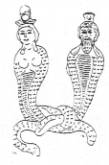 Ptolomaeos I told that Alexander was
led through the desert by two snakes most likely Agathodaemon and Agathe Tyché
identified with Serapis and Isis whose cult Pt. sought to promote[25]
they are here seen in typical late-Egyptian style like a pair of Indian Nagas.
Ptolomaeos I told that Alexander was
led through the desert by two snakes most likely Agathodaemon and Agathe Tyché
identified with Serapis and Isis whose cult Pt. sought to promote[25]
they are here seen in typical late-Egyptian style like a pair of Indian Nagas.
A strange
sign was seen by Alexander's father at his son's birth: he saw an egg break,
and out of the egg came a snake that coiled around the shell and finally
attempted to reenter to where it had emerged, but, having got its head inside,
it died. A god-inspired interpreter explains that the king will have a son who
will go round the whole world, bringing everyone under his sway. But when
turning back, he will die young[26].
But the snake coiling around the egg is an old symbol of the kundalini-force:
its ascent is an inner journey, identical with the journey in the orbit of the
sun around the world. Cf. Job 3,8 about the magicians raising Leviathan: mystic
vision gives magic force. Hermes, the psychopomp, has the caduceus (the two
coiling snakes) as the symbol of his ability to travel fast in the orbit of the
sun. (The planet Mercury is a close follower of the sun).
On the
island of Pharos Alexander finds the "pillars of Helion" and the tomb
of Proteus "over which presides Time... turning the boundless world on his
five-peaked ridges"[27]
– that is the mythical primordial island in the centre of the universe with the
pillars of the sun, here one for each of the 5 elements, not only fire &
vegetation.
Arrian V, 26 conveys a speech by Alexander where he reveals
his plan to move forward to the Oceanos-stream, and then sail around Africa and
in through the pillars of Heracles (following the path of the sun). He speaks
repeatedly about his and the army´s “labours”. Alexander found it important
that Lysippos gave full expression to “the lion-like” look of the king[28]
with the long hair that stood up in his forehead in an anastolê[29].
Acc. to
S.Weinstock[30] it was only
the Syrian-Seleucidian dynasty that used the Nicator-terminology, the
terminology of the victorious sun. (Until it was taken over by the Roman
emperors. A single exception is Attalos I of Pergamon, who called himself
Galatonicés.) Seleukos I is called Nicator, and the Zeus temple in Daphne,
perhaps buildt by him, shows a Zeus with a small Nike-statue on the palm of his
hand; his memorial is called Nicatoreion, and several of his successors use the
Heracles epithet, Kallinicos (“He who has beautiful victory”). The son,
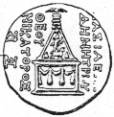
Antiochos I, strikes a coin showing himself as Apollo sitting on the omphalos,
and on the reverse an old man with a bull´s horns and features of Seleukos[31].
Demetrios II Nicator (139-25 B.C.) is shown as Sandan on the pyre.
 But already after the battle at
Gaugamela a mountain was called Nicatorion Oros by Alexander, cf. the Mons Victorialis of the Magi[32].
G.Widengren treats this as a very important tradition linked to the birth of
the Divine Child, the earthly birth of Mithra as Rex Magnus[33].
“The mountain of Victory” also seems to play a role in the Ugarit texts: after
giving birth to a bull calf, the young heifer, Anat ascends to “the Mountain of
Victory”, Saphon also called Arr, cf.
CTA 3, III, 27ff., where Anat is invited to visit Baal on “the heights of
victory”. After Alexander´s victory over Poros the city Nicaea is founded, and
when he, after his return from India, demands to be honoured as a god, it is
suggested that a statue with the inscription, “King Alexander Anicetos Theos”
is put up[34].
But already after the battle at
Gaugamela a mountain was called Nicatorion Oros by Alexander, cf. the Mons Victorialis of the Magi[32].
G.Widengren treats this as a very important tradition linked to the birth of
the Divine Child, the earthly birth of Mithra as Rex Magnus[33].
“The mountain of Victory” also seems to play a role in the Ugarit texts: after
giving birth to a bull calf, the young heifer, Anat ascends to “the Mountain of
Victory”, Saphon also called Arr, cf.
CTA 3, III, 27ff., where Anat is invited to visit Baal on “the heights of
victory”. After Alexander´s victory over Poros the city Nicaea is founded, and
when he, after his return from India, demands to be honoured as a god, it is
suggested that a statue with the inscription, “King Alexander Anicetos Theos”
is put up[34].