24. Summary
The
escatological hope of Roman-Hellenistic time that the soul of the dead can
ascend the heavens and become a star is a belief coming from the Middle East:
“I shall ascend the heavens, above the stars of El
I will elevate my seat. I will sit (enthroned) on the Mount of Assembly, in the
recesses of Saphon. I will mount the backsides of the clouds, be comparable to
the supreme one”[1].
By following the path of the glory of the sun, Ps
73,24f., the year-cycle of the sun (365), Gen 5,23f., the fiery chariot of the
sun (Elija), by riding the clouds (the Son of Man, Dan 7,13) one will be
established, consolidated among the stars on the cosmic mountain Saphon
identical with the starry vault ever turning around its top in the North Star.
The sons of El are the stars, therefore Lel, the mountain of the nightly heaven
is also the mountain of the Assembly of the sons of El.
El Cronos leads
the flight of the Gods (acc. to Philo of Byblos), and is finally apotheosed as
the star Saturn. Saturn is the place where one goes over from the long journey
in the course of the sun to the eternal, fixed state of the shining stars.
Anat forces the sun to carry the corpse of the dead Baal
through the netherworld to Mt.Saphon. The sun's journey is through night and
hell to the summit of the cosmic vault.
Very important is the Ugarit-fragment, RS 24.245, where
Baal is hailed as sitting like “a bear” at the summit of “Divine Saphon”. It is
described as a holy seven-fold mountain with “seven lightening-bolts and eight
bundles of clouds (or peaks?)”[2].
Strangely enough, the mountain is also described as the world tree, the axis
mundi[3].
The Sumerian temple tower and the Egyptian obelisk are
both models of the world mountain and the Mesopotamian kings mounting the 7
steps of the temple tower are apotheosed.
The very old Resheph-temple in Byblos is called the
obelisk temple: in its courtyard were erected a multitude of obelisks. But
Resheph is the god apotheosed as Saturn-El Cronos.The obelisks are raised up as
a “house of eternity” for the deceased's soul. Acc. to Philo of Byblos, El
Cronos was surrounded by a group of eloim,
“gods”, or perhaps rather apotheosed kings and noblemen.
The stone stele is raised on the “Cedar mountain”, the old garden of the
gods. In a strange way the deceased soul is brought near to heaven, walking
among the burning stars on the mountain of El, resting in the eternal depth of
the high heavens, participating in the eternal feast of the gods.
 The picture shows the cavalier god
riding a camel arriving at the gate to paradise. The gate is shown as two
opposites: The column of fire and the column of vegetation (the tree of life
with the bowl of the crescent moon at the top). The mystical flower is seen
above the head of the camel.[4]
The picture shows the cavalier god
riding a camel arriving at the gate to paradise. The gate is shown as two
opposites: The column of fire and the column of vegetation (the tree of life
with the bowl of the crescent moon at the top). The mystical flower is seen
above the head of the camel.[4]
This journey
in the path of the sun to the mystical centre, to paradise, is a very important
motif in Syrian religion. Other important motifs are the demon god in his lion
appearance, and the old highgod and his son, the sun-warrior. A small altar
from Lebanon, now at Ny Carlsberg Glyptoteket in Copenhagen, is adorned with
pictures of all three gods:
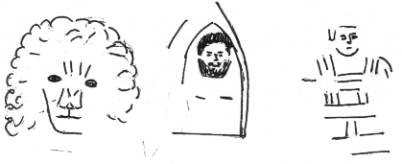
At Sumatar
Harabesi 40 km north east of Harran, there is an old high place dedicated to Sin,
the moon god of Harran. On a mountainside two reliefs are carved: of the old
god Sin called Marelahe ("Lord of the Gods") and the young sun hero
standing in the gate of the sun[5]:

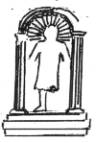
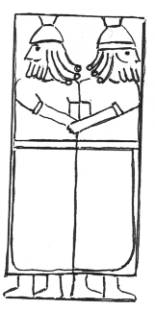 Another important motif is the
primordial twins as personifications of the two pillars of the sun´s gate[6].
Another important motif is the
primordial twins as personifications of the two pillars of the sun´s gate[6].

The cross,
the mystical flower with four petals is the symbol of cosmic centre, of all
diversity being united into one. This can also be shown by a very special
sphere symbolising the unity of cosmos. In a temple from Dura gods are seen
standing on this device[7].
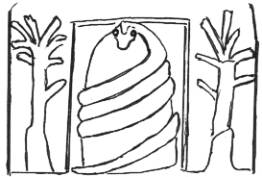
I hope our
small investigation has shed some light over important motifs as the four
rivers from Eden, the two trees and the two primordial brothers as opposites,
the snake and the moving of human mind from unity to knowledge of duality, good
and evil, male and female. Ill.
from Roscher, Neue Omphalosstudien,
Abh.d.phil-hist.Kl.d. Sächs. Gesellsch.d.Wiss.vol. 31.taf III, no.3. See also A.J.Wensinck, Tree and Bird as Cosmological Symbols in
Western Asia,1921.