25. Later developments
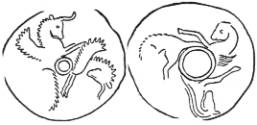
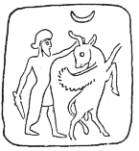 The bull has the moon as its
heavenly horns. That it is not a normal bull is seen from the wings and
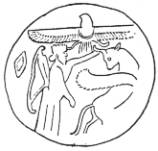
three-fold appearance as running in the circle of the sun. Above the scene of
it being caught is seen the bird of ecstasy, and even the hunter being united
to the bird of ecstasy, or being lifted up in the clypeus (symbol of the sun’s
circle) to the bird of ecstasy by two horses (Legrain,955,876,885, 952f.,969).
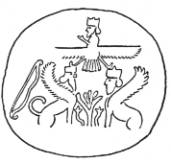
The last seal shows the hunter as the spender of the juice of life. This stream
of liquid has its real source in the primordial mountain with the bowl of the
crescent moon at its top, cf the scenes showing Mithras getting water by
shooting at the rock, Moses by beating his rod against the rock.
The bull has the moon as its
heavenly horns. That it is not a normal bull is seen from the wings and
three-fold appearance as running in the circle of the sun. Above the scene of
it being caught is seen the bird of ecstasy, and even the hunter being united
to the bird of ecstasy, or being lifted up in the clypeus (symbol of the sun’s
circle) to the bird of ecstasy by two horses (Legrain,955,876,885, 952f.,969).
The last seal shows the hunter as the spender of the juice of life. This stream
of liquid has its real source in the primordial mountain with the bowl of the
crescent moon at its top, cf the scenes showing Mithras getting water by
shooting at the rock, Moses by beating his rod against the rock.


The myth surrounding Cadmos and
Harmonia is today only preserved in the Greek version from Thebes. The riding
on the back of the bull, Cadmos following and killing the cow with the sign of
the moon on its flank as an act of creation, the final transformation into a
snake connects this myth with the complex of ideas found in the mysteries of
Mithras. Just after the feasting together with the assembly of the gods, Cadmos
and Harmonia are riding together in the chariot, cf how the journey in the
chariot of the sun in the iconography of the mysteries of Mithras follows just
after the holy meal with Sol, the sun.
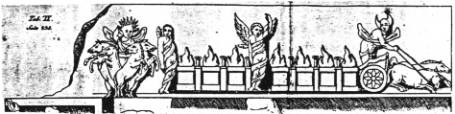
A relief now disappeared, but once
to be seen in the house of Ottaviano Zeno (G.Zoega,Abhandlungen,1817,pp.184ff., cf M.J.Vermaseren, Mithriaca IV,1978,pl.11-17) shows above
the bull-killing scene the sun rising in its quadriga and the moon descending
from a place with 7 flaming altars separated by 6 short columns carrying short
poles or pillars, and as the seventh pole a man with a snake coiling around his
body. In the centre another man with the snake coiling around his body, but
this man has wings and a long stick in his hand, and is standing just above the
top of Mithras' hat. The snake coiling around the first figure is turning its
head upwards, the same direction as the four horses pulling the chariot of the
sun seem to take. The snake coiling around the second figure is looking
horizontically in the direction of the sun. A picture of the lost relief is
preserved in quite another version with a rounded top to fit into a gem.
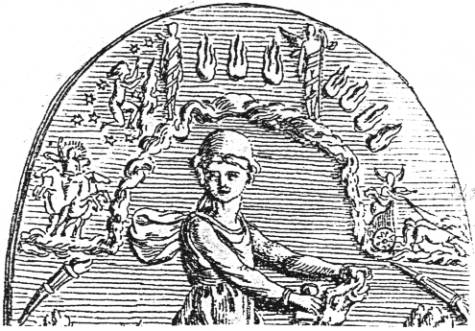
The top of the universe, the goal of
the ascension to heaven is symbolized by the seven pillars of fire separated by
the sevenfold world pillar, 6 of them pictured as the world pillar, the seventh
pictured as Saturn, the god of the world pillar. He is standing next to the sun
travelling towards the summit of cosmos, he is the god for the raising of the
kundalini, the inward journey upwards. The second figure is the unity of the
sun/Mithras/the initiate and Saturn, standing firmly at the centre of the
summit surrounded by sevenfold flaming light, but also with his wings able to
fly in the orbit of the sun (cf the snake looking in the direction of the sun).
It has rightly been stressed by R.Beck[1]
that the heart of this religion is the ritual ascension acomplished magically
in the subterranial caves and called diexodos
and seen as a journey "through and out of the heavens or the
universe"[2]. It is the
same symbolism when the mysteries speak about the "ladder of the 7 gates
with the 8th on the top". By this journey you transcend the destiny laid
down by the planets. Beck has rightly stressed the Babylonian astronomical
notion of the unity of the sun and Saturn as an important key to the
understanding of the relief [3].
He interprets the columns as "swords", but a fresco from Barberini
has trees standing between the fire-altars: the sevenfold tree of life.
The North Syrian background is shown
by the god from Hatra with a lion's face, an ascending double snake, and followed
by the animals, lion, dog, snake, and scorpion, the same animals that follow
Mithras (and Resheph in Byblos). Mithras is the Syrian sun hero travelling in
the chariot of the sun, but as leader of the demonic pack of animals including
the black thief, the raven, and finally changed into the god with the lion's
face, he is the great hunter. An important step towards the full initiation was
the grade, Leo = "lion". In the cave at Santa Prisca the member of
this grade is painted red, perhaps this "intended to portray his fiery
nature"[4]. Porphyrios
says that their hands were washed in honey, not in water, for water was hostile
to fire! The Mithraic god with the lion's face is seen on a relief from Palazzo
Colonna in Rome (CIMRM 383) with a torch in each hand, and with his fiery
breath he makes a fire on an altar burst into great flames.
Austin Layard got hold of a few
tattered pages from the holy book of the Yezidees “containing a poetical
rhapsody on the merits and attributes of Sheikh Adi, who is identified with
the Deity himself, as the origin and creator of all things, though
evidently distinguished from the Eternal Essence by being represented as
seeking the truth, and as reaching through it the highest place, which he
declares to be attainable by all those who like him shall find the truth”[5].
In the EGO EIMI-stile used by divine epiphany he pictures himself as the one
who is both appointed ruler over the cosmos and judge of living and dead.
“And I am he to whom the destroying
lion came,
Raging, and I shouted against him
and he became stone
And I am he to whom the serpent
came,
And by my will I made him dust.
And I am he who struck the rock and
made it tremble,
And I made to burst from its side
the sweetest waters”(Nineveh and Babylon,I,p.90f.).
He clears his road for the lion and
beats both the snake and the primordial mountain. The spiritual goal in the
religion linked to the cult of the hunter is becoming God.
We have already mentioned the description
in the Koran of Dhul Karnain:
“We gave him a way to everything;
and he followed a way until, when he reached the setting of the sun… Then he
followed a way until, when he reached the rising of the sun… and we encompassed
in knowledge what was with him”. Sura 18,83ff.
But we could just as well mention
Moses, also shown as a traveller through the world:
“Moses said to his page: I will not
give up until I reach the meeting of the two seas.” Sura 18,59
When they reach the place, they
forget the fish they caught. When it comes into contact with the sea, it is
revived and takes off, which is the proof that they have reached the place
where the upper and lower seas meet, and where the secret spring of life gushes
forth.
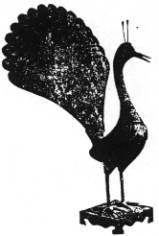
 We have mentioned the Yezidee-religion:
their main god, the peacock angel, the devil, also called Taus Melek, is the
mystical bird, a later development on the basis of the Phoenix & the eagle
of Baalshamim. They have preserved the link between the fiery bird and the
kingship. Acc. to the “Black Book”,
the Peacock Angel is the initiator of kingship: “He gave us, besides the old
Assyrian rulers, the following kings: Nesrox, also called Nasir-ed-Din… (then
is named Kambyses, Artemis, and Shapur I and II) and from them our emirs
descend until this day” (XXII) Nesrox = Nasir is perhaps nsr = “Eagle” in Semitic. (The language of the “Black Book” is old Kurdish.)
We have mentioned the Yezidee-religion:
their main god, the peacock angel, the devil, also called Taus Melek, is the
mystical bird, a later development on the basis of the Phoenix & the eagle
of Baalshamim. They have preserved the link between the fiery bird and the
kingship. Acc. to the “Black Book”,
the Peacock Angel is the initiator of kingship: “He gave us, besides the old
Assyrian rulers, the following kings: Nesrox, also called Nasir-ed-Din… (then
is named Kambyses, Artemis, and Shapur I and II) and from them our emirs
descend until this day” (XXII) Nesrox = Nasir is perhaps nsr = “Eagle” in Semitic. (The language of the “Black Book” is old Kurdish.)
The picture of Taus Melek is from Anthropos VI,p.39:
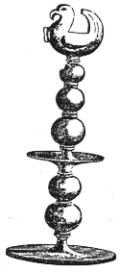
Austin Layard has also drawn the
picture above: “It is not looked upon as an idol, but as a symbol or banner”[6]
It is the late descendant of the semeion with
its five balls and the bird arranged as the crescent moon at the top. It is
interesting to see that Baal and Anat have long gone: what survives is the
symbol of mysticism, the bird of ecstasy.
W.B.Seabrook, Adventures in Arabia,1928 has a chapter on a modern visit to the
Yezidees. He mentions among other things that the snake was blackened by means
of lead. It was called a symbol of wisdom (alam
el akl). Among the other decorations on the walls surrounding the inner
temple yard a double axe is mentioned. Under the holy temple there are caves
going deep into the mountain, one of them leading to a well situated inside the
mountain. As the holy elements of the Yezidees, fire and water are
mentioned. Every spring a white bull is decorated with red flowers, and an
artery on its neck is opened and it is led round and round the white tower of
the temple till the whole foundation is bathed in blood.
Satan, the Peacock Angel, is the
first of seven spirits created by God, who is looked upon as a deus otiosus that has withdrawn from
every influence on the affairs of this world and put everything into the hands
of the Peacock Angel; after reigning for 10000 years the latter will return to paradise
as leader of the seven spirits.
The leader of the sect was
acknowledged as ruler after having conquered this position by killing his own
father!! His forerunners had the right to enjoy the first night with every
bride. These two facts show to what an amazing degree the old figure of the
hunter survives in this “king” of the Yezidees. Also Gilgamesh is said to enjoy
the right of the first night. The founder of the sect, Sheikh Adi, was born in
the vicinity of Baalbek; after a travel to Persia where he received an
important revelation through fire he founded his religion, probably under the
influence of some old Magi teaching. The souls are carried into paradise in a
basket on Sheikh Adi´s head, they undergo no judgement, and do not have to
answer to anybody. An important Yezidee dogma is the ideal of androgyny: in
paradise man will be neither male nor female, but “the perfect union of both”.
They are mostly dressed in black (with red turbans) and their holy book is
called the “Black Book”. They constantly seek to avoid the blue colour, which
in the Middle East is the colour used to scare away demons (the colour of the
water and the sky).
Seabrook is also granted the
opportunity to be present at a Dervish session performed by a group of the
so-called Ruphai-Dervishes (living between Hama and Aleppo). The monotonous
song, “Al-lah”, is broken by the ecstatic call, “Ya hoo!” (= Oh him!, explained
as “Oh, him that is!”), whenever one feels the presence of the divine, and the
posture of Elijah is used to gain melboos
(= trance).
When visiting the Druse community in
Syria he seems to be able to confirm the rumour that, as a symbol of the
Highest, they treasure the golden model of a calf’s head hidden in a silver
box.
This modern traveller brings so many
examples of the amazing continuity of the folk religion that his book deserves
to be mentioned even in a scientific setting.
Cilician
coins sent out by the Persian satrap, Tiribazos (386-380 b.C.), show a god
whose nakedness and polos make him much more a Sandas, or a Melqart, than an
Ahuramazda. The mystical flower is typical of both Melqart and Sandas, and the
wreath of victory is typical of the Syrian Sol Invictus symbolism: the god
coming to the end of his fighting is receiving the crown of victory and apotheosis
in the mystical light or the cultic bonfire.

Ill. from A.B.Cook,Zeus I,p.208 fig. 154, Brit.Mus.Cat.Coins.Lycaonia,
Tarsos p.164 p1. 29,1.
Note
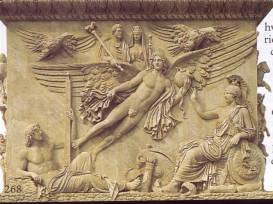
the design of the coin: it is very similar to the one on the base of the pillar
of Antonius Pius showing the emperor's apotheosis. The Roman motif has its
roots in the Syrian Sol Invictus cult and the Cilician Sandan-cult. The eagles
of apotheosis prove that the scene is closely connected with the
consecratio-ceremony at the death of a Roman emperor, where an eagle was let
out from the top of the bonfire[7],
cf. the eagle at the top of Sandan’s
pyra. It was designed as a wooden pyramid, and when it was set on fire, the
eagle at the top was let loose. The presence of the emperor was not in the form
of his dead body, but he was represented by a wax-mannequin.
Note the world-pillar as obelisk. Instead of the
bird with the two snakes hanging down we find the god Aion lifting the emperor and his wife to heaven. But in his
left hand Aion is holding the ball of the universe with a snake coiling round
this “world-egg”, its tail hanging down [8].
The androgynous symbolism of the ascent to heaven requires the presence of the
emperor’s wife although she does not follow him on his funeral pyre.
One of our main theses is that
religion does not change. A modern Curdish sect is Ahl-i Haqq: “Those faithful
to the Truth”. One of the manuscripts used by this sect is ed. by Mohammad
Mokri and given the title Le Chasseur de
Dieu et le mythe du Roi-Aigle, 1967 (“The man hunting God and the myth of
the Royal Eagle”). The hunter, Binjamin (the angel Gabriel in a human body),
gets hold of a magical yellow snare or lasso and with the help of this device
he is able to catch the “unborn and immortal” eagle Simorg, an epiphany of God
himself. Acc. to other traditions this bird has its nest on the mountain Qaf in
the centre of the world. The hunt was succesful when the snare was held up
against Kajwan (Saturn[9])
When Binjamin was incarnated as a
fish he saw the King (God) in his manifestation as Ja, acc to other traditions
the first manifestation of God as the Pearl, the shining world-egg [10].
Binjamin´s magical snare is also
among the weapons carried by Sjah-Palang-Farsi, “King Panther from Fars” [11].
Binjamin called “the Lord og the Covenant” is a parallel to the hunter Mithras
hunting the divine bull. Abraham travels together with Gabriel to Kajwan in the
sense of going to heaven, [12],
cf the journey of Mithras in the chariot of the sun to Saturn. When Abraham is
called “the Rider on the Dark Steed”, and his knife is given special attention
and a special name, Hawam, then this is more the symbolism of the hunter than
that of the Bible.
In a Persian piece of prose,
Iskandar-nama, it is told how Alexander the Great comes to a castle with a high
iron pillar (the world pillar) and on top of it a bird tied to the pillar with
a golden chain [13]. At the cry
of the bird a dragon comes forward, and Alexander has to be saved by
Aristotele. Alexander is here the sun hero confronted with the dragon as
primordial totality.
The Slavonic version of Josephus, de bello
judaico, gives a very interesting description of John the Baptist: he took
neither meat nor bread as food, but survived on bulrushes, roots and chips of
wood, and everywhere on his body where his own hair did not cover he had
covered it with hides of oxes. He was sent out to preach that "no mortal
man" but "the highest" should take over the kingdom and
"rule over you". There would soon be given the people "an
emperor to deliver them". God had sent him to show the people how they
could be delivered "from many tyrants". The son of Herod, the prince
Philip has a dream where an eagle chops out his eyes and the Baptist interprets
the dream as foreseeing that both his power and his wife will be taken from
him.
In Russia and White Russia we have
the old traditions of folk religion associated with John the Baptist, Jan
Kupala, who "falls into water", i.e. is transformed to this vital
element. There are both the traditions of bonfire and water linked to his
important feast at Midsummer. He is in the above mentioned Slavonic tradition
seen as the "bull man" of the folk religion, but also with strong
connection to the forest: the Pharisees address him with the words "You who
have come from the forest like an animal". Now, forests are not a typical
Palestinian phenomenon, and his living from chips of wood confirms his intimate
relation to this forest, which is certainly more Russian than Near Eastern. Jan
Kupala is here an epiphany of "the shepherd", "the
Enkidu-type" of old folk religion and very typically described as the
messenger of the "Highest", who wants to take over after the rule of
many chaos kings, one of whom will be punished with blindness just like Lycourgos,
Orion and Theiresias.
Jan Kupala,
John the Baptist, is celebrated in Russia tn the following way:
At midsummer’s
eve a tree is made up with bonbons
and wreaths and flowers. The tree or a doll supported by the tree is called
Kupalo. Wreaths with candles are put in the water, and the tree is finally put
into a river and songs are sung about Kupalo going bathing, falling into the
water.
The god of vegetation is closely connected to water. He is Kupalo, he is
hunted down by singers who burn him in the pieces of wood thrown into the fire.
This is the old tradition of the god of life-fluids and flowers (Adonis) being
threatened by the demon of fire. But instead of the bucranion on a pole a
horse's head is put on a long pole in the midst of the bonfire. But also the
old symbolism of the lifegod falling into water, being changed into water, can
still be traced.
The Etruscan people came to Italy from Western Anatolia.
S.Hummel, who to a certain degree is building upon an older scholar,
A.Grünwedel, has tried to show a number of similarities between Etruscan
religion and Buddhist tantra [14].
Both the Etruscan and the early Tibetan culture have an “archaic substratum”
“chthonisch ausgerichtet” (p.294) with tumulus-graves,
snake cult with ritual nakedness, creatures put together of man and animal, a
special concern for the dead spirits, mundus as a shaft in the centre of the
town connecting it with the underworld [15].
But Hummel does not take the line of thought as far as Grünwedel, who finds devilish
rituals and black magic by Estruscans as well as by the Manichees and the
Tibetan lamas. All are seen as traces of an original Anatolian prehistoric
religion.
A.Grünwedel[16]
has pointed to the devil of the Avesta and his close connection to the tantric
magician calling upon the dark side of the supernatural world. Acc. to Grünwedel
the tantric tradition of Central Asia has its roots in prehistoric time, and he
tries to find its forerunners in both Estruscan magic and in the inscriptions
of Hieroglyph Hittite. His attempt to solve the riddles of the last-mentioned
can not be considered successful. But his strongly negative evaluation of the
tantra of the red-hat monks of Tibet, so carefully kept secret and covered with
modern humanistic phrases, must be taken into consideration.
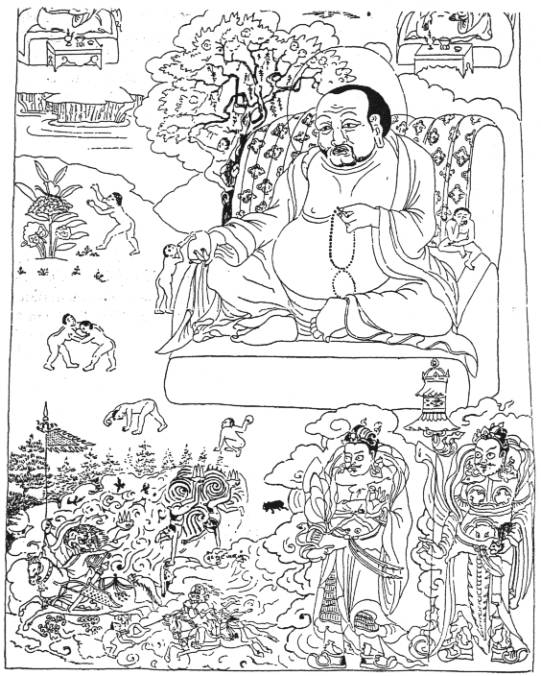
As
fig 4 in his book the picture shown above is used: little boys are playing
around a rather bulky yogi. One is climbing a tree to pick some fruit. At his
feet two are playing with the fruit, and a third is tasting something from the
bag in the yogi's right hand. At the bottom of the picture to the right two
demons, the demon of wealth and the king of the nagas with a snake coiling
around his arm, are looking at a scenery of great importance for the
understanding of the picture: over a small pond of blood, and through a boiling
mist of clouds,a demon with a dog's head is riding, followed by his Shakti. In
one hand he holds a scull with blood coming up in three beams. At the top of
his lance there is a small human scull. His bow is hidden in a bow case covered
with leopard's skin. His wife gallops forward, transfixing a poor boy on her
trident, she is partly covered by a tiger's skin, and with the other hand she
is trying to stuff her mouth with the corpse of a child. Behind them two boys
are turned into monkeys on the background of the fog being changed into a
demon’s head. Both carry sculls filled with blood, and the first one has ripped
open a boy, and is putting his heart into his mouth. They are followed by a dog
with fiery eyes, and by black birds.
Certainly
this is the tradition of the wild hunt: in the presence of demons man is being
changed into animal/monkey – even turned upside down, standing on his hands
holding his cup with his foot. But it seems that the boy holding the apple is
already trying to bring himself into that position: the fruit of wisdom given
to the boys by the fat arhat is
certainly not a good one.
Christianity,
Judaism, Iranian and Nordic religions are ethical religions. They believe in
good and evil, right and wrong. There is another tendency making itself felt in
modern psychology and so called “holistic” New Age-thinking. This tendency
tries to make man transcend his moral upbringing and reach the state of
Nietzsche's “laughing lion”. This tendency has yet to prove its kindness to the
human race.
25.a.
Gnosticism
Simon Magus,
the first Gnostic, and Helene, the prostitute he liberated from a brothel in
Tyre, are symbols of the Father (Salvator) and the soul to be saved (salvanda),
and the cult they teach is a ritual called “Love": a supper, where the
candles are put out by wild dogs attracted by the smell of flesh. When the
candles are turned over, men and women mate freely under the cover of darkness.
This combination of animals tearing the flesh and the human followers giving
themselves to raw and normless behaviour is a remnant of the very old cult of
the “hunter” and his dogs. It is old Syrian folk religion.
Acc
to Irenaeus the followers of Simon make use of paredroi ("sitting
next to you at the table") demons
I,23,4 cf. 25,3 about the Carpocratians who try to commit every possible sin to
avoid being reborn. Rev 2,14-24 speaks about people knowing the depths of Satan
and being followers of the prophet Bileam. The Carpocratian movement seems to
be one of the earliest Gnostic sects, perhaps a Samaritan sect from about 120
A.D. It is characteristic that the libertine Gnosticism (Simon Magus,
Carpocrates) is older than the ascetic Gnosticism. The getting yoked to a syzygos or paredros demon seems to be a main concern.
Very
quickly, Gnosticism seems to have become a calling upon demons more than a
belief in God. Early Gnostic sects emerge as the left hand tantric interpretation of some anti-nomistic features in
early Christian encounter with Judaism. This calling upon a paredros demon has
a clear purpose: to get supernatural power, and to reach liberation from a
bondage created by your own thinking.
Creation as the descent of the kundalini-power from the level of eternal
mystical vision is also known by Corpus Hermeticum: “I see a vision without
limits, everything has become light … and seeing it I was taken away by it”.
And then a little later a darkness was born downwards, scaring and sinister:
“It was rolled into a spiral like a serpent” (C.H. 1,4).
Here the movement is not from earth through the snake-coils to mystic
vision. But from mystic vision through the falling snake-coils to the emergence
of the lower element of “moisture” and “steam”: “this darkness changed itself
to a sort of moist nature letting out a steam like the one coming from water”.
In an important book about Gnosticism, Judaism
and Egyptian Christianity, 1990 Birger Pearson has tried to
rehabilitate Moritz Friedländer who was the first scholar to suggest that
Gnosticism originated in Judaism. In Alexandria a group of “antinomian” Jews
was already promoting their viewpoints on the interpretation of the Old
Testament, which can be seen from the writings of Philo, especially “On the
Migration of Abraham” 86-93 and “On the Posterity and Exile of Cain”.
In the last mentioned Cain is the symbol of heresy. This leads us directly to
the Gnostic sect, “the Cainites”, a radical antinomian sect, who, like the
Carpocratians, “hold that men cannot be saved until they have gone
through all kinds of experience”, “not shrinking to rush into such actions as
it is not lawful even to name”. “An angel, they maintain, attends them in every
one of their sinful and abominable actions, and urges them to venture on
audacity and incur pollution…they do it in the name of the angel, saying, ”O
thou angel, I use thy work; O thou power, I accomplish thy operation”.”
(Irenaeus, Adv.haer. I,31.)
In the
socalled “Left hand Tantra” in India such things are done to attain power from
the dark side, the demons. There are “white” magicians serving a group of
spirits “Agharti” belonging to the light, and there are “black” magicians
serving a group of demons coming from “Shambala”. The dark spirits are served
by acts of transgression of normal moral behaviour, that is by eating meat,
drinking alcohol, committing incest and even murder. By this transgression of
all borderlines of normal thinking one will attain supernatural power and the
assistance of the dark demons who are attracted and pleased by these dark
doings (Benjamin Walker, Tantrism, Its secret Principles and
Practices,1982). In Hippolyt's description of the Carpocratians it is
stressed that only by doing these things one will be able to get “power” and
free oneself from the endless chain of transmigration. Here suddenly the goal
of salvation is defined in a typical Indian way. In the sect of the Cainites
the foul deeds are done to please “the angel”, obviously an angel from Hell and
not from Heaven. The Carpocratians made use of “helping demons”.
Typical of
Indian tantric thinking is the notion of kundalini (Sanskrit = “the
coiled one”). Creation of the outer visible world was brought about as the
result of a fall: originally the female principle, the kundalini-power, was
united to the male principle in the brain of the god Shiwa, but it fell and is
now in its lowest position. Salvation is to try to make the female principle
ascend to reunion with the male principle. There is a perfect parallel between
macrokosmos/macr'anthropos (the god) and microcosmos/man. In the human body the
kundalini-power is resting at the bottom of the spinal cord where it is seen as
a snake coiled in three and a half coils round a golden egg. By the secret
tantric practices it is made to ascend through a channel along the spinal cord
to the top of the brain where the male principle is situated. The most
important way of making the kundalinipower ascend is coitus, or at least trying
to stimulate the erotic feelings until they reach a state where the whole mind
is manipulated. This could be done by trying to hold back ejaculation or by
transgressing normal morals in the sexual behaviour.
The key to
Gnosticism is mysticism. Mystic vision could be prepared by asceticism and
fasting and reduction of sleep. But in India the life of several gurus are the
sad examples of another hidden way.
The tantric
thinking obviously goes back to prehistoric times where it is closely linked to
the belief in the great female life-principle, the mothergoddess. The
similarities between Kali/Shakti and Anat, Athena and Ishtar have long been
known by scholars. The birth of Athena first united to her father's brain and
then jumping down from her father's forehead after the big blow of Hephaistos'
hammer is typically tantric.
Now certainly
Simon Magus is deeply committed to tantric thinking. Like Athena the female
principle is jumping down from her original union with the “Father”, with the
pure mind and becomes entangled in thinking, seeing, hearing, being enslaved in
the unreal world of the senses. Her reunion with the male principle is brought
about by sexual activity during the so called love-sessions (Agapai) where love
is practised indiscriminately after the candles are put out. For the
understanding of the origin of Gnosticism it is important that libertinistic
Gnosticism (Carpocratians, Simon Magus, Nicolaites) is older than ascetic
Gnosticism. Nicolaos was one of the seven deacons named in Acts. He was married
to a very beautiful woman, but although he and his children lived like virgins,
he seems to have committed the outrageous act to offer his wife to his
disciples with the motto that “the flesh had to be used”. He is named together
with Bileam, who in later Jewish mysticism (Zohar II,fol 21b-22a) is
hailed as just as great a prophet as Moses but of the ”left hand”. While the
prophets of Israel served the “upper, right”, he served the “lower, unholy,
left”.
The
Gnostic system of the Naaseni is named after the Hebrew name for serpent, nahash.
“They assert that Edem (= Eden,paradise) is the brain…bound and tightly
fastened in encircling robes, as if heaven”. The paradise river which proceeds
out of Edem and divides in four is 1)the eye 2)hearing 3)smelling 4)the mouth.
In this stream of the senses all the things of the world of the phenomena
originate and take shape and colour: “Into this water, he says, every nature
enters, choosing its own substances; and its peculiar quality comes to each
nature from this water” Hyppolitus, Ref. V,4. The visible world is the
result of a fall of life-giving water falling out of paradise.
A little
later Ref.V,20f. Hyppolitus describes a system obviously closely related
to the system of the Naaseni and developed by a certain Justinus. Here Edem is
a virgin with her lower parts resembling a snake. Instead of a
male and a female principle, we have two male principles, a male Father without
prescience and “a certain Good One”. The lastmentioned has prescience and is the
highest. The female principle is described as passionate, two-minded, two
bodied, but nevertheless the male Father passes “into a concupiscent desire for
her”. Their union gives birth to 12 male angels, Gabriel, Michael… and 12
maternal angels, Babel, Belias, Satan, Naas, Leviathan… and the maternal angels
divide into four, and each fourth part of them is called a river, that is the
four rivers coming out of Eden. After completing the creation of all things
(the wild animals were created from the lower, snake parts of Edem) the Father
wished to ascend, and he does so by using the gate ritual from Psalm 24, and he
is able to enter the highest heaven towards the Good One and see “what eye hath
not seen, and ear hath not heard” (mystical vision). But the female principle
in this system by Justinus is reckoned so low that it has to stay in the lower
world as “she was not disposed to follow upward her spouse”. This is obviously
a later expansion of the original Naassene system from two to three principles.
Although the
coiled one, the snake, in India the symbol of ascension, is not permitted to
ascend in the system of Justinus, it has a much higher position in the
Naasseni-system where it gives its name to the whole sect and is described as a
“moist substance”, and “nothing of existing things, immortal or mortal, animate
and inanimate, could consist at all without him”. “He imparts beauty and bloom
to all things that exist according to their own nature and peculiarity, as if
passing through all, just as (the river) proceeding forth from Edem, dividing
itself into four heads.” The snake-power (in this system a male principle)
giving life and beauty to everything is a close parallel to the Indian
kundalini.
In the
system of Justinus the snake-like figure is certainly not the origin of
nature's beauty. And the maternal angel called Naas is a mere bandit having
intercourse with both Adam and Eve “from whence have arisen adultery and
sodomy”. Here the “Good One” is identified with Priapus “having in the first
instance formed (according to His own design) the creation, when as yet it had
no existence”. Now Priapus is mostly known for his erection and strong
male potency. So obviously male sexual energy is a positive thing and the
Father ascends to see that not all the things he created by using woman as a
mere tool suffers from deficiency. Woman has positive power but “the
entire of the power belonging unto herself, Edem conferred upon Elohim (the
Father) as a sort of nuptial dowry”. In Indian tantric mysticism the wise for
the sake of coincidentia oppositorum must choose as his sexual partner
the primitive washer-woman. The Naassene on the contrary abstain “with the
utmost severity” “from intercourse with a woman.”
The mysteries of
Mithras has as a symbol of the final consummation, the end of Mithras ascension
by flying in the chariot of the sun, the god Saturn standing erect like a
pillar (the Semitic name, Kewan, means “the one standing firm”). Saturn is
wrapped in several, often 7, snake coils, a snake coils up along his body and
places its head on the god's forehead between the eyebrows as “the mystical
third eye”. In iconography this is most certainly the closest we get to the
Indian notion of the kundalini snake that ascends through 7 cakras to mystic
vision. This mystic vision is not brought about by asceticism but by drinking
and feasting on the sacred white bull's meat. The bull is the primordial being,
a perfect parallel to the primordial perfect macr'anthropos, Gayomart, killed
by the devil. Mithras is often pictured as a hunter, a perfect parallel to
Baal, the hunter, killing El's son
Jam-Jaw or castrating
El, the demonic boar/Ares killing Adonis, the lion killing the stag on so many
Phoenician coins, Seth killing Osiris, the god of destruction killing the bull
or the good shepherd. The roaring lion with the raised kundalini is the
ecstatic ascending to heaven by magic force, putting up his throne high above
the stars, Es 14. We are here confronting the last remnant of an old warrior
religion where the initiated are changed first into ravens then into lions,
like the ecstatic warrior ideology of the North where warriors are changed into
bears, werewolves and birds. Among the things dug out from the underground
caves of the Mithras cult were also wolf bones, the leftovers of a meal
consisting of wolf-flesh.
The hunter
and the hunt eventually become a symbol of the hunt for mystic vision: In the
scriptures of the snake-serving sect the Peratae the Bible verse: “Nebrod
(Nimrod) was a mighty hunter before the Lord” is quoted as a commentary to
Jacob's vision of God in Bethel Ref V,11. In this sect the snake
is hailed as the “originating principle of every motion of all things”.
To my mind
Gnosticism is an influx of old Syrio-Palaestinian magic religion with its
striving for the inner union of male with female principle (the male “whores”
dressed like women mentioned both in the Bible and in Lucian, De Dea
Syria and by Apuleius of Madaura) for the purpose of ecstasy. It is the
same magic folk religion illustrated by the many amulets with magical Syrian or
Jewish names and an ascending snake with a lion's head emitting beams of light,
or a warrior with a rooster's head, a human body and two snakes as legs. As a
new religion trying to define itself, Christianity had certainly some
difficulty in keeping this rather juicy material out of the church.
In the
system of Justinus salvation is not so much found in mystic experience as in a
ritual with baptism and enthronement through the gate-ritual.
Also Simon
the Magician starts his cosmogony with a female power, Ennoia, like Athena
jumping down from the Father (degredi ad inferiora, Irenaeus Adv Haer.
I,23,2) The same thing is told in his book, Apophasis Megale (Hipp.Ref
VI,4-13): Everything started coming into existence in the following way: the 6
first-roots of the principle of begetting takes its origin from the fire (i.e.
the supernatural mystical light) as the primordial principle. These roots are:
1)Nous
2)Epinoia (otherwise by Simon called Ennoia =
thought)
3)Fone (=sound)
4)Onoma (=name)
5)Logismos (later in monastic thinking it stands for the
unclean, disturbing thoughts)
6)Enthymesis (taking to heart, having passion about)
When Moses
says that in 6 days God created heaven and earth, Simon of course interprets
this about himself. He is the great cosmic mind, emitting Thinking and Thought
(“in the bible called heaven and earth”), Sound and Name (“called sun and
moon”), Logismos and Enthymesis (“air and water”). To this Simon finds a
parallel in the embryology. The child is fashioned in the womb (called
paradise), and the 4 rivers floating from paradise are the four senses: seeing,
smelling, taste and touch, by which the mind begins to turn itself outward and
lose itself in the outer world of phenomena and its bitterness, but bitter
frustrated passion and desire can be changed into something sweet by the
teaching of Simon, like the swords hammered out to plough irons.
The
original, all pervading cosmic principle is the fire identical with the desire
to generate, to “become inflamed”. This little spark in man, the longing for
sex, will become the great infinite power, the unchangeable Aión when it is
submitted to the right Simonean Logos (teaching). Then it will no longer be in
submission to birth and destruction, and it will not come to an end, even when
the world goes under. The turning sword of fire turns blood into sperm in man
and into milk in the breasts of the woman, and by this “the tree of life is
guarded”. In the Simonean sacrament performed “in the stream of waters”, the
initiated is formed into the image (exeikonisthê) of the great Standing
One, and his little crumbling desire becomes one with the big fire, the divine
cosmic principle. The erotic promiscuity has to be cultivated as it is the
“perfect agape and the Holy of Holies” (The same wording as the one used in the
Gospel of Philip about the “sleeping chamber” 85,19f). It is very necessary
that a man “sows” his seed, for in doing so he will become identical with “the
heavenly Father” and become eternally standing. If not, he will die. The
training of the sexual force is the promotion of the life force. The passion
can be even more useful than the mystic's state of ataraxia as it can be
developed into unity with the all-pervading mystical fire-energy.
To
understand Simon one must remember that the philosophy of his time was obsessed
with speculations about the archai, = the primordial principles of the
cosmogony, cf. the great work of Origine, Peri Archôn. But to understand
Simon's special form of mysticism it is necessary to understand the special
tantra ideology where vision is not brought about by fasting and austerities,
but by manipulating the sexual energies.
The scaring
darkness winding itself downwards in ”terrifying coils” like a snake and being
changed into water (Corpus Hermeticum I) is the sunken kundalini-power.
In tantra, creation
is the falling of the kundalini-power, its being separated from the male
principle. In the system of the Peratae the “Snake”, also called Logos
and Son, is moving up and down, mediating between the “Father” and “Formless
Matter (Materia)”. Hipp.Ref V,9,12 & 17,8.
The
Ptolomaic Gnostic system criticises the Jewish wisdom schools. Achamot's
(=”wisdom's”) seeking the Father nearly ends in a catastrophe, because wisdom
did not have “community with the Perfect Father like Nous” (Irenaeus, Adv Haer
I,2,2). She wants to conceive the “greatness of the Father” but this is
impossible because of the “Magnitude of the Depth”. Obviously we have here
traces of an early Shi'ur Qoma speculation about the gigantic measures of God's
body.
The grand
error committed by Sophia Achamoth is that she did not act in Syzygia with her
male partner. Again this is typical tantric ideology: there is mystic vision
only in the union of male with female. Christianity is also given some
importance: She has to be “shaped” by the “Cross” and the “Saviour”. But the
final salvation is in the syzygia-relationship between the sunken female power
and the saving male power. The criticism of the non-mystical quest for wisdom
is hard. It will only end in unsatisfied passion and desire (Enthymesis
is in the Latin version of the text translated into concupiscentia.) And
it is suggested that it is only under the pretext of loving the Father
that Sophia tries to seeks him. As in the above-mentioned systems the key-word
is sexuality. “The unutterable and unspeakable syzygia” is sent from above
(I,6,4) “He is not of the truth and does not come to the truth, who has not
joined himself with a woman” (ibd.). With a mixture of horror and indignation
the poor Irenaeus has noticed that the Gnostics maintain that vice and
abstinence are good for the Psychic Man, but for the Perfect, the Spiritual Man
it has to be maintained that he is not saved by doing good deeds, but rather by
despising normal morality and “pay his tribute to the flesh”(I,6,3). Some have
secret intercourse with the women they initiate into the doctrine, others feel
no worry in making themselves slaves to carnal desire (ibd.)
It has to
be stressed that Syzygia is the Greek word that functions as the exact parallel
to the Sanskrit word Yoga (from old the Indo-European word for “yoke”). It
means, “put under the same yoke with” and is used both in old India and in
Gnosticism for acquiring a helping spirit, a personal partner in the invisible
world.
In Jewish
tradition Bileam's great sin was that he tempted the Israelites to commit
adultery with and put themselves “in yoke with” Baal-Peor.
In an important book, Guardians of the
Gate,1999, N.Deutsch has dealt with the Mandaeic creator, Abathur, who,
just like Metatron in early Jewish mysticism, is enthroned just below or outside
the cosmic veil between the visible world and the transcendent world. Abathur
is lord over the world of opposites (Deutsch, p.107), he is the sperm coming
down from above in the visible shape of the river Jordan. This is typical
tantric cosmology: The visible world was created when the High God ejaculated
his sperm. Pherecydes Syros has as the first principle Chronos creating the
world out of his sperm. The two first principles of the visible world were acc.
to him Zas and Xthonie, male and female, celebrating the first holy wedlock. In
Mandaeism the first principle was “Life dwelling in its own radiance” (The
primal divine consciousness rapt in mystic vision. There is in Tantric thinking
a perfect parallel between micro-cosmos = man and macro-cosmos= High God.)
Through several intermediaries Life fosters Abathur who is the male cosmic
principle and creates the world by looking downwards into the depth of
darkness. This cosmogony is about the fall of a pure divine consciousness by
contemplating the darkness and thereby being entangled into the world of
phenomena. While Metatron is the mediator for the souls on their way upwards,
Abathur is the mediator for the cosmos on its way downwards.