26. Roman myth
Romulus and Remus were thrown
into the Tiber by Amulius, who had deposed his brother Numitor, father of Rhea,
the mother of the twins. They were suckled by a she-wolf and brought up by a herdsman,
Faustulus: the divine child is hidden by shepherds.
Numitor bears a name close to Numa, the great lawgiver
(cf. the Greek word nomos = “law”).
Numitor is the king of cosmos dethroned by the king of chaos, Amulius
("from a mule?"). During the Lupercus-feast the two brothers R.&
R. were taken captive by robbers and brought to the chaos-king Amulius. The
robbers are the symbol of chaos. At the Lupercalia, naked men dressed only in a
goat's skin are killing, not a wolf, but a dog. We find the old drama,wolf
contra goat/bull, but turned upside down: not the goat, but the wolf is giving
milk to the divine child, and the chaos-band is not dressed as wolf and
panther, but in goat’s skin. We could compare with the myth of the foundation
of Thebes: The brothers Amphion and Zethos are hiding among the shepherds,
persecuted by king Wolf (Lycos) and taking revenge by means of a bull tearing
up the wife of king Lycos.
At the Lupercalia,
two young men we acting in an important ritual: In a cave they were smeared with
blood on their foreheads. The blood was wiped off with wool, and they had to
smile. The wool cleans them from the bloody nature of the wolf, the time of
chaos/ the time of the wolf is over, and the goat or sheep can bring fertility
to the women slapped with straps of goat's skin. It is all to be seen in the
frame of winter, and spring coming with the first of March, the kingdom of the
young god, Mars, or his son Romulus. On the first of March, the old Roman New
Year, there is a Palm Sunday-like ceremony: official buildings are adorned in a
celebration of spring.
The so-called Regifugium, the flight of the king
of chaos, is also the end of winter:
With the help of the wife of his brother, Tarquinius
Superbus kills his brother and is married to the unfaithful wife.
He kills his father-in-law and becomes king himself. He
goes on to kill the husband of his sister. Marcus J. Brutus is acting insane to
save his life. He and two sons of Tarquinius visits the oracle of Delphi to
bring the god gold hidden in a hollow stick. A prophecy from the god foretells
that of all the royal sons, the follower on the throne will be he who first
kisses his mother. Brutus fakes a stumble and kisses mother Earth, and later
takes upon himself to lead the revolt against the cruel Tarquinius-family, also
being guilty of the rape of Lucretia. This is the typical kingship- of-heaven
myth: the king of chaos comes to power by killing the highgod = his father or
brother/predecessor, taking his wife. His reign is marked by chaos and cruelty,
and the young son of the highgod has to hide or act insane. His reign is cosmic order restored, therefore he can
only survive by hiding this and adapting himself to the chaotic order. We find
the same motif in the Nordic legend of Amleth (told by Saxo): Fengo kills his
brother and takes his wife, and the poor Amleth has to act crazy, but in fact
he is wisdom incarnate (like Odysseus). He also has to travel with a hollow
stick, followed by two companions, and comes back with two hollow sticks filled
with gold. The long journey with the two hollow sticks and two companions is
the journey of the sun-hero to the far west or to the omphalos of cosmos, the
paradise-mountain. He kills his father’s murderer and becomes king.
Jane
Harrison (Prolegomena to the Study of
Greek Religion,ch.1) has compared the dancing of the Salii with the dancing
of the Curetes in Crete, beating their shields to prevent the demonic god,
Cronos, from hearing the cries of the
newborn Zeus. She even finds a picture of the Salii with a mysterious child
(the young Mars?). It can be compared to similar pictures on Cretan coins of a
weapon dance surrounding the divine child.
The
Cretan incident is part of the kingship-of-heaven myth: the divine child has to
hide until he is strong enough to lead the fight against the king of chaos, cf.
Romulus & Remus hiding among the shepherds (the bucolic sphere of the high
god). We will find the same setting at the birth of God's son, Jesus, Luke 2;
Matt. 2: The chaos king, Herod, with his mind set on murdering the divine child
hailed by shepherds.
Also
the Immanuel-prophecy of Isaiah foretells the birth of the divine child in a
country sinking into deep chaos, returning to a wilderness where only shepherds
survive on wild honey and yoghurt.
As
already mentioned, the child destined to restore cosmic order often has to act
as if insane: Orestes has to murder his father's killer, becomes insane, is
healed, and can follow his father on the throne. It seems very likely that the
legend of Agamemnon killed by Aegisthes in the bath and entangled in a net is
the god for the life fluid and water killed by the god of chaos. Aegisthes
(“super-goat”) is an avatar of Dionysos, who, at the old spring festival, the Anthesteria,
comes to celebrate hierogamy with the Queen (called basilinna). In the presence of Cheres the men are
tasting the new wine. Dionysos has arrived with the host of dead spirits, chaos
has come to town and license is permitted, and the Queen is in the hand of the
usurper.
But
the drinking party of the men is commemorating Orestes and his gloomy state of
mind: While the Queen is with Dionysos (here called “of the Swamp”), the men
are getting more and more heated by the wine, warming up for revenge. Soon the
usurper will be thrown out and order restored.
In Rome we have the rite of regifugium
on the 24th of February[1]:
after offering a sacrifice, the rex sacrorum has to flee from forum.
Acc to the ancient authors, this is in memory of the flight of Tarqinius
Superbus from the town. This king is especially remembered as a tyrant:
"an unjust, but powerful man", vir
injustus, fortis ad arma tamen.[2]
In the ritual, he acts like a king of chaos: “La figure de Tarquin…
présente le protagoniste du rituel sous les traits du souverain terrible. Le
roi bouffon du règne éphémère assume ici la majesté quon napercoit guère sous
le masque risible du prince saturnalice.”[3]
In Greek mythology, the wild hunter is Dionysos followed by his maenads
dressed in the skins of panthers. In a procession at night, the Sicyonians carry
a statue of Dionysos Baccheios followed by the statue
named Lysios: he that brings frenzied violence and madness/mania, and
the deliverer and purifier of the same madness. A similar duality is seen at
Corinth where two identical statues are called Baccheios and Lysios[4].
Dionysos is both the one who brings mania
and the purifier from this madness.
A similar purification is the essence of the Roman month of February (februum = “an instrument for cleaning”).
The month of February is marked by Dionysiac rites connected with the
Lupercalia: society is cleansed of wolves by men wearing goat’s skin.
Cosmos is restored by Mars, who, in the spring-month of March, recreates
society. The 1st of March is the day where those elected are installed in
public official authority. It is the old New Year’s day, where the doors of the
Regia, the several curias, the flamen's homes and Vesta's temple (while
her fire was rekindled) were bedecked with new laurel leaves after the old
leaves had been removed[5].
Winter is a time of chaos, the month of February was devoted to “purification”.
The young god Mars comes with the new year, spring and life renewed.
It seems as if the oldest agricultural year was a lunar year of 10 months
beginning with the spring harvest. The rest of the year from winter solstice to
March, was a period without any work being done in the fields, and therefore of
no interest seen from an agricultural point of view[6].
This is the reason why the end of the old year is celebrated at the end of
December. Later an extra month of 22 or 23 days, the month of merkedonius, was, in some years,
squeezed in between Terminalia (23rd
of Febr.) and Regifugium, followed by the rest of February consisting of 5
days.
The 23rd of Dec. is the feast for Acca Larentina: “they say that. .the
temple-warder of Hercules was idle during the feast and asked the god to shoot
dice… The prize was a dinner and a whore. When Hercules won, the warder shut up
in the temple a dinner and the most renowned whore of the day, Acca Larentia”
(Macr.Sat. I, l0.7-17). This is a very typical ancient rite: at the end
of the year there is a feast of orgiastic character joined by the lares, the spirits, cf the name of
Larentia. Acca is a goddess, and acc. to Macer's Histories I, Acca was
the nurse of Romolus and the wife of Faustulus: she married a rich Etruscan
named Carutius, and gave her big estate to her foster-son Romolus. This is the
goddess who deserts her husband, the highgod, to give herself to the god of
death. (His name being not without connection to the Greek name of Charon, in
Etruria the great god of death.) Also Hercules is here a variant of the great
hunter. Acca's day is called “black” acc. to Varro de lingua latina,6.23f, and used for ancestor worship.
The
strange Acca is both a prostitute & the mother of 12 sons, two qualities
that normally do not go together. The 12 sons are the New Year, cf the sons of
Jacob. Her husband, Faustulus, is a shepherd, as is Attis. She was herself
called lupa ("she-wolf"), which connects her with the rites of
Lupercalia. The only possible explanation of these facts is the goddess from Asia Minor hunting here, not in the shape of a
leopard, but in the shape of a wolf.
On
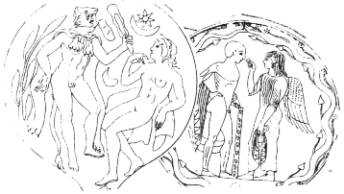
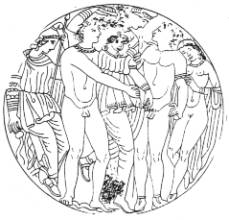
Etruscan bronze mirrors we find Hercules, called Hercle, standing with a woman,
who he obviously wants to take as his property. On the last mirror she is a
very tall woman dressed as Minerva, but without weapons, only with the Medusa-head
on her breast[7]. She is
taken away from another man and mourned for by two smaller persons. Another
mirror (Lex.Icon. 361) 3rd cent. B.C.
shows a woman taken by violence. It is the old hierogamic motif, the symbol of
fertility taken out of its sterile state of mystical primordial totality &
unity marked by the symbol of mystical light: the star united to the crescent
of the moon. On the last mirror, this unity is represented by the man manly
dressed carrying a spear, and the girl showing all her femininity, both by her
nakedness and her jewels: ear-rings, necklace, diadem. They represent the
androgynous, mystical sphere from which the woman is taken out by the god of
fertility, on the first mirror marked with a big symbol of vegetation, which,
on the second mirror, is encircling the whole scene. On this mirror the woman
has wings, showing that she has come from the land beyond. She shows Hercle the
mystical flower, and lifts her skirt to suggest the hierogamy (Lex.Icon. 413, 475-450 B.C.).
On
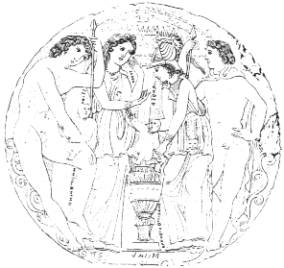
a mirror from Bolsena can be seen the Etruscan Hermas called Turms with a
winged hat and the caduceus. With one hand he is holding around the waist of
the child, Marisisminthians (Mars Smintheus),seated on his bent thigh. Then
Menrva (Minerva) bathing Marishusrnana in an amphora, then Turan (a goddess),
then a young man leaning on his spear, watching. Then a woman, Amatutun,
carrying the child, Marishalna, seated in the hollow of her hand. Under the
central scene is Hercle with his club and 5 other amphoras. Another mirror from
Chiusi shows a young man, Leinth, also with Marishalna on his bent thigh, then
Turan, then Minerva pulling the child, Marishusrnana, out of the amphora, and a
young man leaning on his spear. On the handle a third goddess called Recial.
In
our opinion this shows the god-child Mars being nursed by 3 goddesses, a scene
known from the Dura Europos synagogue and explained by E.Goodenough, who has
collected much material on this motif.

An
Estrusco-Latin basket from Palestrina shows Mars armed and crouching over a
large vessel with a sort of boiling substance (water or fire?). Minerva has her
left arm around his waist, with her right hand she brings a short stick to his
mouth or nose. It looks like the Egyptian “opening of the mouth-ritual’ for the
revival of a dead person: by a magic tool, the breath of life is brought back
to the god who is in the underworld. A 3-headed Cerberos is shown seated above
Mars, and a little Victory hovers over Minerva. Note the kundalini-snake
ascending to one of the three heads of Cerberos. Mars is a god dead and reborn,
or (which is the same thing raised from the realm of death). Better still: he
is the old god, Satres-Hercle, reborn. (Saturn and Hercules belong closely
together in Rome, being served with the same ritual.) Perhaps the native
Etruscan name for Mars was Laran (also seen as war-god on the mirrors), cf the
Roman goddess, Acca Larentia. Acca is
an old baby-word like Attas and Papas, even in Sanskrit its meaning is:
“mother”. Larentia is identical with Lara (like the modern Greek name for the
master of the underworld, Charos & Charondas). The name for Mars has the
old variant, Marmor, with the typical Anatolian reduplication.
Acca
L. was the mother of the 12 Arval-brothers,
who had to chant the old carmen Arvale[8]:
"Do
not allow Plague and Destruction to make incursions into...? Be thou satiated, savage Mars, leap on the
border, stand (guard) .? Help us Marmor, triumpe, triumpe, triumpe,
trium(pe,tri)umpe." Their MAGISTER held office from Saturnalia to
Saturnalia, their archaic prayer invokes Mars and the Lares.
Mars
is the killer and destroyer, born in fire, born in the underworld: ”At a
certain stage of furor (rage) he abandons himself to his nature, destroying
friend as well as foe”(Dumezil).
The
feast for Acca L. was the 23rd of December. It commemorated the orgy in the
temple of Hercules, and consisted in the sacrifice for ancestors called
PARENTALIA: a meal on Acca L. ‘s grave. The very ancient Roman institution, the
curies, observed the end and the beginning of the old year (1st of March) with
sacrifices and banquets. The CURIA ACCULEIA celebrated the festival of Acca
Larentia. In between, in February, was the archaic festival of cleansing
celebrated by the LUPERCI FABIANI and the LUPERCI QUINCTIALIS, each belonging
to a curia.
The mirrors
confirm that the strange myth about Acca L. given to Hercules as his price of
victory (together with a meal: on two mirrors a winged woman is presenting a
plate or dish for Hercle, LexIcon
415f) has an Etruscan origin. In Etruscan myth, the result of the union seems
to be a boy, Epiur, often seen on mirrors with Hercle and Minerva (LexIcon 154-58). Another mirror shows
Hercle with Vile (Jolaos) and the youth called Marshercles (“Hercle's Mars”). As mentioned above,
mirrors show Mars as a child taken out of a crater. To our opinion it is a
parallel to the hailing of the epiphany of Eros-Adonis coming back in spring
from the realm of death, rising from the box of aromates, the beauty box, in
Etruscan myth rising from a jar of wine. Here he is clearly the child of Turan
and Laran, cf. Larentia. The old song of the Arval-brothers calls for
the help of Mars and the Lares. The wings belonging to the female partner of
Hercle, and even to Epiur, is the sure sign of them being Lares, winged demons
of the beyond.
Saturn, a
veiled god bound with straps of wool, is closely connected to a goddess, Diva
Angerona. The feast for Saturn was the 17th of December, the Angeronalia were the 21st of Dec. The
cult image of Diva Angerona was a goddess with her mouth sealed and a finger on
her lips. Saturn and Angerona are the symbols of time returning to primeval
mystical immobility and silence. As the goddess of winter solstice, she is the
goddess for the narrow, short day. "One of the reasons for silence, in
India and elsewhere, is to concentrate one’s thoughts, one’s will, one’s inner
voice, and to obtain from this concentration a magic efficacy...”(Dumezil[9])
In
my opinion, the god Saturn could be understood as the god of primeval paradise
where all men were equal and nature gave abundant harvests to man living in a
state of pastoral simplicity. Saturn rules over the month of December with the
feast of Saturnalia. The double-faced Janus is a Near Eastern god: on Near
Eastern seals the servant-priest of a god is often pictured with two
faces.
A
Hittite seal shows a god and a goddess, the god enthroned with a three-fold lituus,
in front of him an altar carried by two panthers, and in front of the altar his
priest with the cross-symbol and a jug for libations. He receives a delegation
of three men, each armed with a lituus. Behind them a man with a cup
overflowing with water, and over the cup the holy sign of the unity of sun and
moon. He is the highgod pouring out the mystical juice of life. The god with
the threefold lituus and the panther-table must be the great hunter with the
panther as his symbol. His priest is the archetypal ecstatic seen as the merging
of male and female personalities (or young & old). The double face is the
melting together of two, the sign of the cross shows the melting together of
four to one single point.
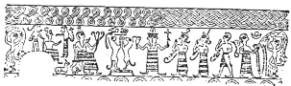
Archiv für Orientforschung VII, 1931-32,p.113,fig 2f.
The
next seal shows the same gods. The young god with short horns and a hairdo like
the Syrian Resheph: high pointed hat and a long band of hair going down the
neck (see also the picture of Kamosh). Behind his throne the double-faced Janus
with the two sticks, symbols of the gate of the sun, receiving a woman
approaching him. Next, a person with raised hands praying to a goddess. Finally
the highgod with the cup of immortality and a twig from the tree of life. The
scene so well known from Assyrian palaces of a winged genius adoring or nursing
the tree of life, is seen in front of the old highgod (note the great beard and
the longer horns):

E.Meyer, Reich
und Kultur der Chetiter,1914,t.IV
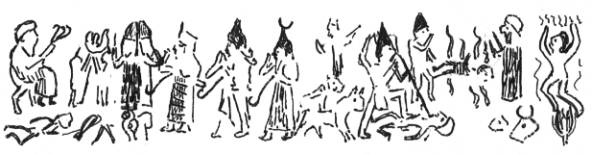
Both
the lituus, the high pointed hat and the arms raised in adoration are known from
Etruscan art, but the most interesting person is the doubled-faced Janus. The
arc of triumph is both acc to A.B.Cook (Zeus
II,pp.350ff.) and A.L.Frothingham (Rev.Arch.1905
II 216-30) the old Roman Janus-gate. HE IS A FAINT ECHO OF THE ANATOLIAN SUN HERO
and spender of the water of life, cf. Janus´s son Fontus (of fons = wellspring).
The
races of the quadrigas in the circus in
Rome was under the protection of the god Sol.
Acc. to Tertullian de spect. 8f. Circus was consecrated to the sun. This
seems to go back to the Etruscan period (A.Szabó, "Lustrum und
Circus", ARW 36,1939,p.157). An
Etruscan mirror, where the god of the
sun, Usil, is bestowing the wreath of victory on a winner in some athletic
game, seems to prove this (Szabó p.158; E.Gerhard, Etrus. Spiegel,CCCLXIV). This is important also for the
Triumph-ceremony: the name of Tri, as well as the name of the Etruscan king,
Tarquinius, brings us back to the Anatolian god, Tarku. The arch of triumph is
the gate of the sun, and the meaning of the ceremony is found in some very old
rite of apotheosis: dressed as Juppiter, riding in the quadriga of the sun,
coming through the gate of the sun, he who is celebratcd chief of arms is
hailed as the sun-warrior.
In Rome,
Hercules was the founder of ara Saturni (Dionysius
Halicarnassus VI 1,4), and the rituals in ara
maxima Herculis were identical with those in the temple of Saturn, the last
mentioned instituted by the Pelasgians and Hercules, Macr.Sat. 1,8: following
an oracle from Dodona, the Pelasgians came to Italy to seek for a swimming
island and to bring an offering of “heads to Hades” and “lights”, i.e. human
beings, “to the Father” (Saturn) Dionysius Hal. 1,19; Macr.Sat 1,7,31. The swimming “Ambrosian Rocks”, the offering of human
beings to Saturn is very typical Tyrian-Punic religion. As late as 216 B.C. two
Greeks and two from Gallia were brought as an offering to Saturn. Both Saturn
in Rome and Hercules in Italy were the guardians of treasures and both had
their heads veiled, like the Punic Saturn (velato
capite).
The Roman Saturn is the lord of vegetation: on his temple-ground could be
seen a statue of Silvanus, the god of the woods, and the holy fig tree
sheltering the divine twins, Romulus and Remus. The slaves ruling over their masters
at the Saturnalia is the symbol of return to primitive classless society. Janus
raises the gate and is the lord of all beginning.