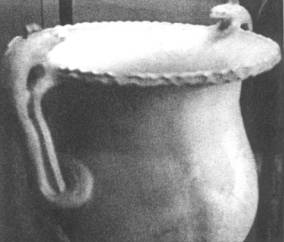
27.
Nordic Myth
Nordic
religion is about the great battle between good and evil, light and darkness.
Man is a warrior, and his highest goal is to die fighting, and if he dies on the
battlefield, he will come to Odin in Valhalla where he must practice his
fighting ability until the last day, when he has to join on the good side in
the final battle.
The
dark side is very strong and constantly threatening the light: “the sun hurries
in its course”, because it is constantly followed by a giant wolf, who wants to
swallow it.
The tree-of-life symbolism
The first root
of Yggdrasill, the cosmic tree of life, is gnawn by countless worms and snakes,
and 4 stags eat its buds. But the 3 Norns nurse the second root laying
soft and wet mud on its root, wet with the sublime white fluid of the well of
Urd: it is the symbol of divine whiteness and holy purity, whiteness without
any element of darkness: everything that comes into this well turns white like
the two swans that swim in the well.
Yggdrasill
is the great upholding force in the universe; the dew dripping from it into the
valleys is the honey drops in the flowers.
There
is a delicate balance in nature, the good life-bringing forces constantly being
worn down and gnawed to the bone by worms and maggots, and many animals feeding
on them. The world exists in the mildness where the roaring, ice-cold rivers of
Hvergelmir meet the burning heat from Muspelheim.
Also
Yggdrasill is the “bridge” that holds the two antagonistic forces together: a
heavenly eagle flying at its top and the dragon Nidhøg in Hvergelmir; between
them the little squirrel runs to and fro as a messenger bringing angry words
from one to the other. Yggdrasill holds the many antagonistic forces of cosmos
in some kind of balance. It is a symbol of God, the Highest, in the midst of
nature when the mighty forest opens up, and poor man in a blessed moment
sees/feels a glimpse of the Almighty.
For
9 days Odin hanged himself in Yggdrasill “an offering of himself to himself”.
Åke V.Ström takes this as a parallel to the purusha-offering in the Vedas. But
this does not explain why he is hanging on the tree of life.
Here
we have to do with a survival of the old prehistoric folk religion. The highgod
is the god of vegetation, and he is killed by the hunter, but often the
ecstatic hunter merges with his victim (ex.: Dionysos). Odin is both the king
of vegetation dying in the tree and the killer. A second motif is that by
experiencing death, Odin becomes the master of magic. Yggdrasill is also called
Mimer's tree, after Mimer's well, where Odin had to pawn his eye. That Odin
only has one eye makes him a mystic looking into ultimate unity, leaving duality. One eye is constantly
looking into the well of wisdom, the other into the normal world.
The
enormous tree going from earth to heaven is a mystical vision of the source of
all life. In the temple of Jerusalem the seven-branded candlestick, the Menorah
was burning night and day, the ever-burning, ever-blossoming symbol of God
himself as the light and life-source of the universe. Yggdrasill is also a
symbol of life always suffering under the attacks of death and destruction, but
conquering darkness and dragons.
From
the horns of the stag, Eikthyrnir, water is running into the well of
Hvergelmir, from which all waters have their origin (Grimnismal 26). Water, the source of all life, is thereby linked to
the holy stag at the tree of life.
Yggdrasill
is a mystical symbol: it is the higher source of all life in the universe, life
in concentrated form. By it is the well of life and the apples which give
eternal life (life ever renewed). Its name means "the horse of Ygg
(Odin)”, the place where he mounts to travel to heaven.
The
goats or stags feeding on the tree of life is a well known motif in the
iconography of the Near East.
In
the palaces of Assyria the tree of life is omnipresent, the earliest occurrence
we have encountered is a seal from Susa. We know it from Genesis and the
Menorah, from the temple of Gades and rather detailed descriptions in Iranian
texts.[1]
It
is not so prominent in Egypt, Arabia, Rome, but we meet the symbolism in full
scale in Nordic myth: the cosmic dimension, the eagle at the top, the snake at
the root, the divine deer, the life-giving function in cosmos, the well of life
or juice of life running from its root or dripping from its top, the apples
that give eternal life to the gods fallen from its branches (Ydun with her
apples fell from Yggdrasill). It seems as if the high North has preserved many
authentic features of a myth that has come to Scandinavia from an area
somewhere between Nineveh and Susa.
In many ways Scandinavia as a remote corner of Europe, far from the many wars
and wanderings pushing populations to and fro has preserved many elements of
archaic folk religion.
At
the beginning, the aser played the game of the golden dice (that is, determined
the destiny), but this golden age came to an end by the arrival of 3 women –
the 3 norns, that now rule over the
destiny of men and gods. Ragnarok means “destiny of the gods”. After Ragnarok,
the gods that are left, will find again the golden dice/tablets.
The
culmination of Ragnarok is the sons of Muspel riding up the bridge to heaven,
which breaks under their horses; first rides Surt, and “before and after him is
fire”. The sons of Muspel form a mighty army and are met by Odin with golden
helmet leading the einherjer (the
dead warriors).
To the Danish Romantic poet, Grundtvig, the Sons of Muspel were the
rationalist thinkers and scholars. Their lack of spirit and inspiration shall,
in the last days, cut off the communication between heaven and earth:
“Is this the light of the living
ones: a science that only shows us death, decay, that everything has to die and
rot”.
“This
is ungrateful to the hidden wisdom, the high Norn who weaves our destiny”. “We
live in times when people, by simply rejecting everything they do not
understand, have attained a high opinion of their own intelligence. They
consider that which they do not understand a nothing, and thereby they can claim that
nothing surpasses their ratio.”
Odin
is the spirit of the North, he is Sig-father,
and he lives in Sig-tuna (Field of
Victory), he is the high god, he is a trinity, "All-father", creator,
and most of the minor gods are his sons, that is: aspects of his being.
Vøluspa: "The Prophecy of the Soothsayer"
tells about the creation of the first human couple, Ask and Embla ("Ask
& Vine", Greek: ampelos),
that they were found "on the ground without much strength", but were
given
ond by Odin
oth by Hønir
la & læti & lito gotha by
Lothur.
ond = breath
oth = inspired mind, ecstasy, madness
(cf. Othin)
la, læti, lito gotha = hair, manners (Danish: lader), good complexion.
Å.V.Ström[2]
enumerates the many examples of Odin, Hønir, and Loki acting together. They are
a trinity consisting of the Highgod, his fair and his darker side. Hønir is
known as a very fair god, but very silent. As a matter of fact, he can only
speak as a medium for the ever-wise Mimer. When Mimer is not present, his
answer is always: "Let others decide". Now the wisdom of Mimer is
certainly the best part of Odin´s thinking. At the end of time, when Ragnarok
draws near, his eye pawned in Mimer's well will be darkened because of the well
being filled with dirt. This lack of clear sight is part of the cosmic
catastrophe. So Hønir is the part of the divine trinity acting out of divine
and perfect wisdom.
Oth is the same word as in Othin.
Hønir is called "long-legged", "pace-Meili" and "king
of the silt". He is the bird of ecstasy seen as a stork, and his name is
connected to the Danish word for hen ("høne").
He is the white side of Odin/Othin reflecting divine wisdom, Lothur is a name
meaning "the hairy one" (Danish: "lodden"), "shaggy". He is the opposite of the fair
personality of Hønir. He creates the
outward pride of man where Hønir created the inward mark of nobility.
The
greatest Danish king is King Frotho. Under him the legendary Frode-fred, "the Frotho-peace”, ruled the whole northern part
of Europe. Frotho is put on the throne while still a young boy, and is totally
dominated by his lifeguard, a band of chaotic-acting, very violent warriors.
They are very threatening to everybody, also to the very beautiful sister of
the king, Gunvør. Their leader wants her as his wife, and to avoid him she has
to turn her home into a stronghold with constant guard. Out of envy, the leader
of the warriors, Grep, kills all other suitors, and becomes the lover of the
Queen, and he and his men act very shamefully to all women, both married and
unmarried.
Then
comes a man of supernatural cleverness to the court. His name is Erik, and he
is an incarnation of the high-god, his name meaning “The only mighty one” (Ein-rikr). He arrives at midwinter, for
in reality he is the light coming back to Denmark. By cunning he gets the hand
of the King’s sister, by cunning he kills some of the worst criminal warriors
in a great fight on the ice, by cunning he conquers a woman who is a kind of
leader of the bad men. By her amazing ability to talk dirty, she has won a
great influence on the hooligans. Everybody fears her tongue. Erik is greeted
by the bad warriors with a great howling: they are organized in a band of 12
“brothers”, they are the men's society of wolf-warriors, dealing with
magic and living in free sexual relations. The King is saved out of their
terror-regime by a near-to-death experience, and instead Erik becomes his
adviser, helping him to win over the chaos-people, the Hunns and the Finnish
army, and at last the famous "Frode-fred" is created by laws issued
by the King. Law and order is established to the degree that the King can put
his golden arm-ring on the ground and leave it, and it is not stolen.
Swana, the sister of Hengist and Horsa:[3]
Swana is a
Nordic goddess. In Saxo VIII we are
told about the great King Jarmerik having his beautiful Queen Svanhild
(“War-swan”) trampled to death under the hooves of horses, but she is revenged
by her brothers. The divine twins liberating a sister is an Indo-European
motif: Castor and Polydeuces liberating Helen, Zethos and Amphion liberating
their mother Antiope, Sita being liberated by Rama and his brother Laksmanam,
Helen being liberated by Agamemnon and Menelaos in the Iliad. Donald Ward[4]
calls it the “Liberation of Kudrun” motif.
The
goddess, the root of fertility, is being held captive by a cruel dragon like
king, a tyrant with chaos as his nature. But in Indo-European tradition the
goddess of the third function, the fertility-function, is always closely
followed by the Dioscuric brothers: they will liberate her.
This
works also the other way around: a pair of brothers, Regnar and Thorald, are
living as shepherds in the forest when they are saved by the magic of their
sister Svanhvide (“Swan-white”) against an attack by all kinds of demons.
Saxo's
Erik frees the sister of Frotho and takes her as his wife, and his Dioscuric
brother, Roller, is even able to take over King Frotho's former queen. This
strange exchange of wives could be explained when we remember that Frode is the
god Frej, and Gunvør, “the beautiful”, an epiphany of Frej's sister Freja. Both
girls represent the goddess liberated by a Dioscuric pair of brothers.
The
woman liberated symbolizes a female power of fertility closely connected to the
white bird, the swan, conf. Helen and the Dioscuri born from a swan's egg.
The
near-to-death experience that liberates Frotho from being dominated by the
demon-warriors to being under the influence of Erik is like a Christian
baptism. Three times he goes down and disappears in the waves, but is saved by
Erik and Roller, Erik's half brother. He is very weak, and only very slowly
regains his voice and his sight, and he wants to kill himself. Because of
Erik's clever talking he begins to hope again.
The
reason for Erik's wisdom is a special porridge prepared for him and his half
brother by Erik´s stepmother, “Crow”, a woman with knowledge of witchcraft. The
best part of the porridge was meant for her own son, the weaker part for the
stepson, who turns the bowl to get the strongest part. Roller spied on his
mother while she was preparing the meal, and saw three snakes hanging over the
porridge letting their venom drip into it. One snake was white hanging higher than the two other worms, being
tied by its tail while the other two were tied around their bellies:
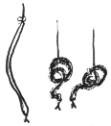
Why
this arrangement, and why was the venom coming from the two black snakes much
stronger and wisdom-giving than the venom dripping from the white snake?
The
poor white one hanging down from its tail is not able to coil. The two being tied around the belly are
able to coil. They are the coiling double-snake, a symbol of mystical vision, the highest wisdom.
The ecstasy of the berserks could also be expressed by bird's heads:
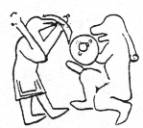
Murthly, Skotland. (Early Christ.Mon. of Scotl.,fig.321)
The
man-into-leopard-symbolism becomes a man-into-wolf-symbolism in Indo-European warrior-ideology,
and we will find the wild hunt and the ecstatic charging of the berserks and
the wolf-warriors under the leadership of Odin in Nordic Religion. The name of
Odin is derived from Wut = “ecstatic
rage”(old-high-Germ.for Odin: Wuotan). The corresponding words in Iranian
warrior ideology is aesma, “wild
rage", and vehrka, “wolf”.
Odin
is the leader of the dead warriors, he is the god of death and is accompanied
by two black ravens. He leads the “wild hunt”.
In
Angl. Chron. Laud 1127 we find the
following description:
“Soon
after many men saw and heard many hunters hunt. The hunters were black and big
and ugly, and their dogs were all black and big-eyed and ugly, and they rode on
black horses and black billygoats … the monks heard the blowing of horns being
blown in the night … the whole springtime until Easter.”
Otto
Höfler[5]
has shown that the archaic masquerade of the young-men’s-society often pictures
the wild hunt/army.
In Indo-European warrior-ideology there were societies
of young men of a deeply chaotic character. They took force from the dark side,
the demon-side of the supernatural. They howled like wolves, growled like
bears, biting their shields, going berserk.
They
were the army of the dead spirits and demons attacking. They were often
fighting in heroic nudity, only with a leather-belt around their loins (instead
of the old leopard's skin) and with a long hair-plait hanging down
behind.
Colin
Renfrew.[6],
the most prominent member of the “New Archeologist School” thinks that the
Proto-Indo-Europeans came from Inner Anatolia. In the 7th mill BC they began to
spread over Europe after a “wave of advance model”. They were the first farmers
slowly spreading while clearing the woods.
Marija
Gimbutas, Lithuanian prof., now working at the University of California, takes
the opposite view: Indo-European languages originated in the Kurgan-culture
5000-2000 B.C. With their herds of cattle and the characteristic battle-axe
they subdued the former settlers violently. She has written in Journal of Indo-European Studies.[7]
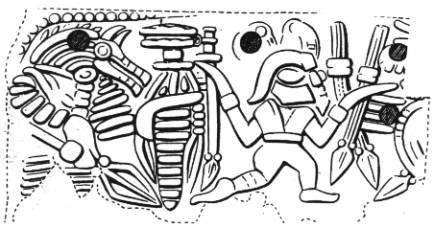
The motif chosen as the front cover
for Ström-Biezais, Germanische und
Baltische religion, is an
ornament from a helmet found at Torslunda, Öland, Sweden. It shows a
wolf-warrior and a man running with a spear in each hand. He has a round face
and on top of the helmet two snakes kissing. He is not to be identified with
Odin as Åke Ström suggests but the scene must be compared to similar scenes
collected by A. Margaret Arent, "The Heroic Pattern: Old Germanic
Helmets"[8]:
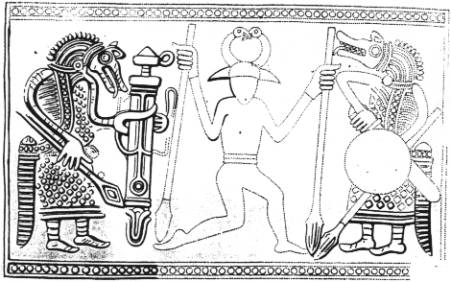
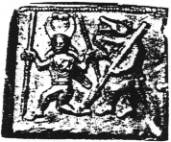
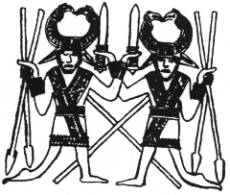
The two pictures at the top[9]
show the man running and a wolf warrior handing over his sword to the running.
The twin motif on the third picture shows that the two spears are the gate of
the sun, guarded by the primordial twins. The flaps on the helmet are not flaps
to protect the neck but the tails of the two snakes coiling together in some
kind of massive cubic knot. The running warrior is the Nordic sun hero who by
his activated kundalini-force is able to follow the sun and have victory over
the chaotic forces and even the hooliganism represented by the much-feared
berserkers.
Odin has made
a covenant with black magic and thereby opened the door to powers that will be
his destiny: the Fenris, the Midgárd-worm, the harrowing of Hell, all of them
children of Loki.
Loki is
perhaps connected with the Danish words for gate: “luge”, ”lukke”. He is the
gate through which evil forces came into the world of aser and men.
The great
theme in Nordic religion is the battle between good and evil. “All-father” Odin
is the leader of the battle, the leader of gods and men against the demons. But
he is vulnerable because of his own dabbling with the occult. Frøj is also
handicapped: he gave his sword for a beautiful demon-girl. So in the end-battle
he will be killed by Surt. Odin will be killed by the Fenris, the
personification of the demon-side of his
own berserk-ideology of man changed into wolf.
Therefore Odin has to die
to give room for resurrected Balder, the Christ-like figure.
Bede's
Ecclesiastical History tells us that
Saxons, Angles and Jutes came over on long-ships about 450-56 AC. The first two
commanders are said to have been Hengist and Horsa (“Stallion” and “Horse”) “Of
whom Horsa being slain in battle by the Britons, was buried…”
This
dual kingship is very typical of Germanic myth. The Longobards were led by the
brothers Aggo & Ebbo (acc. to Saxo). The vandals by Ambi & Assi,
Asdingi by Raos & Raptos. The father of Amlodi (Hamlet) was acc to Saxo,
Horvendillus (“Morning star”), who ruled Jutland together with his brother
Fenge, who later killed him and took his wife. Snorre tells about the brothers
Erik & Alrik, who kill each other with the horse bridles. They are also
early kings. The first two kings of Denmark are Dan and Angel followed by
Humble and Loter. Loter took his brother prisoner. We at once remember the
first king of Rome, Romolus, who killed his brother Remus, and Cain who killed
Abel and founded the first city in the world.
This
myth about the divine twins is very important[10].
They are not always twins, they can also be brothers. They are a Dioscuric pair
like Castor & Polydeuces in Sparta, Castor & Pollux in Rome, closely
connected to the morning- and evening stars and often seen as young horsemen.
It
seems very likely that also the killing of Balder by his brother Høder has some
connection to the myth about the divine twins or brothers. In Beowulf, Herebald
(Baldr) is shot by his brother Hæthcyn with bow and arrow (2435-40) by
accident. After Ragnarok the newborn/reborn world is populated by pairs of
brothers, and among them the brothers Høder and Balder returned from Hell. It
has all something to do with the polarity of life and of the universe.(In
Sumerian and other cosmogonies the world takes shape through a process of
divisions into light and darkness, into the waters over the firmament and the
waters below, into sea and dry land). Balder is light. His eyebrows are whiter
than the whitest flower. Høder is darkness. He is blind. Abel is a shepherd,
Cain cultivates the land, builds a city, founds civilization, his family is a
family of inventors. The divine twins are a pair of opposites.
With
the return of Høder and Balder balance is restored, and strife is finished.
One
of the latest attempts to solve the mysteries connected with the Baldermyth is
Frederik Stjernfelt, Baldr og
verdendramaet, 1990. Stjernfelt rejects Frazer’s understanding of Balder as
a god parallel to the Near Eastern dying and rising gods like Adonis, Attis,
Osiris. He tries to work his way on in the footsteps of G.Dumézil (and René
Girard: the gods throwing their weapons at Balder as a play is in fact a
killing concealed and suppressed by later conscience, and all the blame is put
on Loki who is then chained as the poor scapegoat.) Stjernfelt sees the killing
of Balder in connection with the cosmology from creation to Ragnarok: the
creation begins with the macroanthropos Ymir, who is “evil with all his
family”. Therefore he is killed, and his family, the giants, drown in the
enormous spilling of his blood (except one). Odin and his two brothers do the
killing and the universe is created by the different parts of Ymir's body. But
Odin is himself out of giant family, and Loki, the god full of evil tricks, is
his blood-brother, perhaps even his true brother. Stjernfelt enumerates the
many parallels between the two gods, their working together, and the many
incidents where Loki, with his unsurpassed cunning, has to save the gods from
disaster.
Now
Balder is the god of light: “About him there are only good things to be said.
He is the best and praised by all”, says Snorre. His eyebrow is like the
whitest of all the flowers, and he sends out light. He is the most merciful,
and at his home, Bredeblik, nothing unclean can exist. When Loki, after the
killing of the good god, is chained and finally turned into the devil, this is
the separation of good and evil after a time of innocence, where good and evil
were living together, and Loki living at Asgàrd among the gods.
This
situation, Loki as Udgárdsloki is the present situation, it is the situation of
duality, but will be followed by Ragnarok, where the whole party of evil will
come, and the inhabitants of Hell under the command of Loki. Now in a very
characteristic way they fight two and two with the gods. The Fenriswolf killing
Odin (the wolf being the dark side of this god), but being torn up by Vidar,
Thor's son. The Midgárd-worm killing Thor in its last dying moment. The dog,
Garm, and Tyr killing each other. Frøj being killed by Surt, the giant with the
flaming sword setting the whole earth on fire. Loki and Heimdal killing each
other. Good and evil are coming at each other, and polarity being dissolved.
The earth burns in fire and sinks in the sea, but rises anew from the sea, and
Balder and Høder are reconciled and return from Hell. Stjernfelt is right in
seeing the myth as a myth about good and evil mixed and separated. We can go
even further: Balder and Høder are the two sons of Odin. One of Odin’s eyes is
blind like Høder. Balder and Høder are the splitting up of Odin's nature into
Light and Darkness. The present time is the time of duality, splitting up into
good and evil, and salvation is duality coming into one (good and evil and fire and water).
Balder and Høder are reconciled, but not Balder and Loki. The unity is a
unity of a higher order, and the golden tablets, the symbols of world order,
are found in the grass by the surviving gods. About Balder's son, Forseti, it
is told that all who come to him with difficult strife are reconciled before
they leave him[11].
It is very
difficult to reach a full understanding of the Nordic “devil”, Loki. He is one
of the gods, the aser (Indo-Eur.: *an´sura, Sanscr.: as´ura, Latin-Gothic by Jordanes: anses). He is good-looking, but not so tall, but cunning and full
of evil. At the drinking in Aegir's ale-hall everybody is praising the food and
the feast, but this makes Loki mad, and without any reason at all he kills one
of the servants. The gods are enraged by this and drive him out of the hall,
but he comes back and demands to be let in because of his blood-brother pact
with Odin. This starts an argument, and each time one of the gods or goddesses
are protesting against Loki's presence he answers with a verse of the following
type: “You better keep your mouth…” …and then he mentions a very shameful act
committed by this god or goddess: Odin did sejd
(magic) at Samsø, his wife, the godmother Frigg, committed adultery with both
of Odin’s brothers, Vile and Ve. Freja has flung her leg around every one of
the gods.
Why do the gods tolerate his
dangerous presence which finally results in the killing of Balder, the best of
all the gods, and in giving birth to the Fenriswolf and the Midgárd-worm, and
Loki leading the inhabitants of Hell and all the evil forces in their final
attack on the gods at Ragnarok, the final battle ending the present
world-order? And why did Odin offer him blood-brotherhood, a ritual uniting
them in an even closer unity than normal brotherhood?
Because
he gives the aser certain gifts: he makes the agreement with the giant to
rebuild the wall around Asgárd, he gives birth to the horse Sleipner with 8
legs, Odin’s swiftest means of transportation. He tricks the dwarfs into making
precious gifts for the gods, and as the most important the thunder weapon,
Thor´s short hammer.
In
my opinion Loki is the incarnation of black
magic. He can change into a bird, he can even change into a female being:
“eight winters he was beneath the earth milking cows as a maid, and there gave
birth to a brood” in a womanish way[12].
Under the earth – as a woman: the tantric magician has to integrate the great
female/earth pole of universal duality into his personality and the result is
the strange hermaphrodite nature of Loki. The incarnation of wolf-power and
kundalini-power, the Fenris and the Midgárd-worm are his sons = different
aspects of the black magician’s nature. To get wisdom Odin has to use magic and
ask the vølve who is of giant family born before the Flood (or perhaps this is
the spirit that speaks through the vølve as its medium). Even at the very
moment of the good god's burial the gods have to ask for help from the great
masters of evil magic: Balder’s ship can not be moved into the water, so the
gods send for a giantess from Jotunheimen. She comes riding on a wolf so fierce
that no one can hold its reins, and the giantess has to knock it out. It has
snakes as reins. With one mighty pull she drags the ship into the sea. The
whole beach shakes and is full of smoke, and fire comes out of the rolls under
the keel.
Odin
opened the door to black magic and even made a pact with it with devastating
consequences.
Balder
is the symbol of the glory that shines on life when it is seen with an innocent
eye in the light of eternity (Grundtvig).
Myths
in the days of Grundtvig were interpreted as nature-myths explaining what goes
on in nature: the death of Balder is midsummer, when life at its highest is hit
by the arrow of death.
But
Grundtvig calls our attention to the fact that this myth is not in any way
connected with midsummer, but the main point is the sorrow for Balder’s death
at the birth of time and the hope for his resurrection at the end of the world.
It has something to do with righteousness and original innocence disappearing
from the earth. The evil negative forces in man's heart corrupting the goodness
with which life was created. As a secondary force evil comes in as a strange
corruption of feelings: to enjoy using violence, killing, hurting and wounding.
The gods enjoy being together at Ægir’s hall praising the host, but exactly
this having joy in one another and praising a good man provokes the evil
instinct of Loki, and suddenly, without any motif whatsoever, he kills one of
the servants.
In
Christianity the dying hope was set aflame again centered on a dying and rising
Balder:
Christ
was called “White Christ” after “White Balder”. Grimnersmàl mentions Balder's high-castle at Breidablik: “In this
region there is no cunning”.
Balder
is painted as a king and he is the personification of right: In the ting he is the goal of the harmless
weapon-play of the gods. His death is righteousness disappearing from the
earth.
But
he is also king of the life-forces: Acc. to Saxo Balder is invulnerable because
of a certain sweet food brought to him by the Nordic variant of the 3 graces.
In Near Eastern myth the king of spring is the king of the paradise-mountain
and surrounded by the graces or muses. (Ex: Apollo in the Mt. Parnass
surrounded by the 3 + 3 + 3 muses at the Castalia-spring by the holy laurel.)
The graces are the personification of the life-renewing forces in spring, and
therefore they are painted as the givers of a life-renewing food.
Acc to Gylfaginnung Balder can only be killed
by the mistletoe, in Celtic religion the herb of life. (The famous killing of
divine white bulls in Celtic religion can only be carried out the moment a
mistletoe is cut from an oak.)
Most
important for the understanding af the myth of Balder is the function of Balder
as king and judge. He is the wisest of all the gods, but his judgements (dómr) cannot have a lasting effect (Gylf. 22). However, his son Forsite has
it in his power to bring about an agreement among all who come to him
with strife. “His court (dómstathr)
is the best among all gods and men”. The cosmos which the father could not
create permanently is firmly established by the son.
The
God in Catal Hüyük dies, but is reborn in his son. Also in the myth of Balder
it is of vital importance that Odin can generate a son as a replacement for
Balder and as the one taking revenge for him. The many troubles Odin goes
through (acc. to Saxo) to get this son can be compared with the troubles of
Bata and his cunning in getting the woman pregnant with his son. Odin’s acting
as a physician is a variant of the old motif of giving new life and fertility
to nature/the goddess after the period of chaos and frigidity.
Balder
is the Lord of cosmos killed by the hunter’s bow. Loki is the diabolic huntsman
followed by his children: the Fenris wolf, and the coiled snake and the
inhabitants of hell. He is the demonic side, the “hunter” side of Odin
concentrated and split off from the high God. The group of gods around Balder
shooting at him, throwing stones at him, is the ecstatic pack of initiated
killing the divine bull (or at least a remnant of that motif).
Saxo
tells another version of the Balder-Høder-myth acc. to which Balder is a god,
Høder a man. Balder is caught by the beauty of the bathing Nanna, Høders
foster-sister. It seems a faint echo of Gen 6,1ff: The sons of God seeing the
beauty of the daughters of men. It comes to a battle between gods and men led
by Høder, who is not blind, but a very strong warrior.
In
the Bible the blood of Abel “is drunk by the field”, in Saxo water flows and flows from the buried body of Balder.
Ydun is a Scandinavian goddess with apples that are eaten by the gods as
a “medicine against old age”, the motif is also known from Greek mythology: the
apples of the Garden of the Hespirides guarded by the snake Ladon. An early
flooding of the earth is caused by the killing of the giant and the spilling of
their blood, cf. Gen 6,4.
The mistletoe used as the arrow that kills Balder is a paradise plant: it
grows “east of Valhal” and is, according to Vøluspa, very beautiful, cf the
role it plays in Celtic religion (“nothing is so holy to the druids as the
mistletoe”). In the Epic of the Kings
retold from Firdusis[13]
we read about the fight between Rustam and Isfendiyar. Is. was invulnerable,
and just like the death of Balder his death caused great sorrow over the whole
of Iran. A bird brought Rustam to the outmost border of the earth, and there he
saw a garden, and in it a tamarisk, with a top reaching heaven. He broke off a
branch and made the fateful arrow that killed Isfendiyar.
It seems as if the myth of Balder is full of paradise symbols. And
Vøluspa tells us that after Ragnarok Balder will return together with Høder,
and with Balder’s return the fields will give corn even without any sowing and
tilling. He is the “Lord” of paradise. And Høder is the initiated warrior. His
name means “warrior”, and acc to Jan de Vries the background of the myth of
Balder is a ritual for initiation of the young warrior. In the Bible the name
of the son of Cain, Hanok, means “the initiated one”. Høder is a master of
playing the zither-strings as also the descendants of Cain[14].
Like Eve, Ydun is tempted by Loki. Loki with the Fenriswolf and the Midgárdworm
as his children is the dark side of divine magic, calling upon and arising the
mighty Leviathan, and even raising the ghosts of Hell. He is a symbol of what
is elsewhere called left-hand tantra, cf. his homosexual nature.
Høder is
finally able to kill Balder because he is given some of the godly mash mixed
with snake-spittle brought to Balder by the 3 graces.
“Nine
worlds I remember, nine in the tree
of
the glorious measure-tree, under the earth”.
In
an ecstatic vision the vølve sees
the beginning of time through nine world-ages to the period where the cosmic
world-tree was only a sapling under the earth. Cosmological visions of inspired
persons are also known from India and Iran: the rsi Markandeya sees the
different world-ages and Original Man (purushaya)
and the High-god with many names (among them Yama) sitting in the
Nyagrodha-Tree[15].
The vision tells how the world was made out of the body of the giant
Ymir, in Iran it was made of Gayomart, the different elements coming out of his
body.
The
gods are playing with golden tablet (destiny is fixed by the gods – a notion
also well known from India[16]).
When the gods were playing there was peace and happiness, but then three girls
come from giant-home to the Ida-plain, cf how in Greek mythology Eris (strife)
brings war between gods and men by bringing three goddesses to the Ida-mountain
to compete before Paris of Troy.
This
was the first civil war: the war between aser
and vaner. The vaner gain victory with cunning. A
woman called Gullveig (“thirst for gold”) comes among the aser, but she is a witch. The gods try to gash her with their spears and
burn her (3 times), but she survives, and she is a fortune-teller, a vølve, and
the aser-women are most eager after her services. She makes sejd (practices
witchcraft) in ecstasy. According to G.Dumezil, this first war has its
parallels in the war with the Sabines in mythical Rome, and Stig Wikander has
proved something similar about Nakula and Sahadeva in Mahabharata. The third function is accepted into society only after
a war and a reconciliation.
There
are two groups of gods: ASER & VANER. The "vaner" are gods for wealth, prosperity and
fertility. They have the custom of marriage between brother and sister, and
their names are often of the type, Frøj (brother) Freja (sister); Njord
(father) has begotten the two with his sister. In Germany the female god
Nerthus is known. The word vaner has
perhaps some connection with the Latin Venus.
The
war with the vaner starts with Odin throwing his spear over the army of the
vaner. But the vaner come so close that they break the wall, the breastwork of Asgárd. Peace is brought about by exchanging hostages The vaner Njord,
Frøj, Freja and Kvasir come to Asgárd, and Høner and Mimer come to Van-country.
Høner was good-looking like a king, but he always had to ask Mimer’s advice. So
the Vaner thought that they had been tricked, and that Høner was not a leader
among the Aser. And to see if he was able to act without Mimer they cut off the
head of Mimer and sent it back. Odin takes the head and preserves it and asks
it for advice. (Mimer is the cleverest of all gods).
It seems fair to accept Dumezil's theory about the Aser and Vaner
exchanging the 1st and 3rd functions (the ruling function and the
food-producing function). The Vaner get a king from the Aser: Hønir, but every
time he has to decide in lawsuits at the Ting
he wants to ask Mimer. The Aser get Njord: god for sea-faring, fishing, riches,
Frøj god for fertility, Freja goddess of love.
Gullveig
is in our opinion a variant of the Helene-Kudrun-Svanhild-motif. A woman with
the power of witchcraft is treated harshly (Antiope), but is liberated or
revenged by her dioscurical sons or brothers: the reason for the attack of the
Vaner-army is the maltreatment of Gullveig, and as proved by Åke V.Strøm[17]
the Nordic dioscurical pair, hadingjar, are Njord and Frøj with the beautiful
sister Freja. (Here they are father and son instead of brothers).
The
Aser are warriors; the reason why the Vaner can nearly bring them down on their
heels is the sejd, the witchcraft used
by the Vaner and connected to the magical marriage of brother and sister, an
abominable thing to the Aser – like the acting of man like a woman. There was
“so much disturbance of sex connected to this witchcraft that real men do not
find it fitting to dabble with it without feeling shame”[18].
The meaning of the myth is the bringing about of the
magical unity of manly strength with woman’s magic, the coming together of two
main powers in society and numen: the force of war and the necessity of peace
and fertility. At first, Gullveig creates great disturbance in Asgárd: “Cast
spells where she could… to wicked”. Later the Aser learn sejd from the Vane
goddess Freja[19]. With the
presence of Freja, female magic is fully integrated, and Thor has to fight the
giant who claims Freja as his reward for rebuilding the wall round Asgárd.
Only
one of the giants survives the flood, cf that before the flood lived the
giants, acc. to Gen 6. He is saved floating on a device – perhaps a box (Icel.:
luthr), together with his wife.
Joseph
Feldmann[20] compares
Gen 2f. with both Semitic, Egyptian and Indo-European parallels and even
parallels from African, Pacific & American traditions. A similar tradition
about paradise and the fall of mankind is found not only among the old
high-cultures of the Near East but also by the most primitive peoples of the
earth. The analogies can be grouped into the following four:
1)
The forefathers of the human race were standing in a close relationship to the
godhead and lived a life of happiness due to this union.
2)
A serious sin against God brought this era to an end (but in many traditions
this sin has faded into some act of misunderstanding).
3)
A bad power hateful to man was active in this primordial act, bringing about
the loss of primordial bliss. This evil power was fought and punished, but not
annihilated.
4)
God withdrew from man, left the earth. The result was much pain and a life in
daily troubles and struggle for food; and death came into the world.
In
Nordic religion: There are traces of the
Flood killing the giants, the tree of life, the two brothers the good brother
being killed, the son of god discovering the beauty of a daughter of a man (Balder-Nanna).
But
also the structure worked out by Feldmann can be seen: at the beginning the
golden tablets deciding destiny were in the hands of the gods. But a woman
belonging to the race of the vaner came,
and magic, the art of the androgynous vane-god, was introduced. Odin is not the
good god. He has Loki as his dark magic side and Balder as his bright side.
Evil magic personified by Loki and his children Fenris and the Midgárdworm
becomes very strong. Original sin is the killing of Balder; after that Loki is
chased and chained, but the forces of evil are not annihilated.
Certainly
the promise of the snake in Gen 3 is the old dream of the yogi and the
magician: to acquire secret insights into the nature of both good and evil, a duality transcended in the
mystical experience of raising the snake power, thereby becoming god.
The universe starts with
the two areas of cold-wet: Niflheim towards the North, a world filled with
darkness and fog centered around the well Hvergelmir from which several rivers
flow - & warm-fire: towards the South Muspelsheim flaming with fire and
uninhabited. When the rivers from the north come to a certain distance from the
well they stiffen into ice because of venom
and fermentation in the venom hidden in the stream. Out of the venom comes
vapour stiffening to rime and melting when meeting the warmth from the south
and the mild air of Ginnungegab, the empty space between the two poles of heat
and coldness. From these poisonous drops of fluid life in the shape of the
original giant Ymir is aroused ~“by the help of him who sent the warmth (!)”.
There is also a cow, Audhumla, coming out of the drops, and when it licks
the salty rime-covered stones, a human creature, Buri, appears, he has the son
Borr, who, with the giant-daughter Bestla, has the 3 sons Odin, Vili and Ve.
The name of the cow “without horns” seems to indicate that it is a friendly
cow, and the combination original cow/original man Ymir is also known from
Iranian cosmology[21].
The licking of the cow and venom from the snake reminds us strongly of the two
symbols of totality in Near Eastern pre-historic religion: the bull and the
coiled one. Also the name of Ymir = Yama, Yima, is Indo-European for “twin”,
Tuisto in Tacitus, Germania 2, here
in the meaning of androgynous, twin-sexed.
In both Iranian, Vedic and Nordic religion we find the strange notion of
a magical mystery of world-creation by killing a great bull or a giant:
In India Purusa & primeval
cow. In Iran Gayomart & primeval
bull. In Edda Ymir & the cow
Audhumla.
In
Iran, when the primeval bull is killed by Ahriman, 55 different sorts of grain
sprang from its body, cf the 3 ears of corn coming out of the bull when killed
by Mithras.
Certainly
these myths are different variations of a “Urmythus” from “arischer Urzeit”[22].
F.R. Schröder[23] thinks it
is a cult-myth sprung from the belief in the magical power of the offering of a
human victim. But the double nature of primeval reality as man and bull goes
back to the early agricultural religion of Inner Anatolia, where the highgod is
both god and bull and primeval mystical unity cut up by creation.
The
inner meaning of the myth of Ymir is not to be found in the killing of a human
victim but in primitive pantheistic mysticism. The mystical body of the highgod
is everywhere. He is reality itself and the life forces in it. The life-giving
grain can only come from his body. He is the unity of male and female[24].
Common to Indo-European myth is the creation of cosmos or society by the
dismemberment and scattering of a primordial giant or king.[25]
A Roman tradition suggests the death of Romolus by his being dismembered by the
senators: “But others conjecture that the senators rose up against him and
dismembered him in the temple of Hephaistos, distributing his body, and each
one putting a piece in the folds of his robes in order to carry them away”[26],
”and afterwards he buried that (piece) in the earth”[27].
The Nordic myth of creation tells about the three sons of Bor creating cosmos
out of Ymir´s body, and acc. to an Iranian text, Zad Spram 3,42ff., the primordial ox was killed by Ahriman, the
Evil Spirit, in a cosmogonic assault, and out of the body fluids, marrow and
blood 57 grains and 12 herbs were created, providing food and healing for
mankind.
Acc. to L.L.Hammerich[28]
an important information brought to us by Tacitus has to be translated in the
following way:
They say
that the Semnones are the oldest and most noble of the Suebi. This belief is
confirmed in a religious ceremony of ancient times. At a fixed time, all the
people of the same blood come together by legations in a wood that is consecrated
by the signs of their (ancestral) fathers and by an ancient dread. Barbaric
rites celebrate the horrific origins, through the sacrifice (caesa, lit. “dismemberment”) of a man
for the public good (or: ”in public”)…
There
the belief (superstitio) of all looks
backward (to the primordial past), as if from that spot there were the origins
of the race. The god who is ruler of all things is there. Others are inferior
and subservient.
Behind all this is a very ancient myth about the highest god of
primordial times (either seen as bull or macr´anthropos) being killed and
dismembered as a symbol of primordial unity being scattered.
The
dragon Nidhug gnawing on the third root of the world-pillar Yggdrasill has its
nest in Hvergelmir. Its hostility to the world-pillar proves that it wants to
draw the world back into primordial unshaped totality.
The world-pillar
Some of the coins from
Hedeby have an important motif:
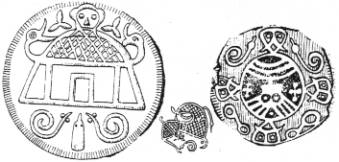 The first coin
shows a temple and two coiling snakes approaching the temple door. Their heads
have a very special design: the eyes are two big balls on each side of a jaw
drawn out almost to a kind of beak. A similar design is seen on the device
standing between the snakes: two eyes on each side of a pointed beak. It is a
symbol of mystical ecstasy, of two becoming one, the double-snake united. On
the corners of the roof are dragon-head decorations. But in an odd way they are
turned back. Instead of apothropaeic guardians of the roof they are turned into
contemplators of the big head on the top of the roof. This head is the
personification of the world-pillar. This world-pillar is the motif of the
second coin. We recognize the head contemplated by the two snakes. Under it can
be seen the three heavens and the world-pillar made as a device, first as a
double union of four into one, and then the union of two into one single beam.
To the right and left the mystical sign of four becoming one: the cross.
The first coin
shows a temple and two coiling snakes approaching the temple door. Their heads
have a very special design: the eyes are two big balls on each side of a jaw
drawn out almost to a kind of beak. A similar design is seen on the device
standing between the snakes: two eyes on each side of a pointed beak. It is a
symbol of mystical ecstasy, of two becoming one, the double-snake united. On
the corners of the roof are dragon-head decorations. But in an odd way they are
turned back. Instead of apothropaeic guardians of the roof they are turned into
contemplators of the big head on the top of the roof. This head is the
personification of the world-pillar. This world-pillar is the motif of the
second coin. We recognize the head contemplated by the two snakes. Under it can
be seen the three heavens and the world-pillar made as a device, first as a
double union of four into one, and then the union of two into one single beam.
To the right and left the mystical sign of four becoming one: the cross.
Now
it becomes clear why Christ on the cross in this early period is so dominated
by the cross-design that his arms and legs are perfectly straight.
The
Saxons honoured a giant trunk erected in open air and called it Irminsul, in
Latin “universalis columna”[29].
The
drawings of the two coins, but not the interpretation, are taken from
S.Nancke-Krogh, Shamanens hest,1992[30].
This remarkable book offers a multitude of new interpretations. We are not able
to evaluate them all. Important is the stress put on archaic symbols of ecstasy
and the travel of the shaman to the top of heaven, a goal only reached by a
union with his female counterpart. Even the macr’anthropos-speculation so
typical for classical mysticism is found by Nancke-Krogh on ancient rock
carvings[31].
Some
kind of mystical flower is also ejaculated by a dying stag on a coin from
Hedeby (800 A.D.). The kundalini-snake is seen falling from the neck of the
stag, and another snake is coiling round itself, stinging the stag in its hoof
(ill. from Nancke-Krogh).
A
very interesting book with a large collection of iconographic material is Søren
Nancke-Krogh, Stenbilleder, 1995
(about stone pictures in early Danish churches). Nancke-Krogh thinks that the
Danes were Christians long before St.Ansgar built his first church in Hedeby
850. They belonged to a Manichean tradition similar to the Bogomil movement in
Yugoslavia. But this theory has no support in the saga-tradition. And the many
symbols of ecstasy could also be explained as a survival of old folk religion.
One
of them is the third eye inscribed in a triangle on the forehead of one of the
three faces of a stone idol found at Glejbjerg, Astrup parish[32].
Another is the centaur with horseback, forelegs of a lion, a human head and
hands holding a snake in the left hand, looking into the eyes of the snake. The
centaur is according to Nancke-Krogh, an archaic shamanistic symbol of extra
power by adding the power of the animal to man[33].
Another
centaur is in our opinion more of a lion-man: a lion, but in exchange for the
lion's head and neck, the body of an armed man with sword and shield and
helmet. Of special interest is the tail of the lion: in a way very typical of
most of the many lions of the stonepictures, the tail is squeezed in between
the two legs, it comes out underneath the animal's belly, and ascends above the
back of the animal where it unfolds into a very big lotus[34].
The peculiar position of the tail is perhaps (?) a symbol of a force rising
from the genitals, a transformed sexual energy. On one variation of the
lion-symbol the tail ends in the mystical plant of life, but in most of the
pictures the tail's end is transformed into a rather voluptuous symbol of
vegetation. In Agedrup church by Odense we find the old classical motif of the
man (here reduced to an idol) between two tamed lions (licking his face). On
another stone he is seen taming the two lions by grabbing their tails and
lifting them up from the ground. He is naked and has a marked erection[35].
On the walls of the church at Tømmerby the great hunter is shown hunting the
stag. He is being helped by two dogs and a panther with a human face. Acc to
Nancke-Krogh this animal is grabbing the end of the great dragon-headed club[36].
The panther giving the great hunter the strength to kill is the old prehistoric
motif. Along the back of the panther is a curly thing: the symbol of kundalini
ascending.
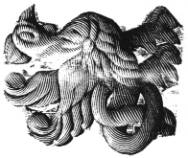 The stag is
seen running towards a strange animal, a rooster with a tail consisting of a
snake's body coiled together into a cross-like symbol. We know this fusion of
sun-bird and snake from the Jao-symbol and the Phoenix: it is the symbol of
mystical totality, all difference and duality coming into one, it is the symbol
of mystic vision "hunted down" by the ecstatic. The baptismal font in
Lihme church shows the hunter being led by the fleeing stag to the holy tree of
life[37].
The stag is
seen running towards a strange animal, a rooster with a tail consisting of a
snake's body coiled together into a cross-like symbol. We know this fusion of
sun-bird and snake from the Jao-symbol and the Phoenix: it is the symbol of
mystical totality, all difference and duality coming into one, it is the symbol
of mystic vision "hunted down" by the ecstatic. The baptismal font in
Lihme church shows the hunter being led by the fleeing stag to the holy tree of
life[37].
Svanhild
In the 8th book, Saxo brings a tragic story
about the beautiful queen, Svanhild, who is trampled to death by horses on the
command of her husband, Jarmerik, but is revenged by four “Hellespontic brothers”,
cf the Anglo Saxon tradition about Swana and her two brothers, Hengist and
Horsa. She is identical with the Sunhilda, who, acc. to Jordanes at the command
of Ermanaric, is torn to pieces, but is revenged by her two brothers[38].
Ermanaric is king of a large
territory reaching from the Baltic Sea to the Black Sea, but his rule breaks
down when the Huns attack. There is no doubt that his name is connected with
Irminsul, the world pillar, and this is depicted in the artificial building he
has erected on a tall rock: below a mound of turf, in the middle rooms, and on
top a parapet, whose battlements were decorated on all sides with shields
glittering like gold. Four large gates emphasize its character of cosmic imago.
While storming the tower, the brothers are assisted by Gudrun, the sorceress.
They tear up the gateposts and die covered with stones, but only after having
cut off the arms and legs of Jarmerik, so that the torso was rolling around
among the dead bodies. Here the legend is a kind of Twilight of the Gods-myth.
The world pillar is cut down, and the world returns to its amorpheus state
symbolized by the helpless lump to which the king has been reduced. All die:
the goddess, the god, the Dioscouric helpers, and Broder (“brother”) assumed
the Royal power, cf the two brothers who get the power on the reborn earth
after the Twilight of the Gods. In Jordanes´ version the assault of the Huns is
the end of the world.
King Hading
As a boy
Hading is living in a kind af female sphere deeply attached to his foster
mother Hartgrepe who even tries to offer herself to him as mistress. Dressed as
a man she tries to accompany him on his journey back to Denmark. She is a very
skilful sorceress who makes galdr.
But by that she has challenged dark forces and is torn to pieces by demons.
(She is the androgynous magician breaking normal morals by the incestuous
behaviour of the vane-gods).
Hading
now meets an old one-eyed man, who feels very sorry for him because "he
was so lonely”. It is true what G.Dumezil has shown that Hading is moving from
the androgynous sphere of the vane-gods to the manly sphere of Odin. The old
one-eyed man takes him to a sailor Liser and he has to follow this viking by
becoming his blood-brother and joining him in his war with Lokker. The dioscuric
names of Liser and Lokker show that Hading has come from unity/totality to the
sphere of duality and strife. He eats lion’s flesh and becomes very strong. But
his many defeats are due to the fact that he is a hero connected with fire and
light, a fighting Odin-hero never in balance. With the coming of spring he goes
to Sweden, but suffers hunger and privation. He is all heat and light[39].
Fire is Odin's element, and therefore he has to be punished as he kills his
opposite, a water-god, during a swim to cool himself in the cold water. As
atonement for that he has to offer black
cattle to Frej, for where poor Hading shows his face everything gets off
balance. At last he has to fly from Uppsala one dark night having lost all his
men. Reality is always tending towards balance, symbolized by two mysterious
voices heard in the night and foretelling a big slaughter of Danes followed by
a similar slaughter of Swedes. A vision is seen of two bald men fighting each
other. The endless fights of the Odin-hero are a tragedy when reality is always
tending towards balance: the victor of today will suffer defeat tomorrow.
At
last Hading understands the necessity of balance and puts the brother of his
enemy on the throne as king. When this man suffers the typical death of the
vane-god of fertility, drowning (being
dissolved) in the big vat of beer, Hading takes his own life by hanging
(strangulating) himself, the typical death of Odin.
The
vane-god is the god of fertility and peace. Odin is the god of death and fire:
all that is burnt on the funeral bon-fire goes through the fire to Valhal acc
to Snorre's description of Odin.
The
two kings following each other in death are the great contrast to the two kings
fighting each other, trying to destroy each other (Uffe & Hading). The
final harmony between the vane-king and the Odin-king is a harmony between two
divine principles. The same motif is played through with the women in the
story. The original unity between female and male is torn up dramatically with
the tearing up of Hartgrepe, and Hading is lonesome. The total
disharmony between male and female is represented by the Odin sphere: Odin
flies from the totally disloyal wife Frigg, and only returns after her death.
The contrast is Queen Gunhild following her husband even in his death as the
picture of total faithfulness. A new crisis comes up because of the daughter
Ulfhild (“war-wolf”) and her plans to murder her father, but Hading is warned
by the spirit of the dead wife.
Hading
is right from his childhood given to manly virtues: ”He despised carnal
lust and was always only thinking on war and raiding.” This masculine soul
Hartgrepe tried to soften. She complains about his strange thinking, only
brooding on fighting, and with no sense for woman: surely the main motif of the
whole story is harmony between male and female nature, light and darkness,
Odin-sphere and Vane-sphere
Saxo
tells us that Dan and Angel did not bear the name of king. Kingdom is first introduced by the sons of Dan: Humble and
Loter. Humble was the first to be hailed as king standing on a stone at the ting. However he was not able to stay
in power, but had to pass it on to his brother. But Loter was cruel & full
of high thoughts about himself and developed into a bloody tyrant so he was
forced to leave the throne. The purpose of this tradition presented by Saxo is
to describe the crises of kingship when founded in the human sphere. After a
time of chaos the kingship is founded again by the gods. G.Dumezil[40]
has shown that the next 4 kings, Skjold, Gram, Hading and Frode are identical
with Odin, Thor, Njord og Frøj. As further proof of Dumezil's findings we might
mention that Skjold is depicted as the “great hunter”, not as a lion-dompteur,
but more in accordance with Scandinavian fauna as “bear-dompteur”, catching a
bear with his bare hands and a belt. Thereby he proves himself an incarnation
of the “big hunter”, in Nordic mythology represented by Odin leading “the wild
hunt” of dead souls and demons mixing with the horde of wolf warriors and
“berserks”, ecstatic warriors transformed into bears.
Haddingjar
is the name of the Nordic dioscuri[41].
They are Vane-gods belonging to the third race mentioned by Saxo 1,7, of mixed
descent, not so strong as the giants, not so full of supernatural power as the
gods. Cf that Hading has giants as his foster-parents. Like Njord he has to
leave the incestuous marriage of the
Vanegods to stay with Odin.
A Swedish Cosmogony
The constant tension between duality and totality is characteristic of cosmogonies. Snorre's version of the Ynglingesaga, which, among other things, is based on a poem by Thjodolf of Kvine, first tells about Fjølner who drowns in the mead vessel (the god whose life-force is dissolved in the intoxicating drink). Then Svegder, who with a train of 12 travels around the world to find the way back to Gudhjem (“Home of Gods”): the sun-hero finding his way to paradise by following the roads of the sun. At the end he becomes one with the primeval rock, the stone stele: by a dwarf he is lured into a large stone (the original meaning of this motif is no longer understood).
A
couple of generations later we hear about Alrik and Erik, the dioscuric pair.
Being equally strong, they kill each other and are succeeded by Ynge (Yngve)
and Alf (personifications of the vanes and the elves.) An interregnum by the
pirates Hake and Hagbard is followed by the brothers Erik and Jørund regaining
the kingdom after this time of chaos.
Also
King Snow, Princess Drift and Prince Fire are mentioned as adversaries of the
Uppsala-kingdom. The cosmogony culminates in Anund, "the Roadmaster"s
creation of smooth roads everywhere. It is characteristic that he dies when
“the mountains take revenge” on him who so often cleared the way through them:
in a deep sunken road he and his men are buried by an avalanche.
The
Swedish kings told about in Ynglingesaga are seen as contrasting pairs:
Fjølner and Svegder.
Vanland and Visbur (both killed by magic), Domald (killed as an offering), Domar (dying in bed), Dygge (dying in bed), Dag (killed in war).
Dygge was the
first to call himself king, Dag was
a war-king and the first (?) to call himself by the name of the war-kings: Gram
(= “grim”).
Alrik and Erik (killing each other).
Ynge
(great war-king) and Alf (liked to go to bed early) killing each other.
The
pirates Hake and Hagbard: the chaos-king dies in a great
bonfire on board his ship leaving Uppsala. After the chaos-king Hake, Jørund
becomes king, and he is the first personification of the law of retaliation
(karma). He takes the ship of king Gudlog of Hålogaland in Norway and hangs the
king in a gallows. Many years later he is attacked by Gudlog's son Gylog and
hanged in a gallows.
Most
despised is Øn who tries to survive death by bringing his sons as an offering
to Odin. Finally he is so old that he has to lie in bed constantly and suck
milk from a horn. Typical personifications of chaos is Hugleik surrounding
himself with musicians and magicians and Tønnes taking power by means of
criminals and slaves.
When
man chooses his religion one can only hope and pray that he chooses an ethical
religion. The Danish historian, Erik Kjersgaard, does not believe in the modern
myth of “the peaceful Viking as the bold tradesman and the peace loving farmer.
It was a hard and violent time, a time for warriors lusting for fight and
looting, a merciless hunt for riches, and an absurd fascination of bloodshed
and plundering, and in the midst of all that a longing for something else: a
death without fear”[42].
An
English historian[43]
has gone through letters written by ordinary soldiers to their families and
discovered the ecstasy of the battlefield, the joy and kick felt by men in war.
They get high in the middle of the slaughtering. It is blood and pain, and it
is sickening, but it is also the ultimate excitement. It is the fascination of
hooliganism, adrenaline pumping, aggression let out. These dark sides of man
have been ignored by many modern authors and left-wing historians believing in
evolution. They are the darker side of man being cultivated in the cult of the
wild hunter leading the army of dead souls and demons and the living, howling
like wolves eager to kill.
Life
in the Viking age was dull, boring to the extreme. Farm-work was hard and
monotonous, life was short, and old age filled with misery. Who can judge them
for wanting something more: going far away behind the most distant mountains to
see the marvels of the deep East or West, not lusting for old age, but for
intensity and adventure.
Only
the spiritual longing of Christianity could overcome this lust for danger and
early death. For Middle Age “Norman” Christianity life was also a journey: the
long road to paradise – and a fight: the constant fight between good and evil.
The mythological Swedish king Svegder devoted his whole life to seeking the
road to Gudhjem[44].
It
is a little painful to read historians trying to underline the many peaceful
skills of the Vikings as tradesmen, carpenters, and farmers. They were ruthless
killers more than anything else. Their highest goal was to go down fighting,
die on the battlefield, only one goal ranked even higher: to make others die on
the battlefield.
Old
prehistoric motifs known from left hand tantra in modern India can be traced.
Not only Odin was the receiver of dead souls, also Freja. Death is overcome by
the magic of the sexual act. When the Viking chief is burned in Russia, his
slave mistress has to follow in some kind of androgynous union. As the poor
deceased is unable to make this particular magic work, his friends have to
perform the orgiastic “tantra”, all having intercourse with the girl destined
to be killed by an old female magician. The female magician and the androgynous
thinking (Frøj-Freja, Njord-Nerthus) show that we are in the field of the magic
of the vaner.
But
the most common hope was in Odin and Valhalla. When Odin puts on his shining
helmet in the final battle of Ragnarok, he is the leader of the forces of good
against evil and darkness.[45]
But Odin is a tragic leader against the demons because he has accepted the
demon wolf-warrior ideology as a part of his own nature (he is always followed
by his two wolves), and this will finally destroy him: he will be swallowed up
by the Fenris-wolf, a personification of the demonic wolf-nature. Thor is the
good fighter without the dark sides. You can see through him. Therefore his son
will kill the wolf.
The
war-god, Tyr, has nursed the Fenris when it was still a cub, giving it food.
Also Tyr has some fatal involvement with the magic of the wolf-warriors, and is
finally maimed by the wolf. This war-god and ting-god is a rather tragic figure, without his right hand to grasp
the sword and lift when taking the oath. He broke his promise to the wolf that
nobody would harm it, and therefore he had to lose his right arm.
Also
Frøj, the god of fertility, has tragedy hanging over his destiny: he gave away
his sword for a beautiful demon girl, and in the final battle he will be
without the sword when he has to fight his final duel with Surt.
Frotho I (Saxo 2nd book)
The sun-hero
must start his life by killing the snake or dragon representing primordial
totality. The snake is situated on a mythological island, where it is the owner
of much gold, the golden paradise mountain. The sun-hero goes to the mountain
to conquer the gold of the sun's halo. He then goes conquering in the route of
the sun to the Far East where he conquers Russia and claims his wife, to the
deep South, where he goes down the Rhine to the farthest border of Germany, to
the Far West to England and Scotland. He goes back to Denmark where he is
invited to celebrate a feast with Skate (familiar to the Greek word skotia = darkness, a personification of
the rule of winter and darkness). He is enthroned on a gold-embroidered carpet,
and is always eating food powdered with gold dust.
Frotho
is Frej, and his sister Swanwhite is Freja. She is the only one who can match
his cunning, and she inflicts a grave defeat on his navy. But they are
reconciled, and by this reconciliation his strength is restored. There is a
clear notion of Frej and Freja as the two poles that must be in counterbalance
and peace to give strength.
The
dragon-fight on the island is repeated by the hero, Fridlev[46].
The monster is attacked as it is coming up from the water. Frotho attacks as it
comes back from drinking water. It is closely connected to this element.
By
its coiling it throws up the earth into two hills with a valley in between: the
primordial island/mountain is cleft in two, allowing the sun to pass.
Fridlev
gives his son and wife to the great bowman, An, at New Year's time. This
leaving wife & son to another is, as we have seen, a very typical
kingship-of-heaven motif. (The hunter takes the wives of the highgod).
On the
Jelling-stone the god of life is pictured as the cross, the tree of life, encircled
by vegetation-runners. He makes room for light and life by forcing the coils of
a double snake from each other, coils sent out by the dragon seen on another
part of the stonesurface.
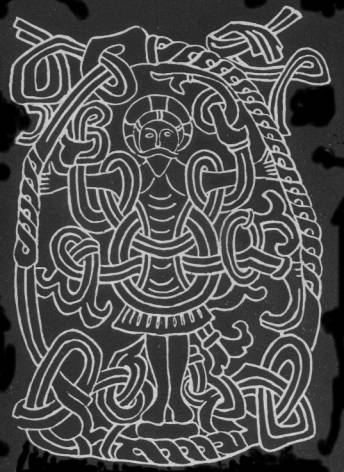
Ill. by Gudmund Hentze, Saxo Grammaticus, fordansket ved Grundtvig
Starkathr, the typical sun hero
Like the sun he is born in the Far East and
turns up on the arena as the sole survivor after at shipwreck[47].
He has six arms like an Indian god, and his unknown origin stresses his supernatural
character. By using a secret path he is able to travel the same distance on a
single day as normal men would need 12 days to accomplish. This speed is
repeated later on a journey from Uppsala to Denmark “in a single breath of
air”. He walks with the two poles of the typical sun hero in his hands. Finally
he is killed by the hunter Had, who was out hunting together with his dogs.
As Heracles by the crossroad has to
choose between vice and virtue[48]
so Starcathr composes many poems in defence and praise of the old martial
virtues of the North against modern lust, gluttony and luxuriance. He has the
life span of three men, fights in the Far West (Ireland), in the High North
(the area around the White Sea), in east (Russia) and in south (Byzans, Poland,
Saxonia).
His fight with the hunter is
Starcathr´s killing Ole[49].
Ole has the light-emitting eyes of the ecstatic (the eyes of Orion, the
Horus-eye). As we have seen above the light-emitting eye is dependant on sexual
abstinence. Ole has a son, but nevertheless a kind of wound in the vital organ
is hinted at. In a particular wild forest he has to fight with two giants. He
is able to kill them both, but with their last strength already brought to
their knees they are able to inflict a wound on Ole’s foreparts, and the hero
would have died of it had not his faithful dog, which followed him everywhere,
cleaned it by licking it.
That Ole´s adversaries are the high
god and his son is seen from the fact that he has to cross a rushing “river of
death” to come to their large stables.
Ole comes to power by tricking the
warriors into helping him, by acting as a beggar’s king. He is the king of
chaos. He becomes a very cruel and unjust ruler. He started with killing 12
warriors led by Hjale and Skate (Hjale means “Christmas” – “(h)jul” in Danish,
and Skate means “darkness”) and are finally dethroned by 12 chiefs. He is king
of the chaotic New Year's feast between two years.
27.a.
A Nordic Yoga master
On the great
silver bowl found at Gundestrup in Denmark 1891 there is a wealth of motifs. On
the outside: busts of different gods, originally 8. On the inside: 5 scenes,
obviously of some religious acts. One of them shows a god sitting in a typical
yoga-posture. He carries on his head the splendid crown of a stag with seven
antlers[50].
He is sitting as a yoga-master with stag and bull at his right hand and hunting
dog and snake at his left. This symbolism of right and left is not accidental.
He is the god of ecstasy, in the right corner of the scene a man is seen riding
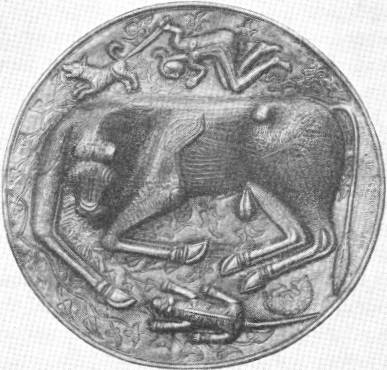
on the back of a dolphin over a fearful sea guarded by lions to meet the divine
bull. In the bottom of the bowl is seen the divine bull hunted down by 3 dogs
and a warrior with sword in his hand. Its horns are damaged and must be added
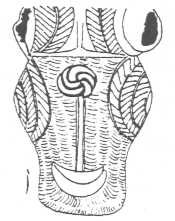
to the scene. On its forehead is a beautiful twisted rosette, the symbol of all
diversity being united into the mystical center. This symbol is fastened to the
top of a column with its base in the crescent moon. This symbol, the crescent
moon, was exactly the symbol resting at the bottom of the bowl when the horns
of the bull were still undamaged. The Gundestrup-bowl is the sacred cup of the
moon containing the mystical drink of immortality made from the
blood/life-fluid of the divine bull leading to ecstasy and mystical vision. The
hunt becomes a religious symbol of the seeking of ultimate reality and ecstasy.
Note that the hunter is androgynous. He has the breasts of a woman and the
spurs of a man on his heals, and he is shown in a posture indicating jumping or
floating through the air.
The
snake with the spiraling horns of a ram in the god's left hand is the
kundalini-symbol ascending to vision of the face of the god. Both the stag,
ram, and bull are symbols of the highgod. When it ascends to its highest position,
the kundalini-force receives the horns of the highgod.
The
hunting and vision of Sct.Hubertus is the vision of ultimate reality, the
vision of the highgod as the suffering god of vegetation and sacrifice, and
this vision was given to bishop Hubertus on Good Friday.
27b. An Interpretation of the Golden Horns found in
South Jutland
The
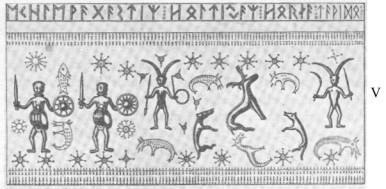
bird eating of the fish and the fisherman carrying the fish in a line are so typical
of the pre-historic Near Eastern iconography that it justifies our search in
this direction for former parallels: The wild hunt with the dead spirits mixing
with the living warriors and dogs and demons in chasing the divine stag is the
holy symbol of the upper ring, the two horned men being supernatural guardian
spirits for the twin-warriors, their “fylgje”.
But notice that the stag is more a mystical symbol being
chased not killed. And by the chase some dog-like demons are brought to death
(death is always shown by the animal sticking its tongue out.)
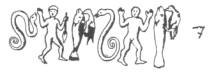
It seems rather clear that the horns are used in some
cult of ecstatic warriordom: Man being changed to wolf or perhaps rather bird.
As pharaoh wins his victory by the magic snake-power raised and attacking from
his forehead, so also this cult has its notion of a dragon-power strong and
chaotic.

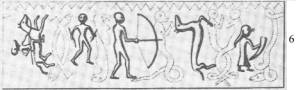
The snake-power is omnipresent like a spiritual force coiling around the
warriors.
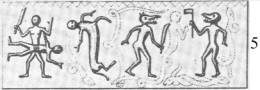
Two bird-masked warriors fighting.
Many
twins and pairs of brothers dominate the beginning of history acc. to both Saxo
and Snorre and Philo of Byblos. They stand contrasting each other or
supplementing each other – even on the shorter Goldhorn. On the lowest ring one
is keeping his body in balance, the other fighting his body. On the highest
ring they look so similar, but a number of details show that they are contrasting twins. One has a scarf with a horizontal
stripe, the other a scarf with 4 vertical stripes. On one hero is seen two
discs surrounded by beams of light, on the other two discs without beams. The
shields are also different like the stars above their heads. On the ring in the
middle the two brothers form a cross, the symbol of totality, of the four
cardinal points being united into one. Like the dioscuric pair Erik and Alrik
mentioned by Snorre who were fond of horses and killed each other with the
horse bridles they are pictured as horsemen, one even united to his horse
becoming a centaur. To the right we se them united in the symbol in Saxon called
“Hengist and Horsa”, III.
The
twins form an interesting system of Thesis, Antithesis
and Synthesis. They are
duality sometimes coming together in harmony, sometimes striving apart from
each other. To our opinion the same structure is behind the myth of the death
of Balder. Høder and Balder are the two sons of Odin, representing light and
darkness but being in some kind of primeval balance. A balance broken by the
death of Balder, but re-established by the return of both Balder and Høder from
Hel in the new world rising from Ragnarok.
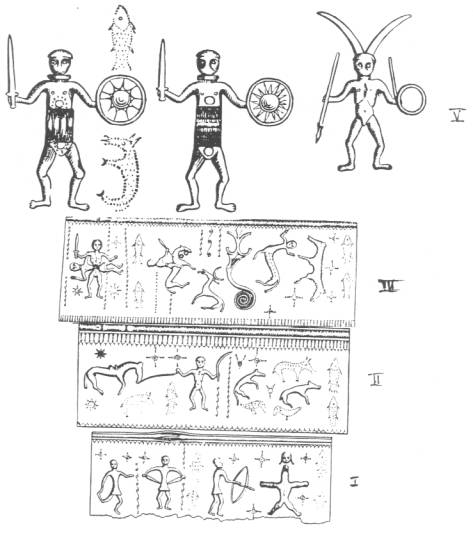
By the one
killing the other primeval unity is broken. The same is shown by the dying stag
and the sign hanging over the mouth of the coiled snake (coiled 3 and 1/2 times
around itself). According to a Danish author, Gunnar Sneum[51]
it is a broken heart. He refers to a Swedish author who has shown the heart
symbol  to be a very old symbol of two united to
one. What is hanging over the gap of the big snake is the two parts of a
broken heart turned away from each other and kept apart by a spearhead.
to be a very old symbol of two united to
one. What is hanging over the gap of the big snake is the two parts of a
broken heart turned away from each other and kept apart by a spearhead.
The bird
tasting the fish is a very old symbol common to the prehistoric cultures of the
Middle East. We have judged it a symbol of a fish-orgy giving ecstasy to the
participants the bird being the symbol of flying and ecstatic flight. Therefore
the snake being sucked by two minor snakes and the hind being sucked are
symbols of an ecstatic state caused by a drink offered by the godmother whose
epiphany is the hind. It is the drink for which Hlewagastir made the horn as
the inscription runs.
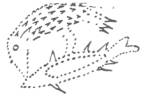
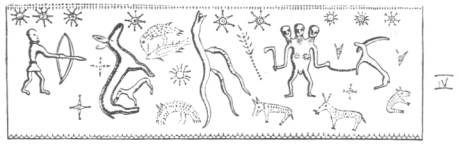
Sneum is the
first one to have brought in the Indian notion of the kundalini-snake to
explain the snake standing on its tail with a pearl in its mouth, the snake
coiled around itself and (on the longer cone/ the other horn) the small man in
a very curious attitude between two snakes unfolding from a coiled position to
a position standing on their tails. This man is rightly seen by Sneum as
flying/floating.
Alas Sneum is
overdoing his case by seeing direct parallels to the Indian
Sankhya-speculation. To use his own language he finds an “old heathen
world-religion” centered around samsara, moksha, reincarnation, samadhi in the
old Nordic world of symbols (rock carvings, the Gundestrup bowl, etc.) This is
certainly going to far. But no doubt he is right in his interpretation of the
snake symbolism of both horns. On the longer horn he rightly calls our
attention to the snake coiling around its opposite:
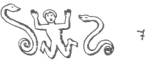
(Perhaps even
the 7 chakras are marked by the 7 flowers)

The use of
modern gurus, Vivekananda and the “Gyllingnæs-swami” Narayanananda, and even
Søren Kirkegaard shows that Sneum is more the ardent searcher for an old “pantheistic
philosophy” as he calls it than the careful user of religiohistorical method.
The twins are the first appearance of duality
in the primeval unity. Their old universal symbol is the two sticks: the gate
of the sun, in Sparta called the DOKANA-symbol:

The world
pillar or world-mountain divided into two makes room in the primordial massive
for the sun to run its course. The primordial massive is also thereby divided
into heaven and earth by the two pillars lifting the vault of heaven. The symbolism
of the twins is a key to many scenes on the long horn. First we find on it the
Gate of the Sun. The parish-parson Jørgen Sorterup has 1717 criticized Worm for
his drawing of the motif on the first ring as two bones with a row of hearts
underneath. They are only sticks and the hearts are not hearts. Mackeprang[52]
has shown that the two square attachments both with 3 small discs are traces of
an arrangement for fastening a carrying chain, the other end of the chain being
fastened to ring no 7. The row of triangles on both ring no.1 and no. 2
(not hearts) are marking the foundation[53]
= the earth. The two sticks are a gate, the gate of the sun being erected in a
universe of primordial waters. The animals with their tails intertwined to the
symbol of the heart are[54]
dolphins and in this posture they are symbols of unity, primordial monad:
duality intertwined to form amorphous unity. In this amorphous matter creation
starts with setting up the gate of the sun.
The upper and
lower waters are seen united filling out the space between heaven and earth
both marked with a line of triangles:
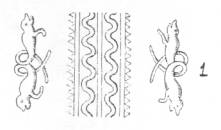
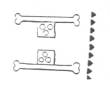
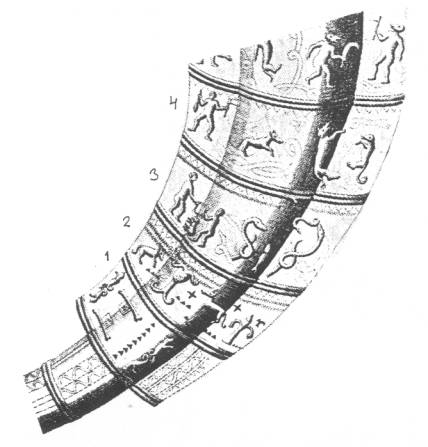
On ring no.2
the two primordial pillars are changed into another duality, the duality
between the pillar of fire and the pillar of vegetation, the cosmic pillar of
fire with the sun and a big star at the top and the pillar of vegetation, the
world tree still seen as a sapling, a stylised acanthus, a symbol well known
from Gaulle-Roman reliefs[55].
Also in Tyre we
have the twins Hypsouranios and Usoos and the two pillars, one of gold and one
of green sapphire, symbols of the fire and the wind (bringing rain and
vegetation). They are also pictured as the fire-alter and the world tree on
many coins from Tyre. Also in Rome we have the god of the gate Janus as the
incarnation of all beginning and the twins brought up as wolf-cubs. They are
city founding twins: Romolus of Rome and Usoos of East-Tyre called Usu. On ring
no.2 the dogs are wolves saluting the sun, are the twins brought up as
wolf-warriors. As noticed by Brix the left with its short tail looks like the
left wolf attacking the bull the right with a long tail looks like the right
monster attacking the bull and even like the head of the right masked warrior attacking
his brother, notice that both the last mentioned have no ears: with small means
they are set out as contrasting twins (long tail contra short, ears – no ears,
curved sword contra axe – and even when shown fused together into a
cross-composition one carries a pearl in the right hand, the other in the left hand. That one is
left-handed, the other right-handed can also be seen from ring no.3, where they
are pulling in some kind of quadrangular object perhaps trying to make the
inhabited part of the earth bigger surrounded by a sea full of big water snakes[56].
How is it that
the two pillars representing the first state of duality emerging out of unity
can also be seen as the pillar of fire and the pillar of vegetation? Of course
they are opposites: vegetation filled with life-juice cannot burn and wither
when temperature is rising. But they have also something in common: when lit
the fire stretches its long flames upward against the sky and in this reaching
for the sky it is quite similar to the tree, both form a pillar reaching for
the sky.
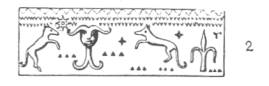
The mystical
cross-flower is also seen over the head of the divine bull.
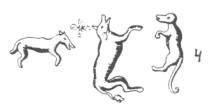
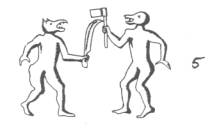
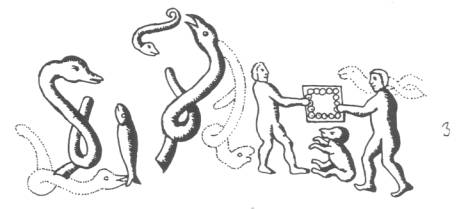
The longer
horn obviously carries some of the same motifs as the shorter. The shooting of
the roe on the longer followed by a person offering a drinking-horn. This goes
well together with the parallel motif on the shorter horn, where the shooting
is of a roe offering the mystical drink to her calf. The 3-headed god with the
goat must be Odin (often seen as a trinity) with the giver of divine mead.
The purpose of
an orgy is to call on the forces of the netherworld, here seen as a horse or
dog with human head joining the fishmeal. Even the lion- or
sphinx-dompteur-motif is seen: a man has put a ribbon on the little demon
changing it to a helping spirit:

In Edda we
find the strange poem “The Flyting of
Loki”: the Gods are invited
to the feast of the sea-god Aegir. Suddenly the mischievous Loki kills one of
Aegir's servants. – He is driven away but comes back and starts a dialogue with
the gods who one by one are brought to silence by Loki revealing their sins and
hidden faults. The gods are paired in some androgynous order. They seek
ecstatic joy in a union of male and female. But Loki comes in as the darker
side of the ecstasy, representing violence and sudden outburst of black
feelings and hate.
Somehow this
poem is a rather late remnant of the old “fish-orgy”, a feast given to chaos
and ecstasy, given by the sea-god. By letting Loki dominate and getting the
last word, the poem seems very critical to the old tradition of the feast of
Aegir.
On ring no.5
we find a centaur with one arm raised and over his head the union of twins both
with one arm raised in the same position. The centaur’s left arm is lowered in
the same position as the fighting warriors. By this posture the centaur is
shown as pointing to both scenes: The ecstatic union of duality and the
splitting up into duality: One being helped by a protecting spirit, the other
by the kundalini snake raised along his backbone.
On ring no.6
the big hunter hunts the divine doe to get the juice of immortality. Its symbol
is the two spirits intertwined. It is the ecstatic hunt. First he has to
control his own body (by being hard on it) and control the ecstatic flight
symbolised by a man riding a fast-running horse with his head dramatically
turned upward.
The centaur is
also seen on ring no.7 playing with a ball and even juggling with a club. In
the last scene the centaur is bound with a collar round the neck. The centaurs
are spirits from the underworld, a demon, and his being bound and tamed is a
symbol of the magician's and the wolf-warrior’s ability to subdue demonic
forces, be familiar with them, play with them and make them serve him.
On the short
horn the wolves are dogs, mostly two in each scene with a third, a demon-dog
hunting in the same pack: the dogs are of two kinds living and dead spirit-dogs
(the tongue sticking out). By the hunt on the stag two spirit-dogs are pushed
aside. Two other spirit-dogs have to submit to the two twin warriors and their
fylgje.

Harald and
Halvdan[57]
is a pair of Nordic Dioscuroi. They have to hide in the forest inside a big
hollow tree, and later they have to act crazy to avoid being killed. They are
the son(s) of the god of vegetation hiding from the king of chaos. They are
brought up as wolves: they fasten claws of a wolf to their foot soles; they
live in the forest and are called by dog-names. Their foster father who brings
them food tells everybody that he is feeding some dogs. Although brought up as
a wolf-warrior, Halvdan also has to fight an ecstatic warrior-type going wild:
The seven sons of Sivald howling, biting their shields, swallowing burning
charcoal, leaping through fire. And later the giant Hardben with his 12
warriors: Hardben has the same ecstatic invulnerability against fire and
burning coal and a taste for raping high ranking-women. As the lord of
vegetation Halvdan fights with an uprooted oak tree as his weapon. After his
first fight he has to take shelter in Northern Sweden by a very wise warrior
called Vitolf (“Wise Wolf”).
Halvdan is opposed to Frotho V and his son Erik (a variation of Frotho III and
his constant helper Erik). Frotho-Frøj is normally the god of fertility, but
here also acting as a god of chaos. After his interregnum he is burnt alive and
Erik like Dionysos is torn up by wild animals.
G.Dumézil has
shown the existence in Indo-European
religions of an ecstatic warrior type[58]
fighting and killing a triple enemy or an enemy with 3 heads (Rome, Greece,
India) and after the fight being so heated that he has to be cooled down
(Ireland). Dumézil thinks this type is connected to an initiation, but it seems
more likely that it is the old prehistoric pattern of the ecstatic hunter
killing the trinity of the highgod.
On
the shorter horn there is a 3-headed god with a goat and an axe. He is not the
direct target of any attack.
If he is Odin
with the magic mead he is a parallel to the bearded figure with the great horn
on the longer horn. He is the spender of a drink of immortality as also the doe
and the snake giving milk to their little ones. So actually he is a parallel to
the doe killed by the bow armed hunter. The killing of the divine stag is the
setting free of juice of life.
This drink of
immortality is linked to the fish orgy by showing one of the fishes with a sort
of inner container, a kind of bladder. The same container is shown inside the
otter. In Nordic mythology the great bowl containing the drink of the gods
belongs to the sea god Aegir and is won by Thor after his going fishing with
the giant Hymer, killing his black bull and nearly killing the snake, the
Midgards-worm. The big container has to be wrestled out of the mystical sphere
of the kundalini-snake and primordial sea after killing the divine bull.
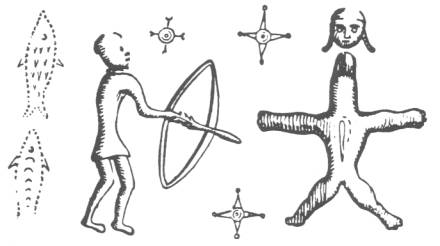
The Austrian
folklorist Otto Höfler[59]
showed the existence of “wolf-warriors”, frenzied martial bands. Alfred
Rosenberg, the chief philosopher at the Nazi-party, was not satisfied and
thought this ecstatic warrior ideology would make Nazism appear ridiculous.[60]
Rosenberg’s enmity, however, gained Höfler the support of Himmler, who made him
join the SS Ahnenerbe division and secured for him a chair as professor of
German philosophy at Munich. The young Swedish student of Indo-Iranian religion
S.Wikander proved the same phenomenon among Iranian warriors[61],
and shortly after defending his thesis at the University of Uppsala he left for
Munich to prepare the German text of his book while attending Höfler’s
“Werewolf-Seminar”. No Germanist was more influential on George Dumézil than
Höfler. Dumezil, Wikander and the Swedish professors Geo Widengren and Åke
W.Ström formed an important group of younger scientists set on digging out the
roots of old Arian Religion. Widengren was a decorated participant in the
Finnish Civil War, officer of the reserve exercising on horseback in the
streets of Uppsala. His final work on Old Arian warrior ideology is the
splendid book Der Feudalismus im alten
Iran. Mãnnerbund- Gefolgswesen,
Feudalismus in der iranischen Gesellschaft
im Hinblick auf die indogermanische Verhältnisse, 1969. Ström’s final
work is his contribution to the series Die
Religionen der Menschheit Bd 19, 1, Germanische Religion, 1975. Following
Dumézil and the Swedish author Viktor Rudberg, Undersökninger i germanisk mythologi, I-II, 1886-9, Ström is able
to prove a lot of motifs common to Germanic and Vedic religion – even suttee, the burning of the faithful
widow (pp.184f.). Ström does not mention reincarnation, but certainly Sct. Olaf
was seen as the reincarnation of the viking king Olaf the Stout[62].
O.Höfler has
rightly seen that the change of man into demon is the main characteristic of
these secret warrior bands. He calls them "dämonische
Verwandlungskulte"[63]
and has already suggested that the mysteries of Mithras with their seven grades
among which are raven and lion have to be seen on this background[64].
The holy drink enjoyed in the caves situated deep in the underground is a drink
for dragons and snakes, for arousing the snake power, see the jar below from
Römisch-Germanisches Museum in Cologne.
It must be stressed that
these warrior bands were a constant threat to society. They are the warriors
sprouting from the dragon teeth sown by Kadmos in Thebes. Kadmos very sensibly
makes them kill each other.