28. The Harappa culture
Now the Indian scholar reading this book will
think: But how can all this be the origin of our belief in God?
Already in 1950 in a very important
article[1]
and on the basis of ceramics (polished black and grey), R.von Heine-Geldern has
shown that cultures in Anatolia and West Armenia in the 4th
millenium were the starting point for a number
of migrations, one of them going southeast to Mesopotamia and mixing with the
El Obeid culture creating the Uruk-culture (and the early culture of Elam),
another travelling toward the east and in the south-western Turkestan giving
life to the East Caspian culture from where it moved on to the north-western
India and to the Lungshan culture in China. A certain kind of earthenware: grey
with a black polished cover which was smooth, almost “soap-like”, when touched,
is found both in the East Caspian and in the Harappa culture[2].
Also the art and principles of writing originated in East Anatolia, which
explains the similarity between the Hieroglyph-Hittite signs and the signs used
in Harappa already noticed by B.Hrozny and P.Meriggi[3].
And perhaps even the similarity with the signs found on the Easter Island in
the East Pacific[4].
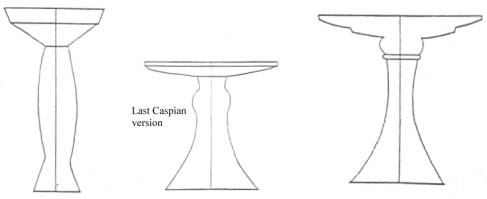
The picture below taken from
Heine-Geldern’s article [5]
shows a very specific model of a ceramic bowl with high foot, both found in the
Chalcholithic culture of inner Anatolia (Alishar Hüyük) and at Mohenjo Daro.
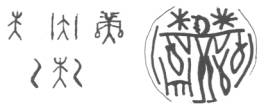
The man sitting in some kind of posture of
meditation is found on several seals from the early Indus culture. He is a god, because on one seal he is seen
being the object of some kind of adoration:
Note the two snakes
ascending behind the backs of the two worshippers. They are the kundalini-power
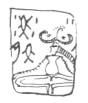
raised to give vision of the god. In another picture he is standing behind the
podium and is easily recognised by the two big horns, and it is here clearly
seen that the top between the horns is a bunch of vegetation. As the giver of
the life-fluids he is seen with a fish both to the left and the right of his
feet, and the symbol of unity and centre is shown under his feet by the two
bulls meeting in the double circle. From his podium two snakes ascend, one with
the head of the divine bull as its head.
His rival is the tiger
grabber, and at his feet the bird of ecstasy is plucking out the eye of a
rhinoceros or unicorn: he breaks up into duality the mystical primordial unity.
A.Parpola has proved that the god of meditation is closely connected to the cow
on Protoelamitic seals from 3000-2900 B.C. The posture of meditation pictures
the old symbol of the pyramid or central navel of the earth seen to the left of
the kneeling cow[6]. The tiger
grabber is identical with the great hunter often seen on the seals as a grim,
fluffy figure with a tiger’s tail and two horns on the head (symbol of
duality?) and a bow in his left hand.

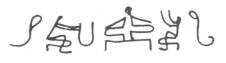
Among the many signs
of the as yet undeciphered alphabet of the Indus culture is a man with a triple
device on his head, a man standing between two rods, and a man with a double
head carrying two buckets in a yoke:
 In my opinion they are gods, the god
of vegetation also seen between two coiling snakes, the god of the gate of the
sun and the twin gods here seen as the dioscurical sons of the high god taking
over his function as the one who brings the water of life and all the life
fluids. In Mesopotamia a similar figure is seen with two streams of water
coming from his shoulders, and the morning/evening star to the right and left
of his head. He has the typical appearance of the guardian of the gate, see below
ch.30. That the two stars are the first division of the high god into duality
is also seen from a seal of the sitting god with the two stars between his
horns. His triple nature is these two sons (with contrasting natures) and
himself (as the unity of both).
In my opinion they are gods, the god
of vegetation also seen between two coiling snakes, the god of the gate of the
sun and the twin gods here seen as the dioscurical sons of the high god taking
over his function as the one who brings the water of life and all the life
fluids. In Mesopotamia a similar figure is seen with two streams of water
coming from his shoulders, and the morning/evening star to the right and left
of his head. He has the typical appearance of the guardian of the gate, see below
ch.30. That the two stars are the first division of the high god into duality
is also seen from a seal of the sitting god with the two stars between his
horns. His triple nature is these two sons (with contrasting natures) and
himself (as the unity of both).
A.Parpola has paid some attention to
those who are "living in a gang of robbers" (vrata) and the vratya-rituals. The Brahmin sons of the Kuru-tribe made an
expedition as vratyas against another
Arian tribe. These gangs are always accompanied by a prostitute and a magadha, a singer or bard. They have to
perform a very obscene dialogue at the mahavrata-feast
(New Year) and even a kind of holy sexual encounter. The same double act of
dirty dialogue and sexual act is known from the horse- and man-sacrifices. But
here it is the queen who has to perform the dialogue with the horse to be
sacrificed. She is called mahisi
("the buffalo-cow"), and Parpola thinks that the horse has taken the
place of the original water buffalo as the symbol of Varuna/Prajapati. The
horse in the sacrifice is killed by the son of a bard, whose head is afterwards
cut off[7].
It seems obvious to me that the
sexual act between the rough woman and the priestly singer is the old tantric
act, also including the killing of the high god present in the buffalo. It
seems to me that the ritual cleansing of the vratya after their predatory raid during the hot summer season is
the old prehistoric cleansing also known from the cult of Apollo and Dionysos
leading those tainted with bloody deeds and chaotic behaviour back into society
from the state of wolves and leopards to a reintegration into human society.
We find traces of the same pre-historic religion in the
Mohenjo Daro culture in the Indus Valley and in the Susa-Uruk area:
a) In India the “lion grabber” has become ‘the tiger
grabber”.
b) The sphinx: the lion with a human face has become a
tiger with a human head, shoulders and forelegs.
c) The whirl of lions has become a whirl of tigers.
d) The bull-man (the Enkidu-type) protecting the
vegetation against a demonic horned tiger. The bull-man has very long hair like
a woman, the tiger-grabber has curly hair. Also the hunters in Catal Hüyük seem
to have short curly hair[8].
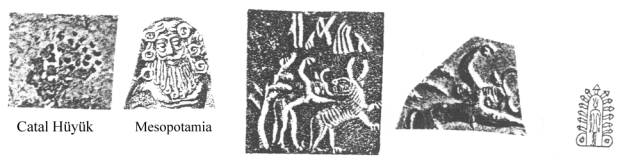
e) A horned god of vegetation with his symbol, a bull
with a human face. That he is the god of vegetation is clearly shown by his
sitting in a tree or standing with two big branches rising on each side of him.
He is threatened by the tiger. It seems clear that the force of life and
vegetation as in Catal Hüyük is linked to the bull, but endangered by the big
beast of prey. This symbolism is not taken over from Sumer, where trees are rare.
f) A row of dancers each with a big waving feather on the
head and very long hair (features indicating ecstasy). There are some features
that indicate that the iconography is not simply taken over from Mesopotamia
but has independent features reaching back perhaps to the Halaf and Samarra
cultures and the early Egyptian cult witnessed by the row of dancing birds and giraffes, with snakes ascending during
the dance.
g) As the last motif we would like to draw the reader's
attention to a very specific symbol: the snake raising itself to a kind of
standing on the tail. We find it on a seal slightly damaged. A man in the
classical yoga posture is receiving adoration from two men with snakes rising
along their backs staring at the meditating god. The snakes standing on their
tails can also be seen on another seal showing a row of horned cattle with
birds ready to fly on their backs, and followed by snakes standing on their
tails. One seal shows a bull with very long beard and as his tail a rising
snake. Now, the tail of the sacred animal being changed into a rising snake,
and the bird and the rising double-snake are, as we have seen, all symbols of
ecstasy.
The symbol of primeval unity is the urus-bull which, in
the archeological reports, is called the unicorn. The other types of bulls are
mostly seen looking into the crib, but the “unicorn” is lifting its head high
with its muzzle inhaling the smoke from an incense-burner holding its head
straight so that only one horn can be seen. It is the holy symbol of one-ness
and ecstatic communication with the things above.
The famous Czech professor B.Hrozny, who solved the
riddle of the Hittite language, has also tried to read the short inscriptions
on the seals from Mohenjo Daro[9].
He finds in the signs some likeness to Hieroglyph-Hittite, and working from the
assumption that it is an Indo-European language he works out a translation. He
finds 25-30 names of different gods of which the most common is Jaje (also in the form Jaj, Ja,Je,I, on
more than 300 amulets). This god is closely connected with the Urus-bull, and
is also identical with the man in or surrounded by the tree. Another important
god is Kush.
Hrozny's reading has not been generally accepted. Jan
Gonda calls it “völlig haltlos”[10].
But lately C.Renfrew has tried to argue for the assumption that the prehistoric
language of the Indus valley was Indo-European. With the diffusion of
agriculture, farmers from East Anatolia settled in Baluchistan from where they
populated Northern India. So perhaps Hrozny's attempt should be given an extra
chance.
28.a.
Indian myth. Indra
The cleaning of Augeius´s cowshed by Heracles
opening a hole in the foundation of the cowshed and leading the river bed of
the river Menios through the sheds is a variation of the old motif of Indra
breaking up the cowshed made by primordial massive rock liberating cows as well
as the streams of water: "To the cowshed rich with oxes shall the demon
killer go to open it for us with his mighty power"[11].
The cowshed is primordial totality with no room for the poor cows.[12]
This act of Indra can also be seen as
the killing of a dragon or mountain, liberating the cows, setting up the pillar
separating heaven and earth. On his
journey to Erytheia, Heracles puts up these pillars and this act is closely
connected to the story about the cattle taken from Geryon, the three-headed
highgod.
By walking on the path of right
Indra´s dog Sarama finds the firm rock
where the cows are housing. The rock is broken by Indra, and out the cows come
like red beams of light or like the water of the falling rain. When S. found
the crack in the rock, she fashioned the "big, old, to the goal leading
path"[13]. Heracles
is the sun-warrior clearing the road of the sun of chaos and monsters, creating
space for the sun to shine in primordial chaos by putting up the two
Heracles-pillars, thereby creating a fixed order. Of Indra it is said:
"…creating for man comfortable paths on which they can easily reach the
gods"[14].
Yajurveda knows 7 Gandharven,
"guardians of the soma". Rig Veda knows only one "lusting for
women and soma", conf the Greek Centaurs, and one of them Pholos, guardian
of the wine drank by Heracles[15].
The Iranian Gandarewa is called "with golden claws", he is a beast of
prey, a panther or a lion and living in the lake in which grows "the
white" haoma-herb. In Rig Veda "the firm place of the G." is the
place of the deceased, where "the wise lick butter"[16].
In Nordic myth we find the strange
story of Odin drilling a hole through the mountain where the drink of
inspiration is stored. He turns himself into a snake going through the hole and
steals the drink and escapes in the shape of an eagle. This mystical drink is
storied in primordial totality, but never the less reached by the god by means
of a kundalini-snake, at the moment of ecstasy turning into the mystical
sun-bird.
Some of the similarities between
Indra and Heracles have already been pointed out by L.v Schroeder in: Denkschriften d. Akad. d. Wiss. Wien,
Phil-hist. Kl., 58. Bd. 1. Abh. 1914: Indra is the great eater of
buffaloes[17],
"supporter of the heaven" (dhartâ
divah) with the great world-pillar (skambhana).
He is not a clear-cut type. His thirst for soma makes him resemble the great
hunter, but he is not a demonic killer like Rudra. In the course of time the
old folk religion will prove its force by letting the old types prevail: the
hunter and the sun hero, Shiwa and Vishnu, and Indra will disappear.
28.b. Vishnu
Vishnu'
s 3 "steps” show that this god is the sun warrior traveling in the course
of the sun, or rather clearing a path for the sun.
1. step is Vishnu on the sun's journey on the clear sky
from east to west.
2. step is its nightly journey hidden to man.
3. step is his mystical nightly appearance as the Seven
Stars' cluster (the mystical 7-fold light on the top of the starry sky). His
highest step is a well of heavenly honey (mádha
útsa[18]).
Visnu as the god who clears the path of the light is closely connected to his identity with
the axis mundi as the pillar
separating heaven and earth, thereby creating room for the sun to
run its course. He has put 90 runners,
each with 4 names (the 360 days of the year), into movement like a rolling
wheel.
It is also closely connected with his avatar as the
Krisna-child fought by Kamsa, the king of chaos. The long plait is acc to Widengren
characteristic of both the young Krisna and the Indo-European warrior-ideology[19].
Vishnu's being the lion-man goes back to the melting
together of sun hero and panther demon as the world pillar making room for
women and cows (on the early seal from Susa).
A similar set of symbols can be found in Buddhist texts:
“As soon as he is born, the Bodhisattva places his feet
flat on the ground, and, turning towards the North, takes seven strides,
sheltering under a white parasol. He looks at the regions all around and says,
with his voice like that of a bull: I am at the top of the world...”[20]
The ladder with seven rungs is mounted by the initiate
in the mysteries of Mithras. But here the ascension is also symbolized by the kundalini-snake
coiling around Saturn to put its head at rest on Saturn's forehead. Mithras is
also seen running to catch up with the chariot of the sun. On some scenes he is
seen flying in the chariot of the sun, reaching Saturn resting with the snake coiling
around his body.
M.Eliade has pointed to “a symbolic-ritual complex”
common to India, the shamanism of Central Asia and the religions of the Middle
East: “one transcends the world by passing through the seven heavens and
attaining the summit of the Cosmos, the Pole.”[21].
The summit is also the point from which the Creation starts. The Pole is not
only the axis of the cosmic movements, it is also the “oldest” place, because
it is from there that the world has come into existence[22].
The Accadian name for Saturn is kajamanu[23] with the meaning “steadfast”. Kaiwan is
Saturn as one with the world-pillar, the axis/centre/world mountain the
“steadfast world pillar”. In the myth of Atlantis[24]
such a “urichalkos”-pillar is
standing at the very centre of the system of concentric channels cutting
through the holy Atlantis-island.
28.c. Rudra
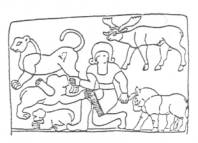 The
pyramidical form of the sitting god, the many lines coming together in his
raised phallus and in the bundle on his head makes him a figure that unites the
many lines in cosmos with the top of the bundle opening up to heaven. The
opposite forces symbolized by the tiger and the bull are both paying homage to
him. We have found, as a parallel to the sitting god, a motif from Karkemish[25].
Here the hunter is surrounded by a multitude of wild animals, but with a firm
grip controlling the bull and the lion, thereby uniting opposites. Everywhere
we find this archaic passion for balance or synthesis. The god is seen as the
union of life-upholding and life-destroying force.
The
pyramidical form of the sitting god, the many lines coming together in his
raised phallus and in the bundle on his head makes him a figure that unites the
many lines in cosmos with the top of the bundle opening up to heaven. The
opposite forces symbolized by the tiger and the bull are both paying homage to
him. We have found, as a parallel to the sitting god, a motif from Karkemish[25].
Here the hunter is surrounded by a multitude of wild animals, but with a firm
grip controlling the bull and the lion, thereby uniting opposites. Everywhere
we find this archaic passion for balance or synthesis. The god is seen as the
union of life-upholding and life-destroying force.
Rudra has all the marks of the wild hunter. He is clad
in the skin of a tiger. He is a bowman killing both ox and man. He is a red
boar and god for fever and coughing. The wild and cruel animals of the forest
are a manifestation of this evil god. He is hara, “destroyer”, and he is living in the North, which makes him
very different from the other gods living in the East. He is the leader of the
pack of demons called Rudras. His two sons hunt like wolves through the forest
tearing up their victims. Like the pair, Baal-Anat and Apollo-Artemis, Rudra
sneaks up behind after his sister Ambika together with whom he likes to kill[26].
Arbman stresses the fact that the light Rudra of the Rig Veda is not the
original Rudra, but a “coelestification” of the Rudra-Shiva of the
folk-religion, who is prince of the demons. His blue colour is the colour of
the corpse. A.Hillebrandt sees R. as a god for all the horrors of the tropical,
hot climate, from the beginning of the hot season until the coming of autumn.[27]
All too often scholars approach the texts of the Middle
East with a western mind and worldview. But in the oldest Near Eastern
religions we meet a kundalini mysticism, in many ways parallel to the Indian
mystical universe.
We have tried to
see Near Eastern religious symbolism in close connection with the oriental
mysticism still ruling in pre-Muslim sects like the Jezidies and the “Seekers
of the Truth” and, beyond the influence of Islam, in Indian tantra. This
applies especially to the Molok-Astarte cults which could be understood in
close connection with similar phenomena in “left-hand” tantra. Far Eastern
mysticism has its roots in Near Eastern. In Catal Hüyuk we find the clear
traces of a mandala-symbolism and versions of early yin-yang-symbols. And its deeper meaning: duality and
diversity splitting up and uniting again, in holy unity, is an overall
obsession in the art of the classical Near East.