29. A Near Eastern parallel to the atman-brahman motif
The castration of Ouranos who would come and by force unite himself to Ge[1],
is the splitting up of cosmic unity, and as the symbol of this division, El
Cronos (and Mithras and Resheph) carries the two world pillars in his hands.
(Also Mithras' killing of the bull is the killing of primordial unity to allow
room for the light, the travels of the sun and the moon in their cars).
Therefore the human sacrifice to Ouranos is the boy called unity, Je(h)ud (Praep.Ev. 1,10,44, cf. 33: monogenés). His killing is, like the
killing of the sacred bull and the purusha sacrifice, creation of cosmos by the cutting up of primordial unity[2].
In death and in the afterlife man returns to this mystic unity, as is seen from
a figurine of clay found among graves, and now in the Museum of Cartage (12 cm,
from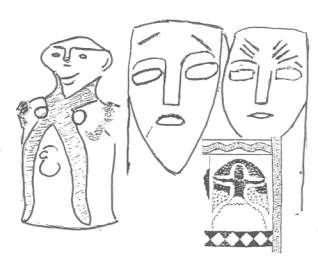 the 7-6th
cent. BC, A.Parrot et al., Les Phéniciens, fig. 166). His body is
close to the shape of the standing stone, it has the marks of androgyny, and on
his breast there is a giant cross uniting left and right, up and down. Standing
stones from the Punic area show the androgyny connected to the life after
death. In Selinus, in the eastern part of Sicily, by a temple for Zeus Meilichios,
were found many stelai, erected over the ashes of sacrificed animals, and
crowned w double busts of male & female[3].
the 7-6th
cent. BC, A.Parrot et al., Les Phéniciens, fig. 166). His body is
close to the shape of the standing stone, it has the marks of androgyny, and on
his breast there is a giant cross uniting left and right, up and down. Standing
stones from the Punic area show the androgyny connected to the life after
death. In Selinus, in the eastern part of Sicily, by a temple for Zeus Meilichios,
were found many stelai, erected over the ashes of sacrificed animals, and
crowned w double busts of male & female[3].
At the palace at Mari is pictured a god, who seems to
rise out of the primordial mountain being one with the starry sky. The picture
has the contours of a stele. He is the union of light and darkness, black but
surrounded by an aura of light. With his body and stretched arms he is uniting
earth and heaven, right and left[4].
In early Syrian Christianity Jesus is called Ihidaja, “the only one”, “unique”, cf
Greek: monogenés, John 1,18. Now acc
to 1.Henoch 49,3, the “Son of Man” is the place where the just deceased are
united after death: “In him (the Son of Man) dwells the spirit of wisdom and
the spirit that offers insight...and the spirit of those who have passed away
in justice”.
J-E.Ménard[5] has shown
that Syrian speculations (known from Liber Graduum) about primordial man, Adam,
as a perfect being ruling over the whole universe, are the key to the Gospel of
Thomas with its ideal of the “single one” (monachos).
To become united to this “man of light” is salvation: ”Blessed is he who shall
stand by the beginning”(logion 18). In my own book, Dåben og Himmelrejsen til den skjulte Adam, I have tried, with the help of the Mandaean notion of the
Secret Glorious Adam as macr´anthropos and world pillar, to show that salvation
in the early church could be understood as being united to Christ as
macr´anthropos. We are here dealing with an exact parallel to the Indian motif
of atman, man’s soul, being united to
Brahman, the big cosmic soul, and
mystical experience is the key to this notion.
Philo says: ”For when the prophetic mind becomes
divinely inspired and filled with God it becomes like the monad, not being at
all mixed with any of these things associated with duality”[6].
Monogenés (“the only begotten”, the Unique) is a symbol
of the consciousness of the mystic, a symbol of the mystical experience of
everything united in love and harmony. Therefore Monogenes is also called “the
beloved”. Jamm and Mot, the sons of El in the Ugarit texts, are jdd “El’s loved one”. In the story about Isaac going to be sacrificed,
Isaac is called jahid (“the only one”), in LXX translated into Greek agapetos = “the beloved”, cf the same
words used about Jesus by baptism and glorification, Mark 1,11 & 9,7. It is
exactly by baptism and final glorification that the symbolism of the mystical
macr´anthropos is used in the early church[7].
Ginza[8]
is about “the young boy”, who is “the just, great, unique one”. In the
Valentinian Gnostics we read about Arké
(“the beginning”) who is Monogenés
& Nous (“pure mind”, i.e.
mystical intuition). In the Ptolomaic Gnostic system Monogenés = Nous is born
of Bythos (“depth”) as the fruit of
the union between the Eternal Father and Enthymesis (“female desire”), i.e. by
the union of male and female cosmic principles.[9]
As the unity of all diversity he is Polymorphos
Monogenes, Act. Thom. 48. Acc. to Philo, God is Father, Episteme (knowledge), mother, and cosmos is Monos & Agapetos,
“the only and beloved son”, ebr. 30[10].
Enoch travels to the “living waters” and to the river of
fire in which the sun sets (1.En. 17,4f.). From the holy mountain of God he
travels to Mt. Zion (24-26), and he travels from east to north, west and south,
becomes king of the universe and learns a lot of astronomical secrets, and is
finally reborn in a child of light (Noah) with eyes like “sun beams”(106,2). He
is the typical sun hero finally apotheosed as the “Son of Man” (70-71).
The Son of Man has to be seen on the background of the
OT tradition of theophany: ”he comes” in his Father's “glory”, i.e. he is theos
epiphanés.
Philo and mystical Judaism share the idea of a heavenly
being/angel, Israel, “the one who sees God”[11].
This is exactly the background of the Monogenés notion of John 1,18 + 47 + 51,
where the Son of Man reveals himself as the new Jacob-Israel.
In fact there are close parallels between the gods of
the folk religion in India and the gods of the Near East, ex: the sun warrior,
who creates space in the universe for the wind to blow and the sun to run its
course and the rain to fall, is personified in the god Vishnu, the shepherd in
Krisna, the great hunter in Shiva. And even the cycles of time and the rebirth
of the great god of eternity are common belief in both the Near and the Far
East.
One of the most important insights
in the modern effort to understand the background of Jesus and the New
Testament is found in a rather modest work by Hugo Odeberg, "Die
mandäische Religionsanschauung"[12].
In Jewish rabbinical tradition there is a tendency to judge harshly about Enoch
and Enosh, quite contrary to the Bible for
which Enosh was the first to call on God´s name Gen 4,26, and Enoch was the man “walking with God”. Obviously
the rabbinical tradition from the 3rd cent. was fighting a mysticism
linked to Enosh (surviving in the Mandaen traditions about Enosh) and Enoch
(surviving in the 1st, 2nd and 3rd book of
Enoch). Acc. to 1.En 70f., Enoch is taken up to heaven and changed into the
“Son of Man” and put on a throne as the ruler of the world. The main motif in
this religiosity is the ascension of a man to the heavenly realm.
In commenting on John 3,13 H.Odeberg[13]
has collected sufficient examples to prove the importance of this motif: “2.En 1-21 tell of Enoch´s ascension into
heaven … 22ff. relate how Enoch is transformed into a Celestial Being. Acc. to Test. Levi 2,5ff. the Patriarch Levi
ascends to heaven while in sleep. Similarly Baruch in 2 Bar and Isaiah in
Asc. Isa. The ascension of St.Paul,
acc. to 2.Cor 12,2.4 ("whether in the body or out of the body", he
could not tell), is well known. 3.En
3-16, 48C speak of Enoch´s translation into heaven and transformation into
Metatron, the Unique Celestial Being. 3
En 1,2.42-48A narrates Rabbi Ishmael´s ascension into the highest heaven
and his visions there in a manner suggesting that that such ascension was the
regular aspiration of the mystic of the circle. Tosephta and TB Hag,b
preserve the well-known tradition of the four ‘who entered Paradise’…The
mystical experiences in question, hence also the aspirations to ascend on high,
were prominent with R.Yohanan ben Zakkai (about 40-80 A.D.) and his school”.
Odeberg (ibd. p.74) also mentions Corpus
Hermeticum IV: the baptism in the
great bowl. The purpose of this baptism is the same ascension to God.
Now in John 3,13ff. it is stressed
that Jesus is the sole mediator of ascent and this is given in the baptism “of
water and spirit” 3,5. It is very important to see the unity of motifs in this
3rd chapter of John: the ascension to heaven, v13 (a) is closely
connected to the “entrance into” and the “seeing the kingdom of God” v.4 &
v.5 and the baptism hinted at in v.3 (b) and the mentioning of the spirit v.8
(c ) - i.e. the spirit received at Christian baptism, but not by the baptism
administered by John the Baptist v.6 & v.22-31(d). Just as in the Mandaeic
version of this religiosity baptism is the means to ascend and become one with
the heavenly man (in Mandaeic terminology “the Hidden Adam of Glory”) and not
so much ecstatic experience.
The “Son of Man” in Dan 7,9-14 is a
personification of the “holy of the Highest” and the key to the scene is the
“thrones” put up, i.e. the key to the scene is apotheosis: man enthroned in
heaven. Also the name Metatron (Greek: =Meta-Throne) must be
understood on this background. “Son of Man” by Ezekiel is the name used for
little man entering the circle of the angels. The “Son of Man” is elevated, and
the believer is elevated in him to eternal life, John 3,14f. He who commits
himself to the Son of Man, to him the Son of Man will commit himself before the
angels of God.
Characteristic of Metatron is that
he is given all the power of God to rule the world and to judge the living and
dead. Exactly the same is said about Jesus and the “Son of Man”, Matt 28,19
& 25,31. Metatron is told all the secrets of God (Odeberg p.204), but he
does nothing of his own will, but only the will of the Holy One[14],
cf. Matt. 11,27.
He is called the “little Jahveh”,
cf. how Jesus in a unique way acts on behalf of God, and even uses the
expression “I am”, a translation of God´s own name JHVH. (Metatron as one with
the Shekinah).
Now in 1.En, Enoch is transfered to
heaven and becomes the “Son of Man”, but the “Son of Man” exists as prior to
creation, he is much older than Enoch, a primordial being, cf how in the
Gnostic “Book of Jeu”, Jeu is called “the great man”, “the first man”, i.e.
macr´anthropos.
We have unearthed a religiosity with
strong mystical features centred on the heavenly man bearing the name of God,
Phil 2,9. To become one with him is mystical theosis.
This is the purpose of baptism where
you become one with Christ and is lifted up to heavenly places. You are even given God´s name and
incorporated into the mystical unity, John 17,11; and finally become one with primordial man by seeing his mystical
glory, 17,22-24.
Now we know that many fragments of 1.En were found among the Dead Sea
scrolls and we know the mystical tradition attached to the feast of Tabernacles
where the holocaust altar was circled with the word “I and He” hinting at a
mystical union with God[15].
It seems reasonable to assume that the old tradition of apotheosis through a
journey along the circling road of the sun to ascent on the heavenly mountain was
still very much alive among the Essene society of “therapists” with their
wheeling dances in imitation of the Exodus towards the “heavenly highland” of
God. And from there were passed on to the small Baptist societies along the
Jordan valley, where also the Mandaean sect seems to have its origin acc to the
research done by G.Widengren and his pupil E.Segelberg[16].
In rabbinical tradition the unification of the celestial man and his
earthly appearance in the flesh is the reason for the angels ascending and
descending on the ladder of Jacob (and in John 1,51) as proved by Odeberg[17].
In 1.En there exists a perfect
parallelism between the "just ones" and the "Son of Man"
with the "Just" as his most prominent title (cf. in later kabbala the
Zadik). Just as the "Son of Man" in Dan 7 is the symbol of the
apotheosis of the people of God, so is Enoch the symbol of an apotheosis of the
"just". This apotheosis of Enoch is connected to investio & unctio: a
change of clothes from his earthly robe to "Garments of God´s Glory"
and he is anointed with the Lord´s "holy oil", 2.En 22,8f and he is
to stand before the Lord´s face for ever 21,3; 22,4-6. The "standing
one" as he who has conquered death is a common expression in the tradition
connected to Simon Magus, who, acc to the Homilies of Clem. was the most prominent pupil of John the
Baptist. "Eternally standing" is also the final goal aimed at by the
Mandaean baptismal ritual. Apophasis Megale, the famous document
circulating in the name of Simon Magus, hails God as He who "stood, stands
and will stand", a variation of the mystical formula of God as the union
of present, past and future existence "He who was, is and will come".
This formula hails god as the mystical unity even of time, and is especially
used in the Johannine writings where Jesus is seen as sometimes a very young
man, sometimes a middle aged, and sometimes a very old man (Acts of John).
So we must assume, as the original setting of early Christianity, a circle
gathering around John the Baptist, and baptism as the sacred act of ascension
to a status as one of the "Glorious Ones", the "Sons of
God", the angels. But mystic vision and ecstatic journey to heaven was
also experienced.
In Dan 7 the "Son of Man" is the symbol of a 5th empire: the
4th empire symbolised by the 4th monster crushing everything with its teeth is
dethroned by the "Ancient of Days", and the power over the world is
given to the "Son of Man", who is the symbol of the faithful
believers, called the "Holy of the Highest".
In
the New Testament 1.Enoch is quoted as holy scripture. In this book, Enoch is
finally elevated to heaven and changed into the Son of Man and given the
authority to rule on behalf of God. In 3. Enoch he is even given the name of
God, he is called "little Yhvh" and Metatron, i.e. the one who has
his throne next to God. The Son of Man as one who is elevated to heaven and
given the kingdom of God is also behind the answer given by Jesus to the high
priest: "Hereafter you shall see the Son of Man sitting by God´s right
hand and coming with the clouds". But not only Jesus is elevated to heaven
and given all power in heaven and earth, also the believers belonging to the
Jesus-movement: "As my father has offered me kingdom, I offer you to sit
on thrones and judge the 12 tribes of Israel". Also in the vision of
Daniel there are thrones set up in heaven.
We have here a religious movement sharing the aspiration to be one with
God, but not only that: expecting to share his rule over the world.
The explanation for that must be the old notion of a heavenly council
consisting of the sons of God. Already in Ugarit, man hopes, when he dies, to
become one of the ilim, "the gods". "When a
famous hero or king died, he was united with the god whose "son" he
was"[18]. The phrase
used about the death of Krt is: Krt shrk ´il = "Krt will unite with
El". de Moor draws the reader's attention to the word shirk, later to become terminus techn. for the gravest possible
heresy in Islam: to elevate other beings to the same level as God.
The
enthronement of a man symbolizing Mandaean truth and religion as ruler over the
eternal heavenly hosts, and therefore named "little Enosh", i.e. the
youngest of the eternal beings, has its perfect parallel in the enthronement of
Enoch, in 3.En called "youth"[19]
and in the New Testament, Hebr 1,4.
A part of this "man into angel" ideology is
the important role played in early Christian service of the trishagion
("Holy, holy, holy…") of the heavenly liturgy[20],
see even the first prayer of the Lord´s prayer and the fact hinted at by
Clement of Alexandria that the early Christians used to jump high in the air at
this moment of the liturgy as if they were getting wings and were ready to fly.
It is vital to understand the
importance of the ecstatic practice of
"journeys to the heavens" in early Christianity. There is a
very clear example of the journey to heaven in the early Christian document
called Ascensio Isaiai 7-11. The
journey is seen as an out-of-body experience 8,11: “No man who returns to the earthly
body has ever ascended to see what you are now looking at…”
Now in the baptismal
rite there was a changing of clothes, a DEVESTIO followed by an INVESTIO by
ALBA BAPTISMALIS, symbol of the new life in close communion with the angels
(seen as men in white clothes). In Asc.
Is, 3,25 it is told that many will change the cloaks of the holy ones and
their glory with the cloaks of the money-makers. The investio at baptism was
seen as a leaving the old life to participate in the life of children of the
light, it was a changing into the ranks of the Sons of God, the angels who see
God and are constantly singing to his praise, as a matter of fact it was a
symbolic leaving the body of flesh to be clothed in the body of Christ of
cosmic dimensions. (Like the Vedic atman
joined to Brahman.)
The
rapture of Enoch is a “prototypical
event”. The chapter 1.En 71 telling about his ascent adds this
interpretation, put into the mouth of the angel Michael: ”All those walking on
your (Enoch’s) paths… their dwellings and inheritance will be with you”[21].
Cf. 1.En 51,4: ”All (the just) will become angels in heaven”. The key to
understanding the belief in the Son of Man, and the key to the Enoch
literature, is this hope for heavenly ascent and an early Jewish merkabah mysticism which believed in
ascent (sometimes by means of the divine chariot of the sun, the merkabah).
This is also the key to St. Paul’s use of “flesh” and “spirit” as opposites,
the flesh, the body is the curtain, the great obstacle preventing the spirit from
transcending to the sphere of God. The eminent German scholar Egon
Brandenburger has interpreted this Pauline motif on the background of a similar
use of “flesh” & “spirit” by Philo of Alexandria, who sees the human spirit
as caught up in slavery to the fleshly, earthly sphere and salvation as “going
out” and “going up” (“Befreiung als
Auszug und erlösender Aufstieg”, ibd. p.154, For a similar interpretation
of early Christian baptism see my own book Baptism
and Heavenly Journey to the Secret
Adam as macroanthropos (in Danish: Dåben
og Himmelrejsen til den skjulte Adam,
pp.1ff.1983). Baptism in the Pauline churches was seen as creating the union of
the small human spirit with the spirit of the cosmic Christ, the heavenly Adam
and macroanthropos, by taking off the garment of flesh and putting on the alba baptismalis
as the symbol of Christ or his Holy Spirit Rom 13,14; Gal 3,27f.